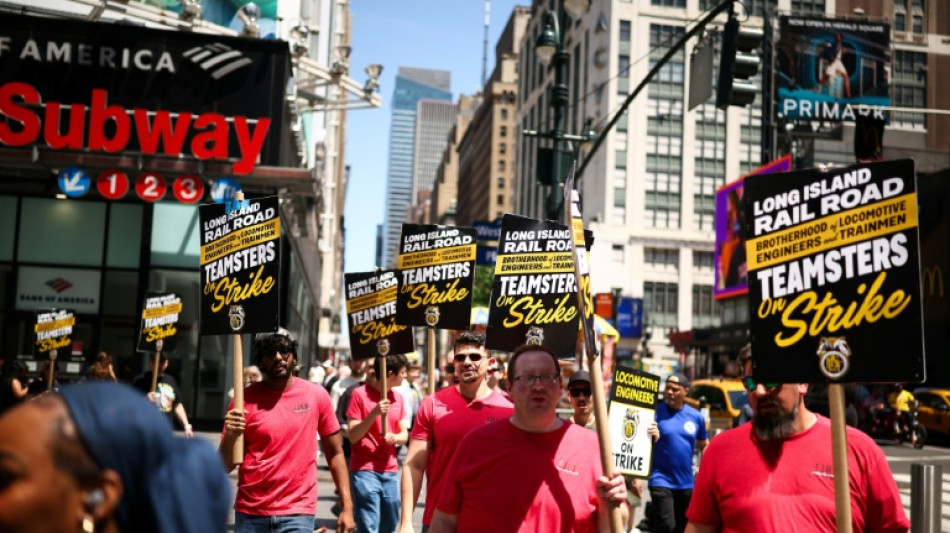
Top UN court says right to strike protected in key labour treaty / Photo: CHARLY TRIBALLEAU - AFP

 Kung wins Vuelta time-trial as Mas retains lead

 DR Congo school fire leaves at least 14 children dead

 USA and France ease into women's Basketball World Cup semis

 ECB lifts borrowing costs amid energy shock, opens door for more hikes
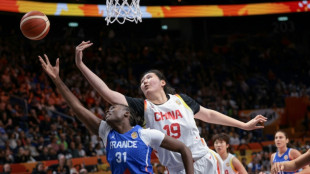 France defeat China to reach women's basketball World Cup semis
 Tribal Launches Campfire, Letting Business and Technical Teams Build on Salesforce Together

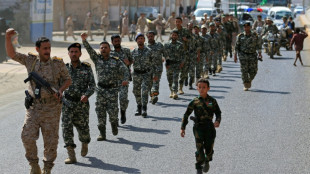 Yemen's Houthis seize key city on Red Sea

 US producer inflation tops expectations as diesel costs jump
 Rubio ends South America swing with Peru security talks

 Defiant Iran seeks to bruise Trump ahead of midterms

 France withdraws support for Infantino in FIFA presidential election
 Evolution Metals & Technologies Provides Initial Revenue Guidance of $400-460mm for Fiscal Year 2027
 Clark-led USA thrash Hungary to move into women's World Cup semi-finals

 Vance takes spotlight as Republicans close Trump-heavy convention
 Russian skater Valieva loses neutral status

 Will Israel's right exploit sanctions in run-up to vote?
 'Metal Gear' creator moves to Xbox after Playstation cancellation

 Indonesia rescues six orangutans from fires in a week
 Macron urges Europe to develop 'crewed spaceflight' programme
 Deals worth billions to be signed as UAE leader visits Germany
 Zamanat Targets GCC’s $250 Billion SME Financing Gap With Up to $100 Million Tokenized Private Credit Fund

 Sri Lanka court revokes monk's pardon, orders return to prison

 'Hopeless, stuck, afraid': US deportees in limbo in Cameroon

 Mount Fuji ends hiking season with landslide, two rescues

 Seahawks beat Patriots again in NFL opener
The top United Nations court ruled Thursday that the right to strike was protected in a key treaty of the International Labour Organisation (ILO), a decision that could have profound implications for global labour relations.
The International Court of Justice had been asked to deliver a so-called advisory opinion on whether an ILO treaty from 1948, known as Convention 87, implicitly enshrined workers' right to strike.
ICJ president Yuji Iwasawa said the court was "of the opinion that the right to strike of workers and their organisations is protected" under that convention.
However, judges said their opinion, which is not binding, should not be understood as laying out any other ground rules for strike action.
The conclusion "does not entail any determination on the precise content, scope or conditions for the exercise of that right", said Iwasawa.
ILO Convention 87 is an agreement between unions and employers including the right "in full freedom, to organise their administration and activities".
- Heated legal battle -
Unions at the ILO had argued that this by extension enshrined the right to industrial action, but employers disagreed, so they took the fight to the ICJ.
Behind the dry legal interpretation of a decades-old treaty lay a heated battle between unions and employer groups at the ILO, which played out in hearings in October 2025.
"This case is about more than legal abstractions," Harold Koh, representing the International Trade Union Confederation (ITUC), told the judges.
"It will affect the real rights of tens of millions of working people around the world," he added.
Koh warned that if the ICJ ruled the right to strike was not inherent in the Convention, companies and governments could start to unpick labour deals around the world.
"National employer groups would contest the right to strike country by country, focusing first on nations with compliant courts, weak civil societies and ineffective media," said Koh.
- 'Inflammatory and alarmist' -
On the other side of the argument, Roberto Suarez Santos, from the International Organisation of Employers, said the 1948 convention "neither explicitly nor implicitly covers the right to strike."
Santos noted that the rules surrounding industrial action varied widely from country to country -- whether emergency services were excluded, for example.
These differences "cannot be resolved by simply reading an abstract right to strike into Convention No.87 and trying to impose it on employers, workers and governments", said Santos.
Rita Yip, also representing the employers' groups, dismissed the union arguments as "inflammatory and alarmist".
The right to strike is still protected in national laws, argued Yip, and does not need to be enshrined in "boilerplate norms, imposed at the highest level".
Urging the court to answer "no" to the question before it, Yip said the case "goes to the credibility of the entire international labour system".
Both sides at least agreed on the importance of the case for labour relations.
"At first blush, this case may not seem momentous," said Koh from the trade union confederation.
"But your decision here will affect every worker in the world," he told the judges.
M.AbuKhalil--SF-PST