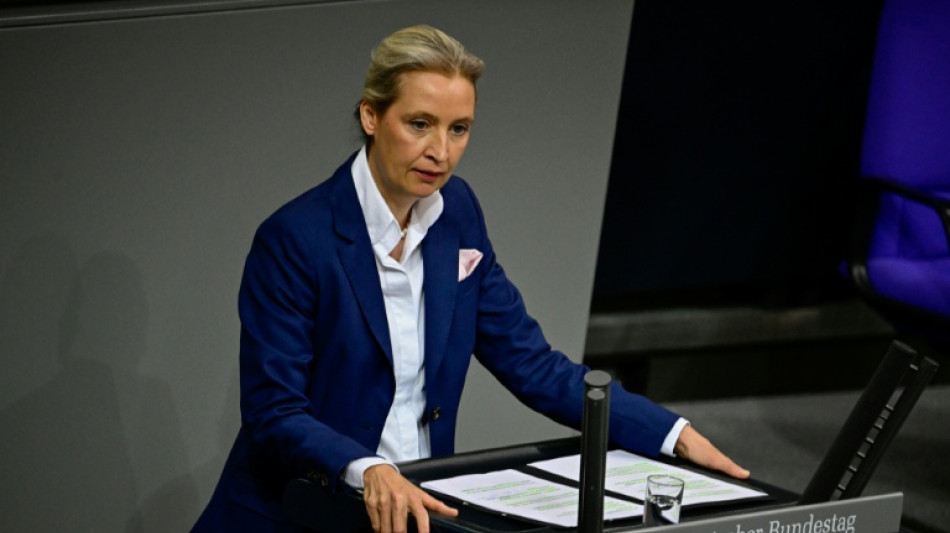
German court rules spy service may not label AfD 'extremist' for now / Photo: Tobias SCHWARZ - AFP

 Chelsea captain Millie Bright retires

 Mercedes warns longer Mideast war could cause shortages

 Hungary's Magyar visits Brussels seeking to unblock EU billions

 Thai ex-PM Thaksin to be released from prison next month

 Much-needed rains revive Iraq's fabled Mesopotamian Marshes

 EU chief says Kremlin imposing 'digital Iron Curtain' on Russians

 Adidas reports higher profits but warns of 'volatile' climate

 Sri Lanka government 'temporarily' takes over cricket board

 Oil rises further with Iran war peace talks stalled

 US judge orders Purdue Pharma to pay billions ahead of bankruptcy

 US opioid crisis victims testify at emotional Purdue Pharma hearing

 Indian opposition slams Nicobar megaport plan as 'destruction'

 Anxiety, resentment around AI spur violence against tech's figureheads

 Hungary's Magyar to push post-Orban EU reset on Brussels visit

 Wembanyama's Spurs advance in NBA playoffs, 76ers stay alive

 Tigres edges Nashville in CONCACAF Champions Cup first leg

 King Charles, Trump toast ties despite Iran tensions

 What we learned from cycling's Spring Classics

 Remarkable, ramshackle Rayo chasing Conference League dream amid chaos

 Cheaper, cleaner electric trucks overhaul China's logistics

 Europe climate report signals rising extremes

 The loyal, lonely keepers of Sudan's pyramids

 Embiid-led 76ers beat Boston to avoid NBA playoff exit

 Exiting fossil fuels key to energy security: nations at Colombia talks

 All eyes on Powell with US Fed expected to hold rates steady

Aav German court ruled on Thursday that the domestic intelligence agency cannot label the far-right Alternative for Germany (AfD) party as a "confirmed right-wing extremist" group, at least for now.
The AfD had challenged the designation, which would empower the spy agency to use broader surveillance powers to monitor it and would embolden political opponents seeking a ban of the anti-immigration party.
The Cologne administrative court's decision puts the designation on hold pending the final outcome of a legal battle between the AfD and Germany's intelligence agency, the Federal Office for the Protection of the Constitution (BfV).
The court found that there were indeed efforts to undermine Germany's free democratic order from within the AfD, highlighting its demands to ban Muslim minarets, public calls to prayer and headscarves in public institutions.
But it ruled that the party as a whole was not "shaped by these efforts" such that "an anti-constitutional tendency can be established" to characterise the party in its entirety as extremist.
Alice Weidel, the party's co-leader, hailed the ruling as "a major victory not only for the AfD but also for democracy and the rule of law" in a post on X.
The decision had also "thrown a spanner in the works" for the "fanatics" seeking to outlaw the AfD, she added.
Interior Minister Alexander Dobrindt, a conservative, noted that the court decision still found reason to suspect the AfD of working "against the free democratic order" and "pursuing anti-constitutional aims".
The party will continue to be monitored as a "suspected" extremist group, he added.
- Politically isolated -
The AfD was founded in 2013 primarily as a eurosceptic party, but has since become more hardline nationalist, putting an anti-immigrant stance at the heart of its appeals to voters.
The party surged to become the largest opposition force in last year's nationwide election, winning nearly 21 percent of the vote.
The AfD is particularly strong in the formerly communist East Germany, holding commanding leads in the polls ahead of several key state-level elections there later this year.
But it remains frozen out of power across the country, as all other political parties have maintained a "firewall" against it and refused to consider cooperating.
Many in mainstream German politics see the AfD's far-right positions and rhetoric as taboo, a view informed in part by Germany's dark Nazi history.
The intelligence agency moved to officially classify the national AfD party as a "confirmed extremist" organisation on May 2 of last year, a step up from its previous designation as a "suspected" case.
The party filed a lawsuit against the move and the BfV agreed to suspend the classification until a court ruling on the matter is issued.
Several regional AfD party organisations have already been designated as "confirmed extremist" groups.
- Calls to ban -
Thursday's decision by the Cologne court, which can still be appealed, keeps it on hold until a verdict is reached in the AfD's broader challenge to the classification.
Some of the AfD's political foes have advocated banning the party -- a process for which there are high legal hurdles in Germany.
It would require, for example, evidence that a party is actively trying to abolish the democratic order and has the means to do so.
Dobrindt and a number of other conservatives have criticised such a move, arguing instead that the AfD must be defeated at the ballot box.
On Thursday, Dobrindt said the court decision only underscored how high the legal hurdles for action against a political party is.
"I have repeatedly said if we want the AfD to go away it should be by governing competently and not by banning them," Dobrindt said.
Q.Bulbul--SF-PST