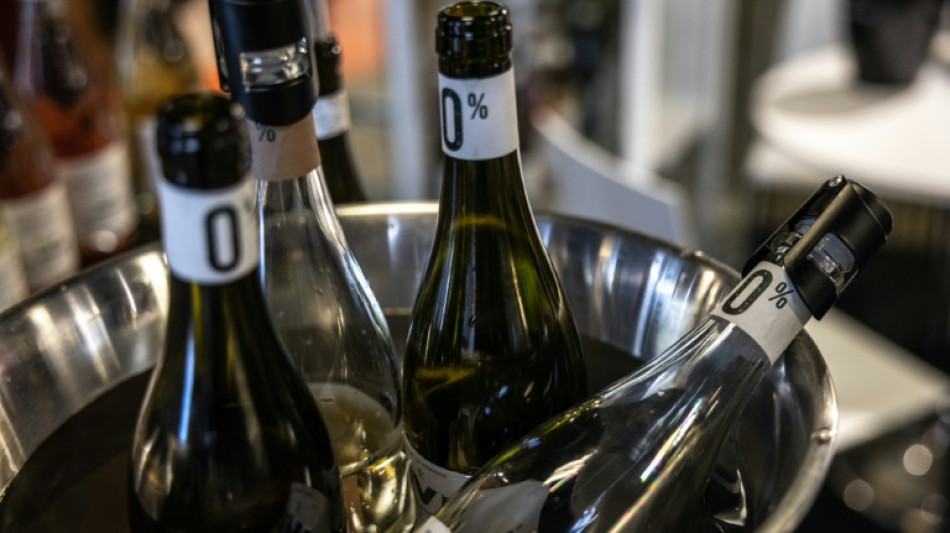
Non-alcoholic wine: a booming business searching for quality / Photo: Guillaume BAPTISTE - AFP

 Iran's World Cup team finds supporters in Mexico

 'Racist thuggery' condemned after second night of disorder in N.Ireland

 G7 allies seek to bridge divide with Trump at France summit
 Pope arrives in Spain's Canary Islands to meet migrants
 Iran warns Mideast truce 'practically meaningless' after US strikes

 Sweden withdraws disputed proposal to jail 13-year-olds
 Small, efficient and revolutionary: The IPOP electric car from Alsace

 Tharp, 20, breaks 110m hurdles world record at NCAA championships

 'Victory' or 'peace': Russian Orthodox believers question Church's war stance

 Swiss to vote on stricter rules for conscientious objection

 Suspense surrounds Swiss anti-immigration vote

 A taste of home: Zimbabwe restaurants revive traditional food

 'It just hurts': Spurs search for answers after epic collapse against Knicks
 Several arrested outside NBA Finals in New York

 The Indian workers training AI robots to take their jobs
 In ageing South Korea, AI dolls care for the elderly
 Stocks drop, oil rises as Iran and rate worries dog traders
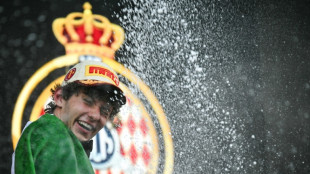 Antonelli seeks sixth straight win at Barcelona Grand Prix

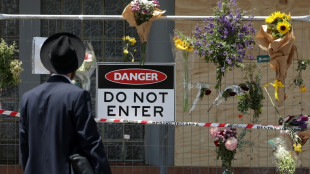 Twenty-two countries tell Iran to stop attacks 'on our soil'

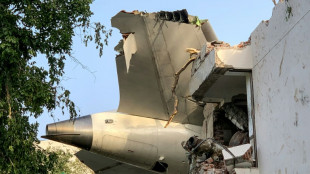 Pilots demand answers ahead of Air India crash anniversary

 Drone rescue highlights US Navy's autonomous push

 South Africa brace for Azteca test against Mexico
 G7 summit under tight security on both sides of Lake Geneva
 Milestone-man McKenzie ready to 'rip' into Crusaders in Super semi
 US renews Iran attacks, Tehran says it closed Strait of Hormuz

Bertrand Degat, vineyard manager for French zero-alcohol wine producer French Bloom, winces visibly when recalling some of the criticism and snobbery he has encountered from his contemporaries.
"Whatever you do, you're judged," he told AFP at the giant Wine Paris industry fair this week where no- and low-alcohol wines and spirits had their own dedicated space for the first time.
"I don't care about it, but it affects me when it's people close to me," he said. "I had people really close to me who said they didn't even want to come to taste it (our wine) at the beginning."
That sort of disdain is still present in the industry -- no-alcohol wines still struggle to match their alcoholic equivalents for complexity and taste -- but attitudes are changing fast.
French Bloom, which hopes to sell a million bottles this year, has won investment from French luxury giant LVMH and is now the official non-alcoholic sparkling wine sponsor of Formula One motor racing.
After launching as a brand in 2021, the company has since bought its own vineyard in southwest France and sells a premium sparkling white at more than 100 euros ($118) a bottle.
As the broader French wine sector undergoes a crisis, with some producers ripping up vines to plant olives or abricots, French Bloom and other non-alcoholic winemakers are booming.
"There's a steady decline in alcohol consumption in France and around the world, wine included, and a rise in responsible drinking," Mathilde Boulachin, founder of another leading French brand, Chavin, told AFP.
"We're here to support responsible drinking, offering different alternatives for all consumers who want another option," she added.
The market is not just Gen-Z youngsters in the West who drink less than their parents and grandparents, but also pregnant women, health-conscious consumers or people who avoid alcohol for religious reasons.
- Wine purists -
Most no- or low-alcohol wines rely on a de-alcoholisation process which sees the wine heated in vacuum conditions, with the alcohol evaporating off at relatively low temperatures.
The problem is that the process strips the liquid of many of its all-important aromas -- an issue some producers resolve by adding in either artificial or natural aromas or added sugar.
The result is wines that fade quickly from the mouth -- the very opposite of a memorable vintage.
"The issue with 0 percent, low and no, is that we've disappointed the consumer for many years. It's always been a compromise," Paul Schaafsma of UK-based wine group Benchmark Drinks told an event on Monday.
"We've thought about it in a wine-making way and said 'we have to start with wine, and then we must de-alcoholise because that's how we do things'. We didn't think about what it tasted like."
Benchmark Drinks, which produces no-alcohol wines for its Elton John and Kylie Minogue celebrity brands, has taken a different approach.
Using an assembler in Germany, it takes grape juice, ferments it with bacteria which does not produce alcohol, and adds Chinese green tea to offer complexity and tannins.
"Now the wine purists can shoot me down and say 'well, it's not a wine because you didn't ferment it with yeast', but we've sold over a million bottles of Kylie Minogue sparkling rose, and consumers love it," Schaafsma added.
- 'Down the sink' -
The innovation and development of the non-alcoholic drinks space was evident at Wine Paris, where several companies were marketing tea-based products packaged and presented in wine bottles.
Should they be considered wine or simply soft drinks?
"I think we have to develop products that have a profile close to wine. They have to be mature, a bit more complicated, and also complex," Johannes Trautwein from the German wine producer Trautwein told AFP.
His family-run company produces a growing range of de-alcoholised wines, as well as more innovative grape-based drinks with natural aromas called "Oh No!".
Martynas Zemavicius, a former sommelier in London restaurants, founded his company Acala in Lithuania to produce tea-based drinks that mimic the minerality, pH level and sugar content of wine.
"We say we make sparkling tea for wine lovers, made by wine lovers," he told AFP at Wine Paris.
He started the business when his wife got pregnant 12 years ago.
"We bought every single non-alcoholic wine we could find, and every single one we poured down the sink," he said.
"Now, there are some good ones, but the majority are still lacking structure, the tannins, the balanced acidity, the complexity," he added.
Z.Ramadan--SF-PST