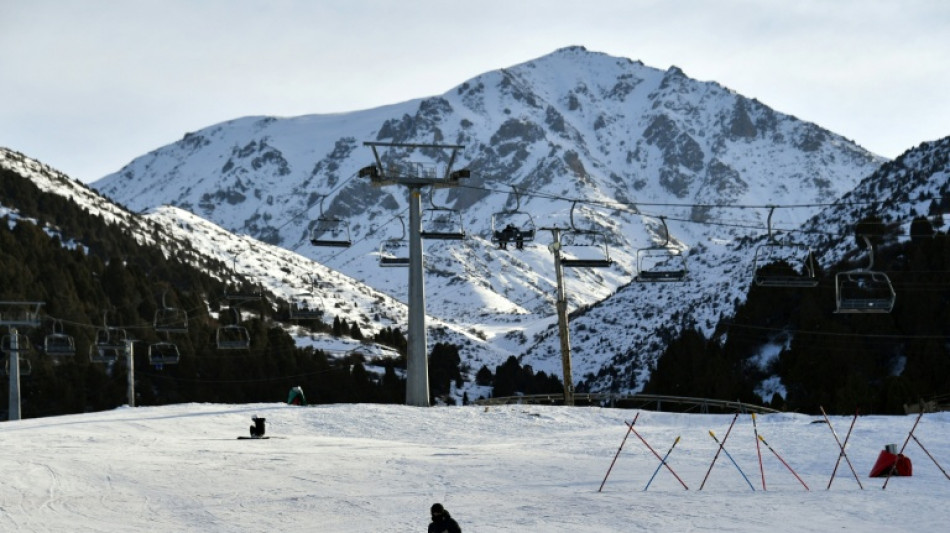
Plenty of peaks, but skiing yet to take off in Central Asia / Photo: Vyacheslav OSELEDKO - AFP

 Apple CEO Tim Cook gives nod to founder Steve Jobs in final memo
 Russian finance minister makes unexpected appearance at G20

 Happy to be back in NY, Sabalenka advances

 Naomi Watts to receive lifetime award at top Spain film fest

 Jury hears closing arguments in Tupac Shakur murder trial
 Pakistan sack coach, send seven players home after England defeats

 New storms threaten Grand Canyon flood search, 2 bodies recovered

 France takes aim at ultra-fast fashion with new levy

 Tribunal says India cannot withdraw from water treaty with Pakistan

 John Galliano pulls US exhibition after antisemitism backlash
 French Top 14 boss offers 'no guarantees' for first Club World Cup
 Munoz reunites with Glasner after joining Forest from Palace

 Liverpool sign Barcola from PSG for £124 million

 Putin, Xi hold talks in Kyrgyzstan as regional summit begins

 ChatGPT becomes first AI chatbot to face tougher EU rules

 Man City sign Palmeiras winger Allan on five-year deal
 More flooding feared at Grand Canyon after storm leaves 15 missing

 RedHill Divests Talicia® to Apotex for $18 Million Cash Upfront Plus Milestones to Fuel Strategic Growth Opportunities

 MEXC Data: BTC Breaks $80,000, Major-Asset Spot Trading Volume Surges 300%

 سفارة فلسطين في عُمان تنظم ندوة لتعزيز الاستثمارات والفرص الاقتصادية

 Swollen rivers, washed-out roads hamper Nepal rescue effort

 In France's north, winegrowers bet on a warmer future

 Deadly virus stalks South Africa's sardines
 South Korea women's football body probes 'period' insult
 Transitional Fashion Essentials for Autumn: Key Pieces from M&S and Joe Browns

Two weeks before setting off for the Milan-Cortina Winter Olympics to compete as Kyrgyzstan's only alpine skier, Timur Shakirov was weaving down a slalom course in his homeland.
Despite being one of the world's most mountainous countries, a lack of infrastructure, poor financing, tricky snow conditions and a sporting culture of traditional nomadic games mean few locals from the Central Asian state have emerged onto the international skiing scene.
"It is hard to train in Kyrgyzstan as we don't have the right conditions and financing," the 19-year-old told AFP from the mountainside in the Ala-Archa National Park, just south of the capital Bishkek.
The surrounding Tian Shan and Pamir mountain ranges -- where peaks reach as high as 7,500 metres (24,600 feet) -- were hosting a regional competition for athletes from Kyrgyzstan, Kazakhstan, Uzbekistan and Tajikistan.
In Milan, he will compete in the Giant Slalom on February 14 and Slalom event two days later -- adding his name to the 20-odd alpine skiers from Central Asia who have competed at the Winter Olympics since the collapse of the Soviet Union in 1991.
- 'Too warm' -
"It is a fairly expensive sport. So the idea that mountainous Kyrgyzstan could easily develop alpine skiing is false," said Yulia Tenkova from the Kyrgyz Ski Federation.
Conditions are also tricky. The snowpack is too soft, meaning bumps emerge on courses too fast after multiple rides.
"To gain proficiency in alpine skiing, you need a totally different snow cover," she said.
"Our climate is too warm and (skiing) is a luxury."
Average temperatures in Central Asia have risen by about 1.5C since 1991, twice the global average, according to the World Meteorological Organization (WMO), a UN climate agency.
While some resorts have turned to snow cannons, solutions are pricey.
This forces Central Asian skiers to train thousands of miles away from home.
"We train mainly in Italy, Austria," said Shakirov, who admires European skiing pros as Marcel Hirscher, Henrik Kristoffersen and Marco Odermatt.
The time in Europe has helped the sport's development at home, he noted.
Kyrgyzstan's Maxim Gordeev, who competed in the 2022 Beijing Olympics, "brought back new methods from Europe and showed me how to train", said Shakirov.
But on the whole, Shakirov regrets low government investment and a dearth of world-class courses that could really boost the sport at home.
- Money problem -
The money to pay for professional and aspiring athletes to train abroad is also in short supply.
"Sometimes plane tickets are so expensive that we have to find funding," said Tenkova from the national ski federation.
"But sponsors are reluctant, because we're not as visible. Unlike wrestlers."
Success in wrestling has delivered a string of Olympic medals for Central Asian nations, leaving other more expensive sports to feel they have been crowded out.
Even in the richest and most successful skiing nation in the region, Kazakhstan, there are not enough well-equipped slopes.
"Alpine skiing is only developed in two regions," said skier Mariya Grigorova, who competed for Kazakhstan at the 2018 Olympics in South Korea.
Now a coach, she said Kazakhstan at one point wanted to end support for its alpine skiing program altogether because "the results weren't good enough".
"In recent years, we trained thanks to personal funds. We even made it to the top 30, top 20. But, as a rule, what result are they always expecting? First, second, third place. That's all," she said.
For skiers from Tajikistan -- none of whom qualified for the Olympics -- participating in the Central Asian Cup is already a win.
Ambitions are high.
Tajik coach Saidakbar Eshonov said he wanted to "take skiing in Tajikistan to a high level, like wrestling".
He hopes easing geopolitical rivalries could boost the sport.
But having signed a final accord last year to resolve the issue, Eshonov was betting on closer cooperation helping lift chances across the entire region.
"We will try to collaborate with coaches from Kyrgyzstan, Kazakhstan and Uzbekistan to bring skiing to the top," he said.
M.AbuKhalil--SF-PST