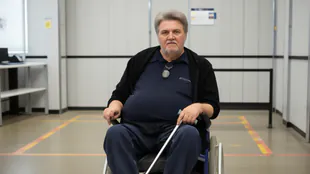
Fire walkers defy pain in ancient Greek ritual / Photo: Sakis Mitrolidis - AFP

 Greenland parliament approves security agreement with United States

 Qatar envoy meets incoming UN General Assembly president

 Trump Signals Willingness to Work With Democrats After Midterm Defeat

 دي برومهد يفتح خياراته لـ "ذا بيغ ويسترنر" قبل عودته في ويكسفورد

 أزمة الإسكان في البرتغال: تصاعد الأسعار يعمق الانقسامات السياسية حول الحريات

 New York City Center revives In the Heights as a timely community story

 Godzilla Minus Zero shifts focus toward postwar human drama

 Mehbooba Mufti urges dialogue and renewed Central Asia links for Kashmir

 Seacliff Healthcare Seeks Specialist GP in Thirroul

 US stocks fall before midterm Election Day as technology shares weaken

 BLS Polymers makes strong market debut at ₹248 per share

 Petrol and diesel prices remain broadly steady across major Indian cities

 Reliance shares remain in focus after near-12% surge

 2026 Arizona Midterms: Key Races, Ballot Measures, and Voter Deadlines

 Coal India prepares possible $1 billion Mahanadi Coalfields listing

Under a cloud of incense smoke, a group of men and women in a village in northern Greece swayed slowly to the music before removing their shoes and rushing, barefoot, onto waiting embers.
The fire walking ritual, held on the day of the Orthodox feast of Saint Constantine and Saint Helena on May 21, has been practised for over a century in four villages of the Greek region of Macedonia, which borders Bulgaria.
Each year, this ceremony -- called "Anastenaria" ("sighs" in Greek) -- attracts crowds of visitors.
Considered a pagan ritual to honour the ancient Greek gods Dionysus and Artemis, the ancient custom was once banned by the powerful Greek Orthodox Church.
For the past several decades, cooler heads have prevailed.
But the rite remains shrouded in mystery.
"Those who walk on fire don't like to talk about it much," explained Sotiris Tzivelis, 86, who grew up in the village of Agia Eleni, near the city of Serres.
"Back then, when someone fell ill, we would call the 'anastenarides' to help heal them," he told AFP.
The family requesting help would make a special handkerchief, to be blessed during the ceremony.
It is one of these handkerchiefs that the ceremony leader, Babis Theodorakis, gives participants to mark the start of the ritual in the "konaki" -- a room decorated with Orthodox icons where participants prepare by dancing to the sound of the lyre and the drum.
When ready, they head to a nearby meadow and form a circle around the glowing embers.
"I have never walked on fire, but every year, I give our family's handkerchief to the dancers before taking it back at the end of the ritual," said Tzivelis.
- Pagan ritual -
According to local tradition, the rite originated in the villages of Kosti and Brodivo in southeastern Bulgaria, where Greek communities lived before emigrating to Greece in the early 20th century with the collapse of the Ottoman Empire.
"How to walk on fire without getting burned, I can't explain it to you!" said Babis Theodorakis, the ceremony leader.
Apostolis Vlaspos, 65, who has practised the ritual for 20 years, described it as "something internal, an indescribable force".
"The first time I walked on fire, I saw the image of Saint Constantine, whom we call 'grandfather', and I felt like an electric shock," he said.
After circling the glowing embers three times, participants begin to walk on them, swaying to the music and clutching icons under their arms.
When they return to the "konaki", visitors rush to photograph them and check that they have no burns on their feet -- proof of a miracle, according to believers.
The ceremony concludes with a meal of mutton specially slaughtered for the occasion.
"Those who say that people walking on fire are in a trance are wrong," said villager Kostas Liouros, 67.
"What happens to them is natural and requires mental peace and great concentration," he explained.
"Some say we drink alcohol or that before removing our socks and shoes, we coat our feet with herbs and things like that, but none of that is true," added another participant, who declined to give his name.
V.Said--SF-PST