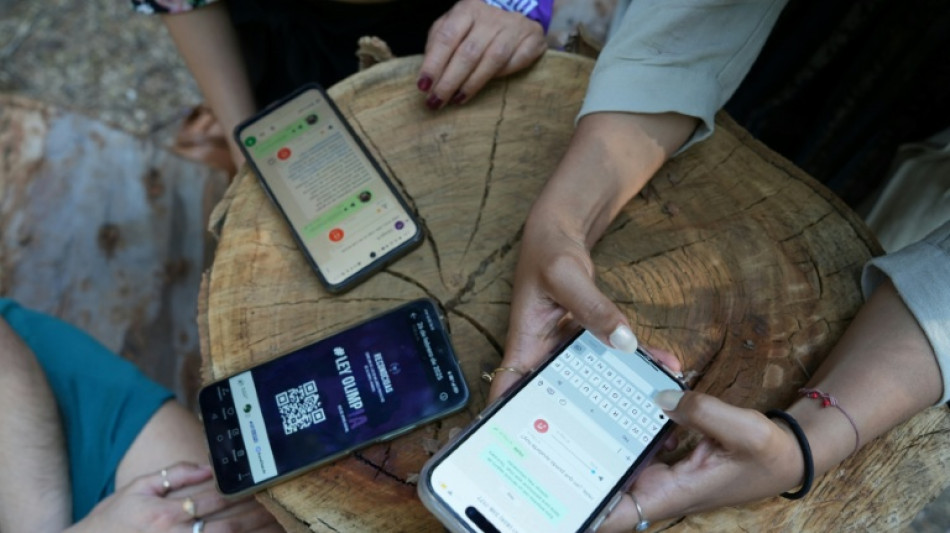
AI chatbot helps victims of digital sexual violence in Latin America / Photo: Zina DESMAZES - AFP

 WHO eyes 'encouraging' signs in DRCongo fight against Ebola

 Liga boss criticises Real Madrid trio for Ceuta shirt incident

 WTA Finals moved to Charlotte from 2027

 Almost 8,000 excess deaths in France's scorched summer: statistics

 Ex-president's lengthy war crimes sentence shocks Kosovo

 US House faces test on sweeping Russia sanctions bill

 British PM says to make 'difficult decisions' as inflation rises

 TotalEnergies pumps up controversy in France with cut-price gas

 Global fuel price demos: a round-up

 Leverate Launches MCP for Traders to Connect AI Assistants With Trading Platforms

 MEXC Launches $1M "Discover Your Wall Street DNA" Campaign to Help Traders Find Their Market Fit

 Emporio Armani names Dario Vitale new creative director

 Maresca defends VAR officials after Man City benefit from error

 Courts jails LGBTQ activists as Turkey crackdown widens

 French court to hear Depardieu's appeal against rape trial order: sources

 The German state premier hoping to halt far-right surge

 Lebanon wants Israel security deal as prelude to peace: president to AFP

 England's Brook keen to learn from 'hero' Pietersen after stunning ton

 Saudi says Houthis target Mecca, warns of 'red line'
 Phillippines ex-leader Duterte makes first appearance at ICC

 Lebanon wants Israel security deal, Hezbollah disarmament without confrontation: president to AFP

 BASIS.pro Expands On-Chain Infrastructure with XDC Network Partnership and Zypher DAO as Auto Earn Goes Live

 Samson relishing battle with teen star Sooryavanshi for India spot

 Pickle-flavoured tart? AI inspires Japan's convenience stores

 Macau holds first closed-door national security trial

Two women from Mexico and Ecuador who spent years fighting to be recognized as victims of online sexual violence have inspired an artificial intelligence chatbot that helps others facing abuse.
OlimpIA, which was developed in Mexico, provides legal advice and emotional support through the WhatsApp messaging platform using several dozen languages.
It was born from the experiences more than a decade ago of Olimpia Coral and Isabella Nuques, both now 30, before they had met.
An intimate video of Coral was shared without her consent in 2013, and when she tried to report it to Mexican authorities they informed her that there was little they could do to help.
"They told us that nothing could be done about this violence because it was virtual, and the virtual wasn't real," she said during the first Latin American Summit of Digital Women Defenders, held recently in Mexico.
The same year, in Ecuador, explicit photos of Nuques were published on social media.
She felt not only powerless but also violated again when the police officer she reported it to showed a sexual interest in the pictures, the communications expert told AFP during the same event.
- Legal advances -
The two women began fighting for digital sexual abuse to be recognized as a crime in their countries, both with success.
In 2018, a reform was passed to punish digital violence in Coral's home state of Puebla in central Mexico.
A law named after her took effect in 2021 across Mexico -- where around 10 women are murdered every day on average -- putting offenders at risk of up to six years in prison.
That same year, Nuques celebrated the approval by Ecuador's National Assembly of a digital violence law that provides for sentences of up to 16 years in prison.
Argentina, Chile and Panama have adopted legislation similar to that of Mexico, while half a dozen more Latin American countries are moving in the same direction.
According to the United Nations, 38 percent of women worldwide have experienced digital violence, although the actual number may be higher.
In 2013, Coral founded a group of activists who began providing advice to victims.
The technology company AuraChat.Ai later became interested in her project, and last September they launched OlimpIA, increasing their capacity from 100 to more than 1,300 consultations a month.
Since then, the platform has handled more than 8,000 cases, most of them in Mexico, but also in Spain, Colombia, Honduras, Ecuador, Panama, Guatemala and Peru, tailoring the advice to each country, said Fernanda Medellin, co-founder of the chatbot.
The Ley Olimpia AI initiative was recognized as one of the 50 most innovative projects at the Artificial Intelligence Action Summit in Paris in February.
- Specialist focus -
Unlike other AI chatbots like ChatGPT that gather information about countless topics, OlimpIA focuses on the issue of digital sexual violence.
Psychologists, lawyers and other experts collaborated for months to train it with specific input and a language that imitates a kind human voice.
"Some models (used by OlimpIA) act as lawyers, others as digital defenders, or as psychologists. Others act as security filters that detect risks for the victim, or as emotional radars that analyze text and audio to understand their emotional state," said Enrique Partida, co-founder and CEO of AuraChat.Ai.
One psychologist helped the chatbot to offer ways to deal with anxiety crises or panic attacks -- common symptoms among victims.
While most of its users are women, it can also be used by men.
Similar projects have been developed in countries like South Africa, where the chatbot Zuzi provides support in cases of physical or sexual abuse with features including an emergency button and evidence storage.
The developers of OlimpIA want the next version to be accessible even without an internet connection, so it is accessible through phone calls in remote regions.
There are also plans to integrate sign language and Indigenous languages in the future, said Edith Contla, director of strategy at AuraChat.Ai.
It is also hoped that the platform will serve as a link for users with police and other officials, reducing the risk of them being abused again.
Q.Jaber--SF-PST