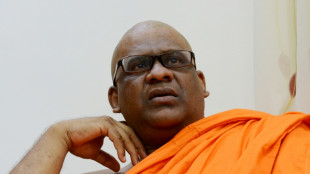
Hong Kong not becoming 'police state', says city's top cop / Photo: Peter PARKS - AFP

 Putin arrives in India for BRICS summit coloured by wars

 Springboks, All Blacks clash in groundbreaking US decider

 Man United, Bayern cruise as Como make dream Champions League start
 Musiala returns to help Bayern sink Bodo in Champions League

 Surging oil prices, higher bond yields weigh on stocks
 Russell admits he needs luck as Antonelli focuses on the job
 Canada pledges support for Ukraine air defense as Zelensky visits
 Latin America fact-check group asks Meta not to replace verification practice
 Seahawks' Darnold gets good news on hip injury: coach

 Evasive Alonso teases reporters on his F1 future
 What to know about Trump's $5,000 'dividend' pledge
 Leclerc concedes he 'went too far' in Hamilton Monza incident

 Shelton, Tiafoe in spotlight as Zverev aims to build on Grand Slam success
 England close in on Test series sweep against sorry Pakistan
 England dominate sorry Pakistan, close in on Test series sweep
 Kung wins Vuelta time-trial as Mas retains lead
 DR Congo school fire leaves at least 14 children dead

 USA and France ease into women's Basketball World Cup semis
 ECB lifts borrowing costs amid energy shock, opens door for more hikes

 France defeat China to reach women's basketball World Cup semis
 Tribal Launches Campfire, Letting Business and Technical Teams Build on Salesforce Together

 Yemen's Houthis seize key city on Red Sea
 US producer inflation tops expectations as diesel costs jump
 Rubio ends South America swing with Peru security talks

 Defiant Iran seeks to bruise Trump ahead of midterms

Hong Kong is not becoming a "police state", the city's top law enforcement officer said Tuesday, days after his officers stamped out the city's once-permitted commemorations marking Beijing's deadly Tiananmen crackdown.
The Chinese business hub is preparing for an upcoming leadership change as well as the 25th anniversary of the city's handover from Britain, for which President Xi Jinping is widely expected to visit.
Speaking to local outlet HK01 about beefed-up security activity around the event, commissioner Raymond Siu Chak-yee rejected criticism that the police were becoming too powerful.
"A police state is where the government forcibly controls various aspects of people's life with administrative measures and without going through legal procedures. Do people think Hong Kong is like that?" he said.
"Hong Kong is a society of rule of law, not a police state."
His comments come after police arrested six people on Saturday as authorities pounced on any attempt to publicly remember China's 1989 crackdown on peaceful protesters.
Amnesty International has accused authorities of "harassment and indiscriminate targeting" for the arrests.
Police closed the site of a once annual Tiananmen vigil and jampacked the surrounding area, one of the busiest shopping districts in Hong Kong, with officers.
People were stopped and searched for carrying flowers, wearing black and, in one case, carrying a toy tank box.
On Tuesday authorities rolled out a "counter-terrorism reporting hotline" for residents to report "violent acts, suspected terrorism-related activities, in particular extremist plots".
People would be paid for "reliable" information, they said.
- Protest documentary -
Since Beijing imposed a national security law on Hong Kong in 2020 after large and sometimes violent pro-democracy demonstrations, authorities have cracked down on dissent.
In another interview with the South China Morning Post, Siu "advised" residents they should not watch or download an award-winning documentary about the 2019 protests if they are uncertain about the legal risk.
The film, "Revolution of Our Times", has recently become widely available on US streaming platform Vimeo.
Siu did not however specify whether the movie or the production team had violated any law or had been investigated by the force's national security unit.
"If they're not sure whether this would commit [offences under] the national security law, then I would advise them to try to distance themselves from doing such acts," Siu told the Post.
Produced by Hong Kong director Kiwi Chow, the movie takes its name from a then popular -- but now outlawed -- protest slogan.
It debuted at the Cannes film festival last July and in November won best documentary award at Taiwan's Golden Horse Award, an event dubbed the Chinese-language "Oscars".
It has never been shown commercially in Hong Kong as the city toughened film censorship after the passage of the security law, and Chow sold the rights to his work overseas to avoid scrutiny.
S.Abdullah--SF-PST