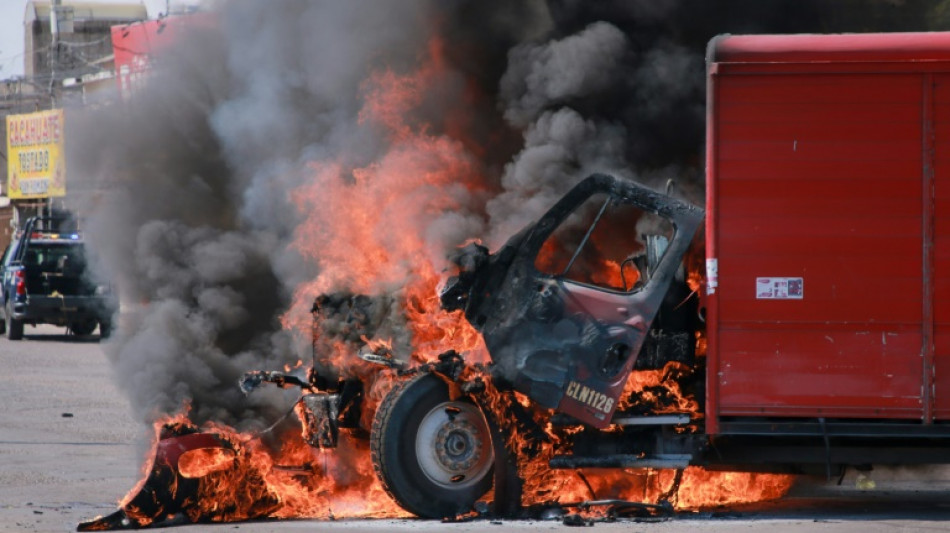
Could 'terrorist' designation lead to US strikes on drug cartels? / Photo: Ivan MEDINA - AFP/File

 Amorim's Milan beaten by Benfica, Sunderland make dream European return

 US stocks fall, dollar gains after Fed lifts interest rates
 Seahawks rule out Darnold for Sunday game at Arizona
 Mbappe explains Ceuta shirt stance after criticism

 Improving Atletico cruise to comfortable win over Osasuna

 Candidate for UN chief calls for AI regulation akin to nuclear weapons

 O'Neill expects Celtic recovery after Old Firm misery
 Man City midfield trio backed to emulate Rodri and Silva

 'We're losing control,' AI pioneer Yoshua Bengio tells AFP
 WHO eyes 'encouraging' signs in DRCongo fight against Ebola
 Liga boss criticises Real Madrid trio for Ceuta shirt incident

 WTA Finals moved to Charlotte from 2027

 Almost 8,000 excess deaths in France's scorched summer: statistics

 Ex-president's lengthy war crimes sentence shocks Kosovo

 US House faces test on sweeping Russia sanctions bill

 British PM says to make 'difficult decisions' as inflation rises

 TotalEnergies pumps up controversy in France with cut-price gas
 Global fuel price demos: a round-up

 Leverate Launches MCP for Traders to Connect AI Assistants With Trading Platforms

 MEXC Launches $1M "Discover Your Wall Street DNA" Campaign to Help Traders Find Their Market Fit

 Emporio Armani names Dario Vitale new creative director
 Maresca defends VAR officials after Man City benefit from error

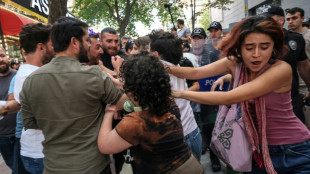 Courts jails LGBTQ activists as Turkey crackdown widens

 French court to hear Depardieu's appeal against rape trial order: sources

 The German state premier hoping to halt far-right surge

US President Donald Trump's decision to designate eight Latin American drug trafficking groups as "terrorist" organizations has raised speculation about possible military action on foreign soil.
What are the ramifications of the order targeting six Mexican drug cartels, Venezuela's Tren de Aragua and Mara Salvatrucha, the street gang with close links to Central America?
- Is military intervention likely? -
The cartels' designation as terrorist groups "means they're eligible for drone strikes" wrote tech billionaire Elon Musk, who has been given a prominent role in the Trump administration, on his social media platform X.
Experts, however, said that bombing Mexican cartels or sending troops over the border still appeared unlikely, although Trump's unpredictability makes it impossible to completely rule out.
The idea "used to be something that was found in a niche, very much on the fringes, and now it is at the center of the discussion," said Cecilia Farfan-Mendez, an analyst at the University of California Institute on Global Conflict and Cooperation.
Trump's negotiating style is to push his counterparts to the "extreme," said Steven Dudley, co-director of the InSight Crime think tank.
"The extreme is military invasion, of course, so what he's looking for is middle ground," Dudley said.
Vanda Felbab-Brown, an expert at the Washington-based Brookings Institute, believes that unilateral US military strikes against the cartels would risk dealing "a tremendous setback" to the fight against fentanyl smuggling.
"Mexico would consider this act an invasion, and whatever law enforcement cooperation that does exist would grind to a halt," she wrote in an article for Foreign Affairs magazine.
- Will it reduce fentanyl trafficking? -
The strength of fentanyl means that both its ingredients and pills can be transported in tiny quantities and still be profitable, according to experts.
"You don't need a truck, a boat, a plane, you need human beings," and the millions of people crossing the Mexican-US border every day make it "impossible" to control smuggling, Dudley said.
Farfan-Mendez said that Trump's strategy, focused on blaming and coercing Mexico, avoids addressing fentanyl as a health crisis that kills tens of thousands of Americans every year.
"If the goal is to prevent these deaths, this designation is not going to save more lives. It requires a public health policy," she said.
Felbab-Brown said that asking Mexico to completely halt the influx of fentanyl into the United States was "an unachievable demand."
- Will it enable US to dismantle cartels? -
According to Trump's executive order, it is US policy "to ensure the total elimination of these organizations' presence in the United States and their ability to threaten the territory, safety, and security of the United States through their extraterritorial command-and-control structures."
Dudley doubts that the cartels can be eliminated, either by deploying more troops on the ground or by using legal tools, because they are "sophisticated and very dispersed" organizations, capable of quickly recomposing.
"It cannot be solved by capturing a single person... or by dismantling an entire organization," he said.
According to Felbab-Brown, unilateral US military strikes "would almost certainly fail to destroy the cartels."
Replacements for leaders who were killed would be quickly found and the cartels "have repeatedly demonstrated a capacity to re-create damaged drug labs within days," she added.
- What are the risks for US companies? -
The designation "theoretically allows US authorities to impose penalties on entities and individuals that provide material support to cartels, including companies paying extortion fees under duress," according to the Mexican political risk consultancy EMPRA.
According to Dudley, the broad legal scope of the decree means that "in the hands of irresponsible authorities" it could be "extremely dangerous."
If the Mexican subsidiary of a US company pays extortion to a cartel, the parent company could be accused of "material support" for terrorism, he said.
"Providing even a pencil, a toy, or a cup of coffee can trigger severe criminal and financial penalties," Felbab-Brown said.
A.AbuSaada--SF-PST