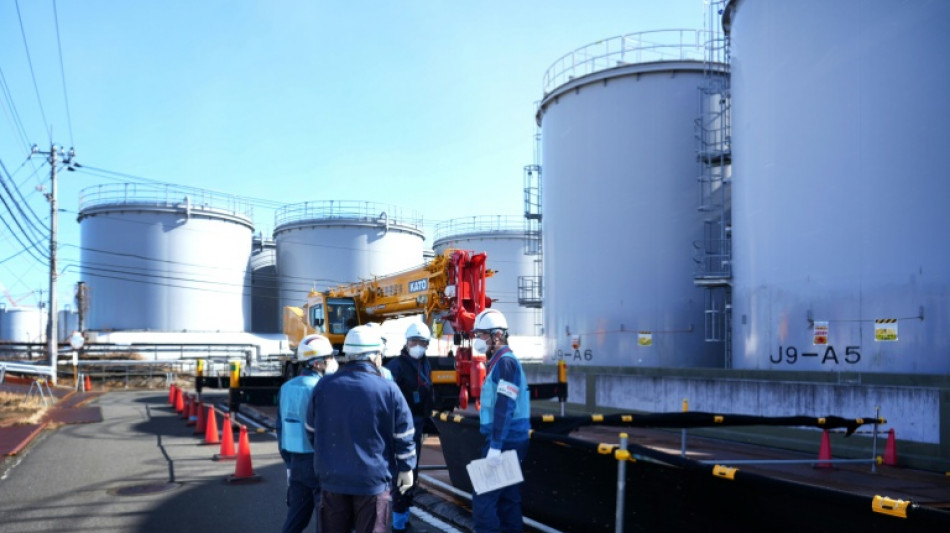
TEPCO takes on challenge of making space for Fukushima nuclear debris / Photo: Atish PATEL - AFP

 Amorim's Milan beaten by Benfica, Sunderland make dream European return

 US stocks fall, dollar gains after Fed lifts interest rates

 Seahawks rule out Darnold for Sunday game at Arizona

 Mbappe explains Ceuta shirt stance after criticism

 Improving Atletico cruise to comfortable win over Osasuna

 Candidate for UN chief calls for AI regulation akin to nuclear weapons

 O'Neill expects Celtic recovery after Old Firm misery

 Man City midfield trio backed to emulate Rodri and Silva

 'We're losing control,' AI pioneer Yoshua Bengio tells AFP

 WHO eyes 'encouraging' signs in DRCongo fight against Ebola

 Liga boss criticises Real Madrid trio for Ceuta shirt incident

 WTA Finals moved to Charlotte from 2027

 Almost 8,000 excess deaths in France's scorched summer: statistics

 Ex-president's lengthy war crimes sentence shocks Kosovo

 US House faces test on sweeping Russia sanctions bill

 British PM says to make 'difficult decisions' as inflation rises

 TotalEnergies pumps up controversy in France with cut-price gas

 Global fuel price demos: a round-up

 Leverate Launches MCP for Traders to Connect AI Assistants With Trading Platforms

 MEXC Launches $1M "Discover Your Wall Street DNA" Campaign to Help Traders Find Their Market Fit

 Emporio Armani names Dario Vitale new creative director

 Maresca defends VAR officials after Man City benefit from error
 Courts jails LGBTQ activists as Turkey crackdown widens

 French court to hear Depardieu's appeal against rape trial order: sources

 The German state premier hoping to halt far-right surge
Workers at Japan's crippled Fukushima nuclear plant have started dismantling water storage tanks to free up space for tonnes of nuclear debris, 14 years after the facility was hit by a devastating tsunami.
Operator Tokyo Electric Power Company (TEPCO) has been charged with finding a suitable place to store around 880 tonnes of radioactive material that remains inside the Fukushima Daiichi plant's damaged reactors.
"Currently, there is no more land available in Fukushima Daiichi", Naoki Maeshiro, project manager for TEPCO, who is overseeing the operation which began on Friday, told AFP.
Three of plant's six reactors were operating when a tsunami caused by a massive earthquake hit on March 11, 2011, disabling their cooling systems and sending them into meltdown.
Ever since, TEPCO has been holding 1.3 million tonnes of water -- a combination of groundwater, seawater and rainwater -- at the site, along with water used for cooling the reactors.
The water, which is treated to remove various radioactive materials, has been held inside more than 1,000 tanks that occupy much of the plant.
In one of the zones called "J9", the giant steel tanks tower over employees at work, obstructing the view of the rest of the plant.
"To proceed with the next steps, such as retrieving the fuel debris, a certain amount of land is necessary," added Maeshiro.
Scrapping the water tanks became possible after TEPCO began discharging treated water from the plant into the Pacific Ocean in August 2023.
Japan and the International Atomic Energy Agency (IAEA) have assured that the operation does not harm the environment.
Getting rid of the welded containers is considered a crucial step in the decades-long decommissioning process.
Once removed, the utility company plans to build facilities to store highly dangerous molten fuel debris after extracting it from inside the reactors.
"As long as the fuel debris remains in its current state, the risks remain very high," Nobuhide Sato, a risk specialist at TEPCO, told AFP.
- Arcade-style claw machine -
The company has developed a telescopic device that can collect debris remotely for safety reasons and to avoid radioactive material leaks.
A demonstration attended by AFP was carried out in reactor number five, which was not in operation when the tsunami hit.
Before entering the zone, which is under high surveillance, employees put on masks, safety helmets, a full body protective white suit, and three pairs of socks and gloves as a precaution against radiation.
Armed with a flashlight, Sato stopped in front of a hole, around 60 centimetres (two feet) in diameter, that has been drilled into the structure protecting the reactor's core.
The plan is to extend the specially developed telescopic device several metres through the hole to reach the radioactive debris in the reactor.
The device resembles an arcade claw machine, so the "arm grabs the debris, lifts it, and retrieves it," said Sato.
In early November, TEPCO announced a debris sample weighing 0.7 grams (0.025 ounces) had been successfully extracted and sent to a laboratory near Tokyo.
The analysis will help determine radioactivity levels and the chemical composition of the molten fuel debris, a key step in the colossal dismantling project.
"Depending on the results, we will see whether it is better to use water to collect (the fuel debris) in the reactor or to do it in a dry environment," Sato said.
The TEPCO employee then enters the base of the reactor, where workers can only spend a maximum of two hours a day due to radiation levels.
"If we can properly recover the fuel debris and store it safely, it be a great help in reassuring nearby residents," Sato added.
A second sampling of nuclear material is scheduled between "March and April," according to TEPCO, which should provide enough information about its composition to move to the next stage -- a larger-scale extraction of radioactive debris by 2030.
The overall project is expected to take between 30 and 40 years, the company said.
I.Yassin--SF-PST