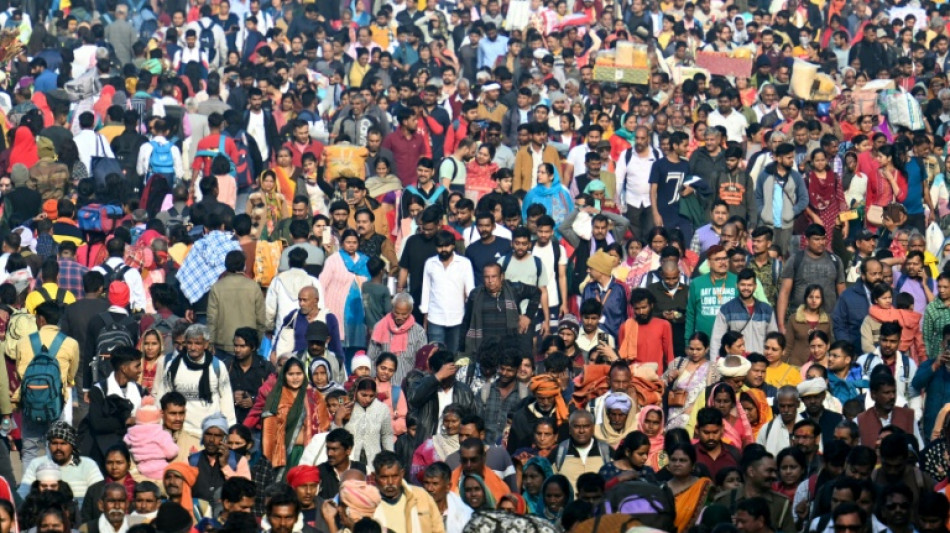
India's Hindu mega-festival supercharges economy / Photo: Idrees MOHAMMED - AFP

 US House backs data center power cost bill amid midterm backlash
 US Congress passes sweeping Russia sanctions bill

 Barca hit Racing for seven as Atletico crush Osasuna

 US Fed raises rates to tackle 'too high' inflation, irking Trump

 Man Utd misery mounts after League Cup collapse against Brighton

 Turkey releases 106 protesters, jails more LGBTQ activists

 US Fed raises rates to tackle 'too high' inflation in move sure to rile Trump

 England were 'waiting for death' in World Cup semi-final defeat: Tuchel

 NFL star fined for displaying name of slain Palestinian girl

 Witsel retires from internationals after 18-year Belgium career

 US Fed raises rates to battle inflation in move likely to rile Trump

 Fitzpatrick 'not comfortable' over Dubai golf finale

 Gaza apartment block collapse kills 21, including 12 children

 Gaza apartment block collapse leaves 21 dead

 US House targets data centers as midterm backlash grows

 French ex-minister Dati goes on trial in Renault-Nissan corruption case
 'Being Heumann' captures joy in fight for disability rights

 Retired great Nadal to play in exhibition matches

 IR-MED and Dice Technologies Announce collaboration to Evaluate and Advance Pressure-Injury Prevention Platform in Japan
 Watts, Pitt, Cruz to light up Spain's top film festival
 Sweden expels Iran embassy employee over anti-Jewish threats

 Toogood Gold's Table Mountain Sits in the Shadow of a Nevada Gold Rush

 MEXC July–August Security Report: 38.66M USDT in Risk Funds Intercepted, Futures Insurance Fund Hits 792M USDT

 'Breathing toxin every day': Indonesians choked by haze feel helpless
 Stocks edge higher ahead of US Fed rate call

The unfathomable scale of the world's largest religious festival in India overshadows many nations in size -- and for the economy, its impact is just as dramatic.
"Business is booming everywhere for everyone across our city," said taxi driver Manoj Kumar, whose northern Indian home of Prayagraj has swelled from its normal seven million residents dozens of times over.
Religion, politics and the economy are deeply intertwined in India -- and the six-week-long Hindu festival of the Kumbh Mela gives one of the clearest examples.
The Hindu nationalist government of Prime Minister Narendra Modi has poured in funds for large-scale infrastructure upgrades.
"We are seeing an unimaginable transformation of our city," 37-year-old Kumar said.
"There are new roads, bridges, additional flights and trains, new hotels and restaurants, and an unmet demand for workers."
The Kumbh's extraordinary scale provides a major job boost, with millions of visitors splashing out on accommodation, transport and food.
Kumar's daily earnings shot up to around $250, roughly eight times as much as usual.
"I've had some of the busiest 18-20 hour workdays of my life with little or no rest," he said. "But I am not alone in benefiting -- this is a life-changing event."
- 'Big driver' -
The state government -- led by firebrand Hindu monk Yogi Adityanath, chief minister of Uttar Pradesh state and a key leader in Modi's Bharatiya Janata Party (BJP) -- controls lucrative service contracts for its running.
It is impossible to independently verify government statistics of a religious celebration that critics say is being cashed in on by Hindu nationalist leaders to burnish political credentials.
That includes the reported more than 435 million pilgrims to have taken a ritual river dip so far -- with the festival running until February 26 -- that organisers say is based on artificial intelligence assessments from surveillance camera networks.
It also includes the whopping $24 billion Adityanath projects it will contribute to the economy -- that's the equivalent of more than the population of the United States and Canada splashing out the entire annual GDP of Armenia.
They are staggering statistics even for the world's most populous nation of 1.4 billion people.
Devendra Pratap Singh, president of Associated Chambers of Commerce and Industry in Uttar Pradesh and Uttarakhand states, puts the figure as even higher --- at about $30 billion.
"Our economy would obviously grow because of this mega event," he told AFP. "We're seeing its benefits at every stage, with impacts on transportation, hotels, food, and every other sector."
With the festival funnelling religious tourism on a vast scale, local reports say the state also expects $3 billion in additional government revenues including taxes and fees.
"How gods drive India's consumer economy," The Economic Times newspaper said in a report last month.
"The Kumbh is the most visible part of a big driver of India's economy, the festival cycle."
Major household brands see the Kumbh as ripe for opportunity, setting up shops and pouring in advertising.
In the crowded tent city along the river banks, where pilgrims come to take ritual dips, an army of vendors sells everything from food and clothes to prayer items, flowers and festival memorabilia.
- 'Phenomenal' -
Sanjeev Singh, from Adityanath's office, says the Kumbh Mela makes global festivals look small -- pointing to Brazil's Rio Carnival with some seven million participants or the Muslim hajj in Saudi Arabia with nearly two million.
"The sheer scale is mind-boggling," Singh said. "This is phenomenal."
Hotel owner Deepak Kumar Mehrotra, 67, said his two properties have been fully booked. "Demand has really shot up," Mehrotra said. "People across all strata are getting really good business."
Rooms, if available, are going for up to 10 times their regular rates -- with top-end hotels charging $900-$1,200 per night -- almost as much as the annual per capita income in Uttar Pradesh state.
Meeting demand has been a challenge, with chefs, drivers and electricians in high demand.
Travel agent Shahid Beg Romi, 62, who runs Sangam Travels, said businesses were struggling to "adjust to this drastic change in the footfall" in Prayagraj.
"Even small areas 50 miles (80 kilometres) outside Prayagraj are packed," Romi added. "People are staying and commuting to the Kumbh from there".
The impact is felt in other Hindu pilgrimage sites in the state, including Ayodhya and Varanasi, with devotees journeying on to pray there too.
"Such mega-events obviously create new growth and work opportunities," he said.
Q.Bulbul--SF-PST