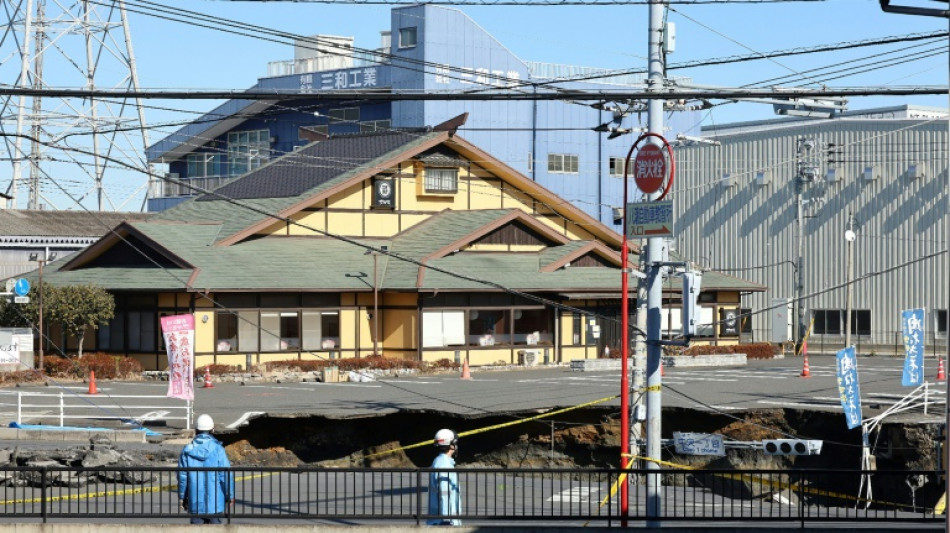
Japan's Olympic pool-sized sinkhole highlights risk of old pipes / Photo: STR - JIJI Press/AFP

 NFL Chiefs' Kelce among investors bilked in Ponzi scheme

 Trump threatens EU over 'hostile' Canada association plan

 Argentine judge orders suspension of Falklands oil project

 Carrick takes the blame as troubled Man Utd suffer League Cup misery

 Barcelona hit seven in Racing Santander rout

 Amorim's Milan beaten by Benfica, Sunderland make dream European return

 US stocks fall, dollar gains after Fed lifts interest rates

 Seahawks rule out Darnold for Sunday game at Arizona

 Mbappe explains Ceuta shirt stance after criticism

 Improving Atletico cruise to comfortable win over Osasuna

 Candidate for UN chief calls for AI regulation akin to nuclear weapons

 O'Neill expects Celtic recovery after Old Firm misery

 Man City midfield trio backed to emulate Rodri and Silva

 'We're losing control,' AI pioneer Yoshua Bengio tells AFP

 WHO eyes 'encouraging' signs in DRCongo fight against Ebola

 Liga boss criticises Real Madrid trio for Ceuta shirt incident

 WTA Finals moved to Charlotte from 2027

 Almost 8,000 excess deaths in France's scorched summer: statistics

 Ex-president's lengthy war crimes sentence shocks Kosovo

 US House faces test on sweeping Russia sanctions bill

 British PM says to make 'difficult decisions' as inflation rises

 TotalEnergies pumps up controversy in France with cut-price gas

 Global fuel price demos: a round-up

 Leverate Launches MCP for Traders to Connect AI Assistants With Trading Platforms

 MEXC Launches $1M "Discover Your Wall Street DNA" Campaign to Help Traders Find Their Market Fit
A massive sinkhole near Tokyo that swallowed a truck and its driver a week ago, and has filled with sewage and debris, highlights the risk posed by Japan's ageing pipes.
Emergency workers have been striving in vain to reach the 74-year-old man, who rescuers have had no contact with for a week, and who was likely buried under sediment and sewage water in the sinkhole in the city of Yashio.
Officials say corroded sewerage pipes created the sinkhole that is now 40 metres (130 feet) wide -- nearly the size of an Olympic swimming pool -- and 15 metres (50 feet) deep.
Cranes have been mobilised and a 30-metre slope built to locate and reach the driver, with a second slope under construction, but progress has been slow and dangerous.
Koichi Yamamoto, an official with Yashio's fire department, told AFP on Tuesday that rescue efforts had been suspended.
A "substantial" amount of sewage water has accumulated at the site, eroding the surrounding soil and "constantly flowing in like a river", he said.
"This makes it impossible for us to proceed."
Also "hampering our rescue operation is a pile-up of heavy masses such as debris, slabs of asphalt and concrete that need removing", Yamamoto added.
When the hole suddenly opened up in Yashio, in the region of Saitama near Tokyo, during the morning rush hour on Tuesday last week, it at first looked like just one of thousands of sinkholes reported annually across Japan.
Their occurence is trending upwards in Japan, topping 10,000 in fiscal 2022, with many of the sinkholes sewage-related in urban areas, a land ministry probe shows.
- Ageing pipes -
Initially the hole was around five metres in diameter, then a much larger cavity opened nearby and the two holes merged.
To reduce the volume of sewage, locals were urged to "use as little water as possible" for three hours on Tuesday afternoon.
This was on top of requests already issued for about 1.2 milion people in Saitama to refrain from non-essential use of water, such as taking baths or doing laundry.
In response, some onsens have opened their public bath facilities for free to accommodate residents in Yashio and nearby areas, according to local media.
The week-long sinkhole saga was a reminder of the insidious corrosion gnawing at Japan's ageing water and sewerage pipes, Shinya Inazumi, a professor of geotechnical engineering at Shibaura Institute of Technology, told AFP.
The majority of the underground infrastructure was developed during the country's rapid post-war economic growth.
"Many sewerage pipes in Japan have already outlived their service life (of 50 years) so pipes anywhere else could break due to ageing," Inazumi said.
In just over 15 years' time, 40 percent of Japan's sewerage pipes will have exceeded their lifespan, according to an estimate from the land ministry.
In Yashio, local authorities attributed the initial chasm to rusty, punctured sewerage pipes that absorbed the surrounding soil, creating a hollow under the ground.
Extreme weather events such as intense rain -- made more frequent by climate change -- can also exacerbate this kind of infrastructure failure, Inazumi said.
"Rainfall these days can be extremely heavy and localised, which means a great amount of water seeps underground," the professor said.
"The water gushes in at an incredible speed, accelerating the growth of an underground hollow by making it bigger and bigger through erosion."
Y.Shaath--SF-PST