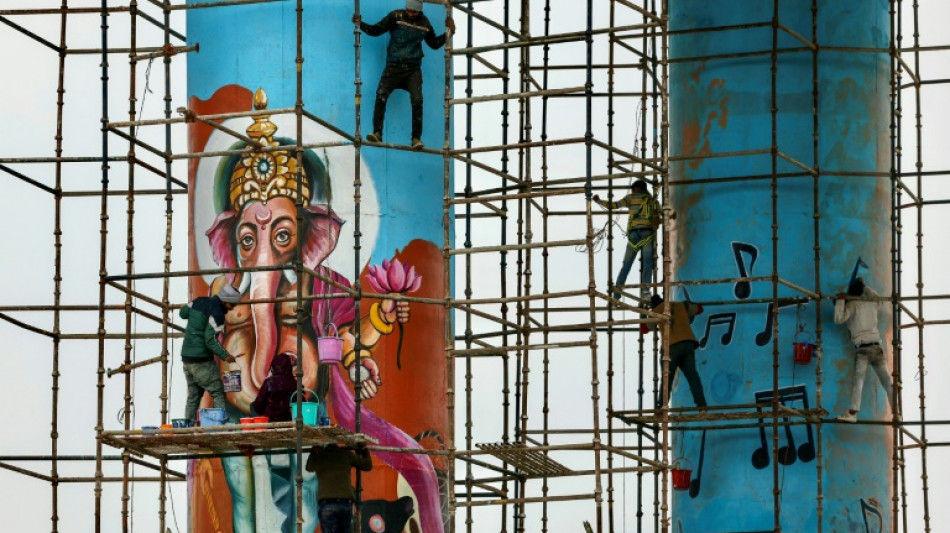
India's Kumbh Mela, world's largest religious gathering / Photo: Niharika KULKARNI - AFP/File

 'Vande Mataram': Why is India's freedom song in spotlight?

 Counterculture pop artist Peter Max dies at 88: US media
 Asian Games chief defends 'functional' rooms after backlash
 Leader's sister says only 'idiots' think N. Korea to give up nukes
 World's water cycle becoming more unpredictable, UN warns
 Where the US-China tariff row stands ahead of White House summit
 Croc-habitat gets green light for 2032 Olympic rowing

 Indonesia cash-for-photos scheme turns animal hunters into protectors

 'Left-field' life: Briton becomes Thailand's top foreign monk

 India's transgender amendment leaves many in limbo

 Trump to host Xi amid pomp, low expectations

 Harry set for UK public outings with security, royal status hazy
 NFL Chiefs' Kelce among investors bilked in Ponzi scheme

 Trump threatens EU over 'hostile' Canada association plan
 Argentine judge orders suspension of Falklands oil project

 Carrick takes the blame as troubled Man Utd suffer League Cup misery

 Barcelona hit seven in Racing Santander rout

 Amorim's Milan beaten by Benfica, Sunderland make dream European return

 US stocks fall, dollar gains after Fed lifts interest rates

 Seahawks rule out Darnold for Sunday game at Arizona

 Mbappe explains Ceuta shirt stance after criticism

 Improving Atletico cruise to comfortable win over Osasuna

 Candidate for UN chief calls for AI regulation akin to nuclear weapons

 O'Neill expects Celtic recovery after Old Firm misery

 Man City midfield trio backed to emulate Rodri and Silva

Organisers of India's Kumbh Mela have prepared to host a staggering 400 million devotees at the six-week Hindu festival that starts Monday and is expected to be the largest human gathering in history.
Pilgrims will come from across India and beyond to take part in elaborate rituals, prayers and religious processions with elephants, as well as horse-back parades and chariots.
The mass Hindu mela, or fair, runs from January 13 to February 26 on the river banks of Prayagraj in the northern state of Uttar Pradesh.
Organisers say the scale of preparations for the Kumbh Mela is akin to setting up a country from scratch.
- Mind-boggling numbers -
Around 150,000 toilets have been built along with community kitchens that can each feed up to 50,000 people at a time.
The last celebration at the site, the "ardh" or half Kumbh Mela in 2019, attracted 240 million pilgrims, according to the government.
This year, authorities are preparing for up to 400 million people -- more than the combined population of the United States and Canada.
Mela authorities and police have set up a network of "Lost and Found" centres as well as a special Kumbh phone application to help lost pilgrims reunite with their families.
- Sacred bathing -
The Kumbh Mela, the "festival of the sacred pitcher", is held at the confluence of the Ganges, Yamuna and mythical Sarasvati rivers.
A central part of the rituals is bathing in the holy rivers, with the dawn charge often led by naked, ash-smeared monks.
Hindus believe that those who immerse themselves in the waters cleanse themselves of sin, breaking free from the cycle of rebirth and ultimately attaining salvation.
Many pilgrims embrace a life of simplicity during the festival -- vowing non-violence, celibacy and the offering of alms -- and focusing on prayer and meditation.
- Cosmic battle -
The festival is rooted in Hindu mythology, a battle between deities and demons for control of a pitcher, or kumbh, containing the nectar of immortality.
During the battle, a cosmic fight called "Samudra Manthan", or the "churning of the ocean", four drops of nectar were spilt.
One landed at Prayagraj, where the Kumbh is held every 12 years.
The other drops fell in Nashik, Ujjain and Haridwar, cities where smaller Kumbh festivals are held in intervening years.
The mythological battle is mentioned in the Rig Veda, an ancient sacred canonical Hindu text.
One of the earliest historical mentions of the festival comes from Chinese Buddhist monk and scholar Hiuen Tsang, who attended in the seventh century.
- Key dates -
Bathing takes place every day, but on the most auspicious dates, it is known as Shahi Snan, or "royal bath".
Ceremonies include the visually spectacular "aarti", when vast numbers of priests perform rituals holding flickering lamps.
Devotees also float a sea of twinkling "diya" prayer lamps, crafted from baked flour, that glow from burning mustard oil or clarified butter.
Key dates include January 13, the start of the mela that coincides with the full moon.
One of the most popular days is January 29, Mauni Amavasya, when celestial alignments are said to be ideal for purifying waters.
Celebrations culminate on February 26, Maha Shivaratri, the final holy bathing day.
S.Abdullah--SF-PST