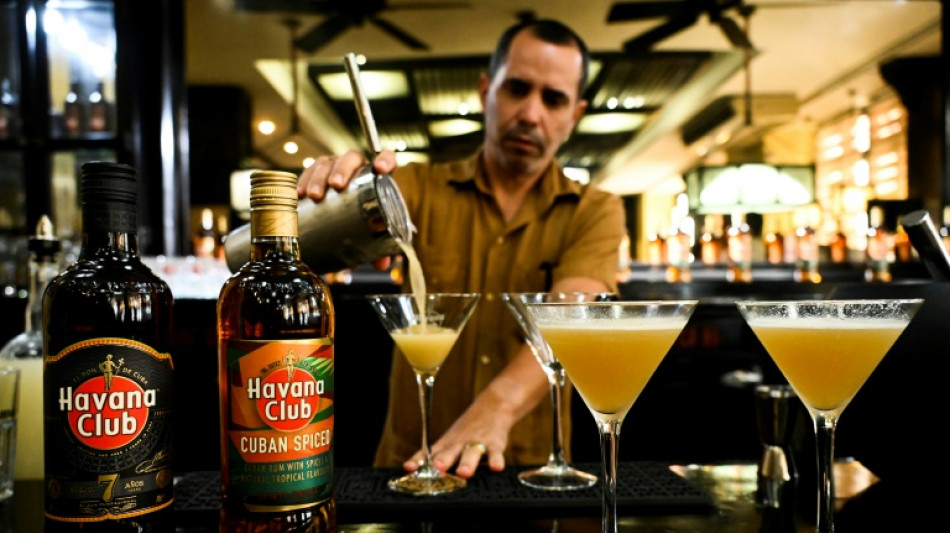
New twist in US-Cuba trademark fight over Havana Club rum / Photo: YAMIL LAGE - AFP/File

 'Vande Mataram': Why is India's freedom song in spotlight?

 Counterculture pop artist Peter Max dies at 88: US media

 Asian Games chief defends 'functional' rooms after backlash

 Leader's sister says only 'idiots' think N. Korea to give up nukes
 World's water cycle becoming more unpredictable, UN warns

 Where the US-China tariff row stands ahead of White House summit
 Croc-habitat gets green light for 2032 Olympic rowing
 Indonesia cash-for-photos scheme turns animal hunters into protectors
 'Left-field' life: Briton becomes Thailand's top foreign monk
 India's transgender amendment leaves many in limbo
 Trump to host Xi amid pomp, low expectations
 Harry set for UK public outings with security, royal status hazy

 NFL Chiefs' Kelce among investors bilked in Ponzi scheme
 Trump threatens EU over 'hostile' Canada association plan

 Argentine judge orders suspension of Falklands oil project
 Carrick takes the blame as troubled Man Utd suffer League Cup misery
 Barcelona hit seven in Racing Santander rout
 Amorim's Milan beaten by Benfica, Sunderland make dream European return

 US stocks fall, dollar gains after Fed lifts interest rates

 Seahawks rule out Darnold for Sunday game at Arizona
 Mbappe explains Ceuta shirt stance after criticism
 Improving Atletico cruise to comfortable win over Osasuna

 Candidate for UN chief calls for AI regulation akin to nuclear weapons
 O'Neill expects Celtic recovery after Old Firm misery
 Man City midfield trio backed to emulate Rodri and Silva
One rum, two owners: the decades-long legal battle between the Cuban government and spirits giant Bacardi over the popular Havana Club rum brand has entered a new phase with the enactment of a new US trademark law.
Entitled "No Stolen Trademarks Honored in America Act" and signed into law last month by outgoing US President Joe Biden, it prohibits US courts from recognizing trademarks that were "illegally confiscated" by the Cuban government since the 1959 Cuban Revolution.
The law cements Bacardi's rights to Havana Club and could prevent Cuba's state-owned Cubaexport and its French partner, beverage giant Pernod Ricard, from asserting their rights to the brand in the United States.
While Cuba currently cannot export its rum to the United States because of a decades-long trade embargo, the government in Havana and Pernod Ricard believe that maintaining trademark rights to the iconic drink is important in case restrictions are lifted.
The law, which was championed by incoming Secretary of State and Cuba hardliner Marco Rubio, was swiftly criticized by the government of the Communist island, which said that it violates international norms.
"Once again, the United States government provides space for the dark interests of the most aggressive anti-Cuban sectors whose manipulation of the American political system has become a practice," the government said in a recent statement.
Bacardi, which was exiled from Cuba after the country's Communist revolution, says that the Cuban government unlawfully seized rum distilleries and the Havana Club brand from its founder Jose Arechabala SA in 1960.
But the Cuban government has maintained its rights to the brand and has marketed Havana Club worldwide, with the exception of the United States because of the embargo Washington imposed in 1962.
In 1976, Cuba managed to assert its rights to the brand in the United States, until Bacardi contested it in 1995 and started selling its own rum in the United States under the Havana Club brand.
- Booming market -
The legal fight is unlikely to subside because the rum industry is booming.
According to a recent report by Dublin-based consultancy Research and Markets, the global rum market is expected to grow at an average rate of 7.7 percent per year over the next six years, jumping from $19.1 billion in 2024 to $32.2 billion by 2031.
In 2016, the United States Patent and Trademark Office (USPTO) renewed Cubaexport's registration of the Havana Club brand for ten years, but the enactment of the law is likely to complicate its renewal in 2026.
John Kavulich, director of the New York-based Cuba-US Trade and Economic Council described the law as "an immensely cost-effective" lobbying effort for Bacardi.
"Most significantly was the complete lack of opposition -- even from the most vocal members of the United States Congress who support commercial, economic, financial, and political re-engagement with Cuba," Kavulich said to AFP.
After the brief thaw in US-Cuban ties that began under Barack Obama (2009-2017) and the strengthening of sanctions during Republican Donald Trump's first presidency (2017-2021), which largely remained unchanged under Democrat Biden, tensions with Havana could rise further under Trump's second term.
L.AbuTayeh--SF-PST