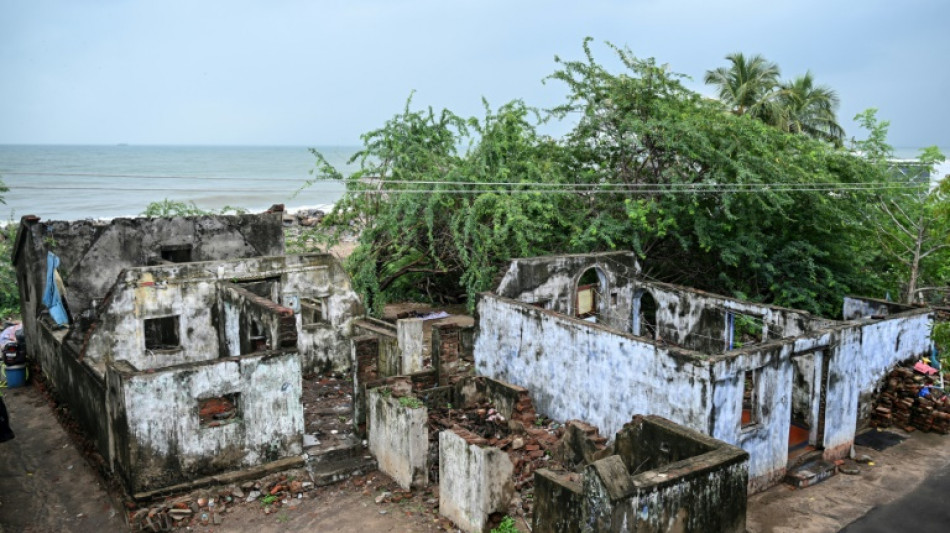
Storm fears overshadow India coast decades after tsunami / Photo: R. Satish BABU - AFP

 'A disaster' if Man City do not win says Maresca after flawless start

 Kerry James Marshall: American 'blackness' painter celebrated in Europe

 Spain coach De la Fuente offers 'full support' to people of Ceuta

 Russia seizes assets of Nestle, French firms over West's Ukraine support
 England can build on World Cup 'spirit', says Tuchel

 UNESCO can be 'moderator' in AI debate: chief to AFP

 Infantino 'must go', says German FA vice-president

 Russia seizes assets of Nestle, French firms

 Japan's busiest rail station tests robot bins

 Anthropic says AI systems moving towards building themselves

 Asian stocks boosted by falling oil, yen weakens after BoJ rate hike
 Pakistan court blocks expulsion of Afghan medical college students

 Athletes 'can't take it any more' as Asian Games issues mount

 Allen lights up Bills' new stadium with 41-31 win over Lions

 Afghan medical students in Pakistan hope court stops college expulsions

 AI doomsday warnings unlikely to slow IPOs but questions linger

 ICC eyes China in bid to expand cricket
 Nkunku craving freedom and fun on RB Leipzig return

 Bhutan's traditional archers lose ground to development
 Asian stocks track Wall St rally as oil prices drop

 South Korea makes Asian Games complaint over Japan warlord ceremony

 US aid cuts are killing Kenyan sex workers

 October 7 survivors, families take centre stage in Israel vote
 Captain Mat Ryan axed from Socceroos squad for Brazil games

 US approves sale of 48 F-35 jets to Saudi Arabia

The deadly tsunami that swamped India's southern coast two decades ago was a one-off disaster, but storms that are growing ever more intense spark panic each time howling gales whip up waves.
Maragathavel Lakshmi shudders when she hears lashing rains or winds, recalling how her daughter was swept away when the 2004 tsunami, triggered by a huge earthquake off Indonesia, crashed onshore almost without warning.
"Weather alerts have made life easier, but the fear of what a heavy rain or strong wind might bring is still there," 45-year-old Lakshmi said.
More than 220,000 people were killed as the devastating waves hit shorelines around the Indian Ocean, including 16,389 in India, according to the international disaster database EM-DAT.
Fear of the weather is based on a very real threat -- and the risks are increasing.
Dangerous cyclones, the equivalent of hurricanes in the North Atlantic or typhoons in the northwestern Pacific, are an annual menace.
Better forecasting and more effective evacuation planning have dramatically reduced death tolls, but scientists say human-driven climate change is intensifying their power.
"Summers are very harsh now and rains are heavier," Lakshmi said, saying weather alerts sent her anxiety soaring.
A warmer atmosphere holds more water, meaning rains are heavier.
"Strong winds scare us," said her husband Maragathavel, who like many in the region goes by only one name.
"Every time it rains heavily, water (floods) our area," the 49-year-old fisherman added. "It seems on those days that the sea has still not left us."
- 'Very afraid' -
The December 26, 2004 disaster was not caused by climate change but by a 9.1 magnitude earthquake that struck off Indonesia's Sumatra.
Hours later, Lakshmi heard a loud rumble and then saw enormous waves -- rising as high as 40 metres (130 feet) -- approaching her neighbourhood on the shore in Akkaraipettai, their village in Tamil Nadu state.
Lakshmi showed a photograph of her daughter Yashoda, who her father had been looking after for the day next door when the waves struck.
"She would have been 22 years old now," Lakshmi said tearfully.
The 45-year-old remembers people getting swept away or holding on to whatever they could.
"Some people were naked or barely had any clothes left on them," she said.
The tsunami also hit the chain of Andaman and Nicobar islands, where at least 4,000 people were killed. The victims included 109 Indian air force pilots, crew and around 40 of their relatives.
At least 870,000 people were left homeless in India.
Many, like Lakshmi, were moved to new settlements inland.
Their neighbour, fisherman P. Mohan, 46, said weather alerts still gave him shivers of fear.
"If I see some warning about the weather, I do not even step out of the house," he said.
"Until the rains or cyclone -- whatever is the warning -- comes and goes away, I am very afraid."
- 'Cannot control nature' -
Mohan had a rod put into his leg after being injured in the tsunami, which also killed his mother.
Neighbours had last seen her sitting beside the sea when the waves hit.
He could not identify her from the "swollen and disfigured" corpses laid out for identification in the days after the tsunami.
"Was she buried along with other people who could not be identified? Is her body still in the sea?" he asked. "I do not know."
A few friends told him that they might have seen his mother's body amid other unidentified corpses.
It took him a decade to fully accept her loss and hold symbolic final rites.
A seawall made of concrete and bricks of homes destroyed by the tsunami now divides land from water.
Villagers hold prayers each day at a temple to a Hindu deity believed to protect them from the sea.
But Mohan said he now simply accepted his fate.
"God cannot control nature," he said. "What has to come, will come."
I.Matar--SF-PST