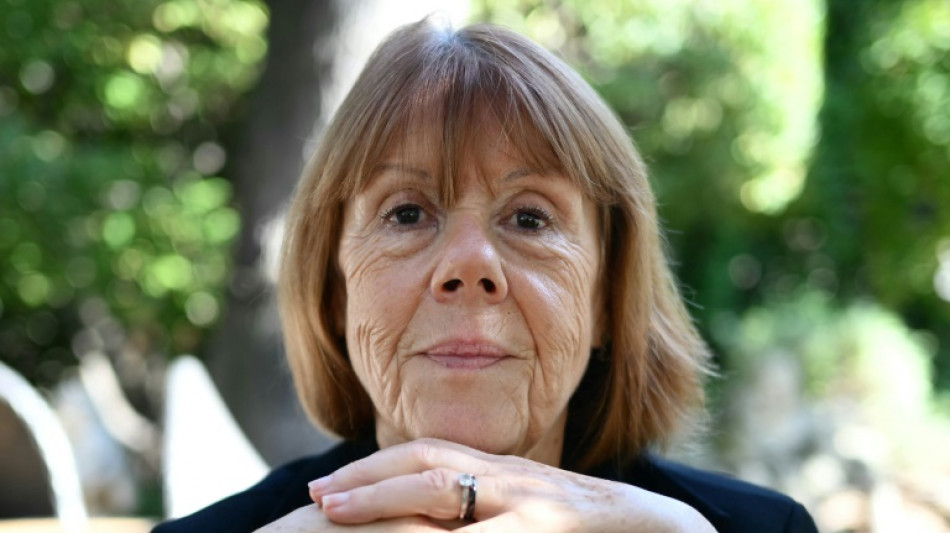
'Ordinary and out of the ordinary': covering France's mass rape trial / Photo: Christophe SIMON - AFP

 'A disaster' if Man City do not win says Maresca after flawless start

 Kerry James Marshall: American 'blackness' painter celebrated in Europe

 Spain coach De la Fuente offers 'full support' to people of Ceuta

 Russia seizes assets of Nestle, French firms over West's Ukraine support
 England can build on World Cup 'spirit', says Tuchel

 UNESCO can be 'moderator' in AI debate: chief to AFP

 Infantino 'must go', says German FA vice-president

 Russia seizes assets of Nestle, French firms

 Japan's busiest rail station tests robot bins
 Anthropic says AI systems moving towards building themselves
 Asian stocks boosted by falling oil, yen weakens after BoJ rate hike
 Pakistan court blocks expulsion of Afghan medical college students
 Athletes 'can't take it any more' as Asian Games issues mount

 Allen lights up Bills' new stadium with 41-31 win over Lions

 Afghan medical students in Pakistan hope court stops college expulsions
 AI doomsday warnings unlikely to slow IPOs but questions linger

 ICC eyes China in bid to expand cricket

 Nkunku craving freedom and fun on RB Leipzig return

 Bhutan's traditional archers lose ground to development

 Asian stocks track Wall St rally as oil prices drop

 South Korea makes Asian Games complaint over Japan warlord ceremony

 US aid cuts are killing Kenyan sex workers

 October 7 survivors, families take centre stage in Israel vote

 Captain Mat Ryan axed from Socceroos squad for Brazil games

 US approves sale of 48 F-35 jets to Saudi Arabia

France's trial of a man who drugged his wife so dozens of strangers could rape her while unconscious has been both ordinary and extraordinary, AFP journalists who have been covering it say.
Details of the case have horrified audiences in France and abroad since the trial began on September 2, drawing renewed attention on the widespread crime of rape and the issue of consent.
But it has also catapulted its main victim, 72-year-old Gisele Pelicot, into the limelight as a feminist hero demanding a patriarchal society change its attitude to sex crimes.
Dominique Pelicot, 72, has admitted sedating his then wife with sleeping pills from 2011 to 2020 so that men he recruited online could rape her in her own bed, meticulously documenting the abuse in video footage.
As the court case draws to a close with verdicts expected on Thursday, the AFP journalists who have been covering it say it has raised questions both about gender relations and how to report sensitively on horrific abuse.
Video journalist Viken Kantarci remembers the first day of the trial.
"Gisele Pelicot turned up and we knew that she, like us, was discovering all these faces -- the faces of the men who had raped her -- for the first time," said Kantarci, who covered the story with colleague Fabien Novial for AFPTV.
"We were soon plunged into the atmosphere of what the trial would be: something both quite ordinary, in terms of the type of people we were seeing, but also out of the ordinary because of how many of them there were and the extent of the alleged crimes," he said.
Beyond Dominique Pelicot, the other accused aged 27 to 74 have hailed from all walks of life, and included an unemployed man, a truck driver, a journalist, a firefighter, an engineer and an electrician.
All are accused of raping, attempting to rape or in one case touching Gisele Pelicot, except for one who has been charged with repeatedly abusing his own wife after drugging her with Dominique Pelicot's help.
Several have admitted rape but many have maintained Dominique Pelicot manipulated them and they thought they were taking part in a couple's fantasy.
- 'Anonymous victim to hero' -
Many had expected the trial to be held behind closed doors.
But Gisele Pelicot demanded on its first day that hearings be open to the public. She argued that it should be up to abusers -- not victims -- to feel shame.
David Courbet, one of AFP's text journalists who has been reporting from inside the courtroom, said that decision changed everything.
Gisele Pelicot's choice "enabled the trial to exist and, hopefully, leave its mark on history", he said.
AFP initially only used the main victim's first name and the initial of her last name to protect her family's privacy.
But after she spoke to the media three days into the trial, saying she would fight her corner until the end, the news agency decided to publish her full surname with the consent of her family's lawyers.
While Gisele Pelicot has since divorced her husband and reverted to using her maiden name, she has decided to use the surname carried by some of her children and grandchildren during the trial.
"She went from anonymous victim to hero, carrying a political, universal message," Courbet said.
As news of the trial spread, Gisele Pelicot, her fringed bob haircut and round sunglasses inspired art and messages of support in Avignon and other French cities but also abroad.
The town of Avignon started to beat to the rhythm of the trial, with repeated feminist protests outside the courthouse and restaurants often fully booked for lunch.
Journalists soon learnt who ate where: which restaurants served the civil parties, and which fed the defendants.
"From just a few cameras at the start of the trial, other French and foreign crews then started arriving in the following days," said video journalist Kantarci, listing British, US and Spanish media in particular.
In the hall outside the courtroom, they rushed in every day to catch images or soundbites as civil parties, defendants and their lawyers made their way to and from hearings.
From as early as 5:45 am -- two and a half hours before the courthouse opens its doors -- members of the public have been standing outside to try to nab one of around 30 seats in a single room transmitting hearings via videolink, sometimes without success.
- Photographer in awe -
Barred from the courtroom itself, AFP photographers and video journalists have tried to capture a sense of the proceedings from the margins, through capturing the chants of support to Gisele Pelicot outside court, speaking to villagers in Mazan where the Pelicots used to live as well as to sociologists.
Inside court, Benoit Peyrucq has been sketching those taking the stand or sitting in the dock. His sketches of Dominique Pelicot have been among the most popular with AFP clients.
Just outside, AFP has seen Gisele Pelicot arriving with her head held high to be greeted by applause or even bunches of flowers, while her alleged abusers have sought to avoid cameras, concealing their features under hoodies, baseball caps or surgical face masks.
Kantarci, the video journalist, said several had even been "aggressive towards the media".
Photographer Christophe Simon, who has been with AFP for four decades, said the trial had required more sensitivity than other stories.
"We gave Gisele Pelicot and her family a lot of space because we could imagine what they were going through," he said.
Instead, day after day, he said, he built up a relationship with Gisele Pelicot and her lawyers, greeting them and exchanging pleasantries.
"One day I even tripped and she helped me get up," he said.
On October 23, her lawyers agreed for him to take her portrait. She has not accepted any other such request since.
They met in the early afternoon in the garden of the hotel where she was staying.
The veteran war reporter told Gisele Pelicot he was greatly "impressed" by her courage.
"She looked surprised and interested," said the photojournalist, whose portrait of Gisele Pelicot staring straight into his lens has since been published around the world.
- Troubling footage -
As AFP's then-bureau chief for the southern city of Marseille and surrounding area including Avignon for most of the trial, Isabelle Wesselingh coordinated much of its coverage with her deputy chief Olivier Lucazeau.
"The repeated rape of a woman is really shocking, and you also realise the extent to which the case has ripped a family apart," she said.
But also "we had to keep in mind that a trial requires a two-sided debate, fair coverage of the defence's point of view, and a certain questioning of things -- all without underplaying the suffering".
Following AFP guidelines on covering sexual abuse, the team prepared by discussing the best language "to avoid voyeurism and remember the dignity of victims while covering incidents that were sometimes really vile", she added.
Text journalists also discussed how to prevent post-traumatic stress with AFP's work doctor before the trial started.
This was especially useful after judges, at the request of the civil parties, allowed reporters and members of the public to watch the graphic videos Dominique Pelicot filmed of strangers abusing his wife.
David Courbet says he realised watching the footage how important it was for it to be seen.
"They speak for themselves," he said.
To cope with their brutality, he said, he tried to focus on the wallpaper or the news bulletin you could hear on in the background.
Philippe Siuberski, another text reporter who covered the trial, said Gisele Pelicot "was sleeping, unresponsive".
"You could clearly hear snoring," said the journalist normally based in the southern city of Montpellier.
"We do our job as journalists. But it's not always very nice to be a witness," he said.
"I would watch two to three seconds (of the footage) then return to my notes, or look to see how Dominique Pelicot or Gisele Pelicot were reacting," he said.
"More than the words, it's the images that stay with you," said the journalist who also covered the 2004 trial of Belgian child rapist and murderer Marc Dutroux.
- 'Thank her' -
Due to staff availability, it was mostly men who covered the mass rape trial for AFP.
"Ideally it would have been good to have a man and a woman, but we had to plan according to who was available and who might be reluctant due to the nature of the case," said Wesselingh.
But she said it was "interesting to have men confront these questions about masculinity and the behaviour of 50 ordinary men," she said.
Courbet, the text reporter, said he hopes the trial will help men to "think more about consent".
"The trial has forced us men to think about our past, present and especially future behaviours," he said.
His colleague Siuberski said he was mostly impressed by Gisele Pelicot's strength in "never veering from what she wanted to say", though she could so easily have been overwhelmed by what happened.
Kantarci, the video reporter, said it was difficult not to be moved by all Gisele Pelicot had achieved.
"As a journalist I probably shouldn't, but I want to thank her," he said.
L.AbuAli--SF-PST