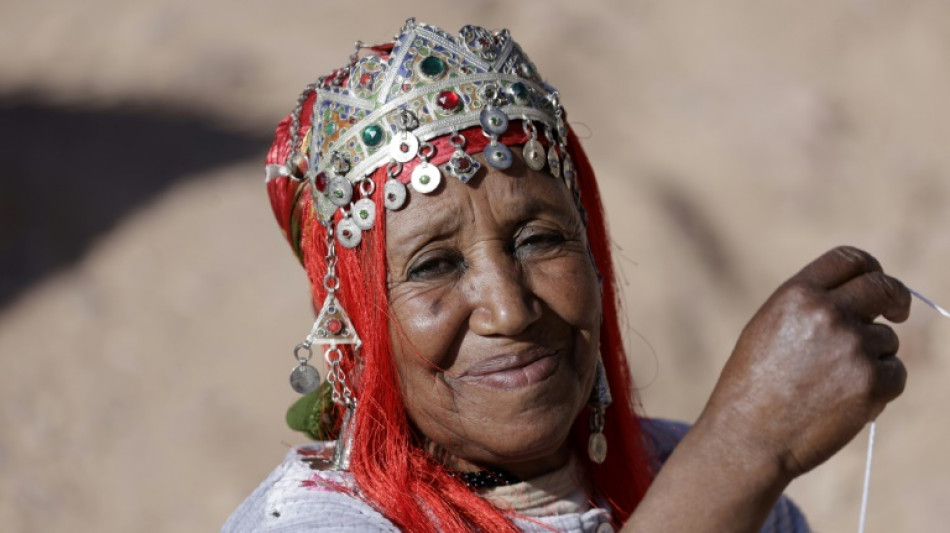
Morocco's women rug weavers battle to save age-old craft / Photo: - - AFP

 Macron warns of Russian 'hybrid' threat after meeting presidential hopefuls

 UN holds third informal poll for new chief

 Kulusevski return can spark Spurs: De Zerbi

 Shakira to cap off world tour with Madrid 12-gig run

 Isolated Syrian-Druze city blames Damascus for shortages

 Isolated Syrian-Druze city shortages
 Dutch drop Depay for Germany match in Xavi's first pick

 Ronaldo named in Portugal squad for Nations League

 Stock markets diverge after central bank rate hikes

 Anti-Assad music star makes triumphant return to Syria

 In-form Fernandez included in Spain Nations League squad

 Arteta buries hatchet with Hurzeler ahead of Brighton clash

 Alexander-Arnold and Palmer return to England squad for Nations League

 Russians vote as Ukraine war drags on for fifth year

 Backpackers fret over Australian visa crackdown

 Most Asian stocks track Wall St rally, yen drops after BoJ rate hike

 Russians begin voting in controlled election as war drags on

 Trump 'clearly' wants dialogue with Pyongyang: South Korean President

 Bank of Japan hikes rates to 31-year high to battle inflation

 Thailand's Muslim separatists vow to fight to the end

 Mideast turmoil, AI set to dominate UN gathering of world leaders

 Australia to detain tourists who overstay visa, minister says

 Championship rivals brace for renewal of bitter feuds
 In Brazil's Amazon, the hunt for oil fuels hopes and fears

 Australian athlete who soiled herself apologises for continuing Hyrox race

In southern Morocco, women are the guardians of the age-old craft of carpet weaving, an intricate art form that often leaves them with meagre earnings.
Women like Ijja Benchri, who creates carpets on a wooden weaving loom outside her small home in the village of Taznakht, follows traditions going back many generations.
"I started when I was 11 or 12, imitating the women I saw weaving," said Benchri, 60.
"Little by little, I learnt, and it became my life's work."
Known for their bold geometric patterns and vibrant colours, the handwoven rugs are a fixture in local markets and a favourite among tourists.
In 2022, traditional carpets accounted for nearly 22 percent of the kingdom's artisan exports, according to government data.
The mountain villages around Taznakht are famous for their Ait Ouaouzguite carpets, named after a native Amazigh tribe, one among a grouping of several communities indigenous to North Africa long referred to as Berbers.
The carpets are woven by the women on small traditional looms, either at home or in specialised workshops.
They are then categorised into various styles, depending on their region of origin and their designs.
Some of Morocco's finest rugs are crafted from high-quality sheep wool in Jbel Sirwa just south of the Atlas Mountains, and dyed using natural pigments from plants like henna, pomegranate peels, or indigo.
Though industrial dyes have replaced natural ones for most weavers because they are cheaper and can be produced more quickly.
"This tradition has been handed down for centuries, from mothers to daughters," said Safia Imnoutres, who leads a local women's weaving cooperative.
She was one of the women showcasing their creations at a recent festival in Taznakht dedicated to safeguarding the heritage.
- 'Comes from within' -
Creating a single carpet can take two to four weeks depending on its size, said Benchri, speaking in Tamazight, the community's language recognised as an official language alongside Arabic in Morocco.
"I choose the colours as I go, according to my feelings," she added.
Imnoutres also described the process as "instinctive", guided by emotion rather than a predetermined design.
"Weaving is an expression of the women's feelings, when they are joyful, when they are melancholic," she added. "It's an art that comes from within."
But beyond its artistic value, weaving is a vital source of income.
Every Thursday, many travel to a weekly market to sell their rugs, often to middlemen who set the prices.
On average, a large rug sells for just 250 Moroccan dirhams (around $24), with its final price later raking astronomical profits.
In cities like Marrakech, some 250 kilometres (160 miles) north of Taznakht, they are sold in bazaars for up to ten times the original price.
Other rugs are listed at up to $6,000 on online platforms.
"We earn very little," said Benchri. "The intermediaries decide the price, and we have no choice but to accept it because this is our livelihood."
These diminishing returns, she added, have contributed to making the craft less attractive for younger women and jeopardising the handcraft tradition.
Additionally, the influx of cheaper, machine-made rugs has deepened competition.
To address these challenges, a new exhibition space in Taznakht allows some weavers to sell their work directly to buyers, cutting out middlemen.
The centre also tries to open new avenues for these women to sell their products independently through courses in digital marketing.
"If this heritage isn't made financially viable, we risk losing it," Imnoutres warned.
R.AbuNasser--SF-PST