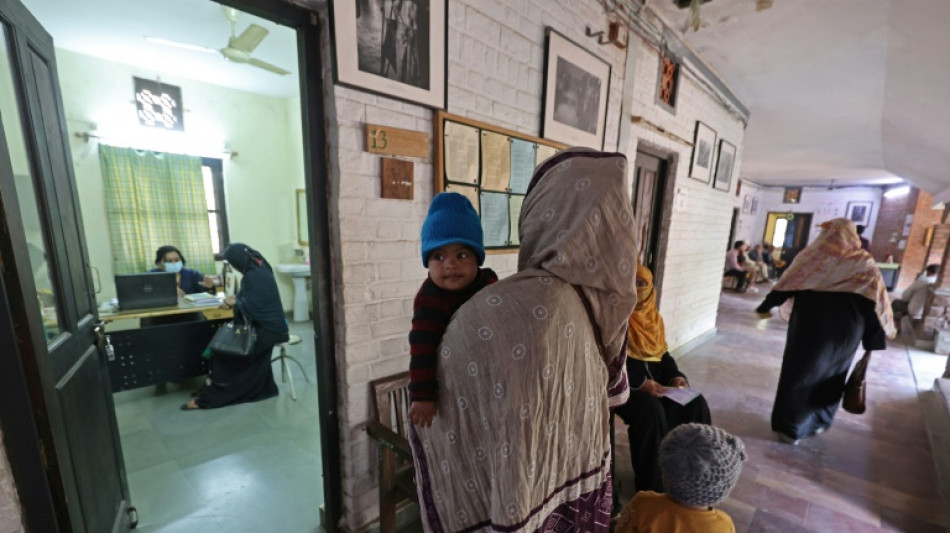
Four decades of horror after India's Bhopal gas disaster / Photo: Gagan NAYAR - AFP

 Crisis-wracked Volkswagen warns of 10-bn-euro hit to profits

 Costa Rica's Grynspan tops third informal poll for UN chief: diplomat

 Stock markets retreat after central bank rate hikes
 Russia labels director of Cannes Grand Prix winner a 'foreign agent'

 Macron warns of Russian 'hybrid' threat after meeting presidential hopefuls

 UN holds third informal poll for new chief

 Kulusevski return can spark Spurs: De Zerbi

 Shakira to cap off world tour with Madrid 12-gig run

 Isolated Syrian-Druze city blames Damascus for shortages
 Isolated Syrian-Druze city shortages
 Dutch drop Depay for Germany match in Xavi's first pick

 Ronaldo named in Portugal squad for Nations League

 Stock markets diverge after central bank rate hikes

 Anti-Assad music star makes triumphant return to Syria

 In-form Fernandez included in Spain Nations League squad

 Arteta buries hatchet with Hurzeler ahead of Brighton clash

 Alexander-Arnold and Palmer return to England squad for Nations League

 Russians vote as Ukraine war drags on for fifth year

 Backpackers fret over Australian visa crackdown
 Most Asian stocks track Wall St rally, yen drops after BoJ rate hike
 Russians begin voting in controlled election as war drags on
 Trump 'clearly' wants dialogue with Pyongyang: South Korean President

 Bank of Japan hikes rates to 31-year high to battle inflation
 Thailand's Muslim separatists vow to fight to the end

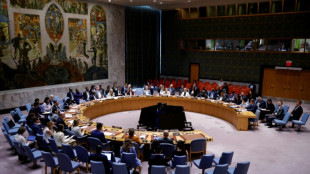 Mideast turmoil, AI set to dominate UN gathering of world leaders

Just after midnight as poisonous plumes of smoke wafted through the Indian city of Bhopal four decades ago, Gas Devi was born, gasping for every breath.
Her feeble cries were drowned out by the screams of men, women and children as they ran to escape the cloud of highly toxic gas leaking from the Union Carbide factory on the night of December 2, 1984.
Some 3,500 people were killed in the immediate aftermath, and up to 25,000 are estimated to have died overall in the world's deadliest industrial disaster.
Forty years later, the horror continues to blight the lives of those like Devi -- as well as countless others born with deformities since that fateful night.
Devi, a daily wage labourer, has constant pain in her chest, one of her lungs is not developed fully and she keeps falling sick.
"My life is a living hell," Devi told AFP, speaking at her shanty in Bhopal, the capital of the central state of Madhya Pradesh.
Even if she wanted, she cannot forgot the night she was born.
"My parents named me Gas," she said, her eyes welling up. "I believe this name is a curse. I wish I had died that night".
Twenty-seven tonnes of methyl isocyanate (MIC), used in the production of pesticides, swept through the city of over two million people after one of the tanks storing the deadly chemical shattered its concrete casing.
As the white cloud of MIC shrouded areas close to the factory, people started collapsing in the streets.
Nathuram Soni, now 81, was among the first to rush out.
"People were frothing from their mouths. Some had defecated, some were choking in their own vomit," said Soni.
A handkerchief tied over his nose, Soni used his pushcart to carry his wailing neighbours, many of them infants, to hospital.
- Unrelenting tragedy -
Rashida Bee, co-founder of the Chingari Trust charity that offers free treatment to children of gas-affected families, believes those who died were fortunate.
"At least their misery ended," she said. "The unfortunate are those who survived".
Her trust has seen more than 150 children being admitted this year alone with cerebral palsy, hearing and speech impairments and other disabilities.
She blames the disorders on the accident and the contamination of the groundwater.
Testing of groundwater near the site in the past revealed cancer- and birth defect-causing chemicals 50 times higher than what is accepted as safe by the US Environmental Protection Agency.
"This tragedy is showing no signs of relenting," said Rashida, 68, who has lost several members of her family to cancer since the accident.
"The soil and water here are contaminated -- that is why kids are still being born with deformities."
Union Carbide, which was acquired by the Michigan-based Dow Chemical Company in 2001, routinely dumped chemical waste years before the disaster, campaigners say.
Large evaporation ponds outside the factory were filled with thousands of litres of liquid waste.
Toxins penetrated the soil and the water supplying several neighbourhoods.
Dow Chemical did not respond to AFP's request for comment.
Tasleem Bano, 48, is convinced of a link between the plant and congenital illnesses.
Her son Mohammed Salman's limbs were splayed when he was born.
"His twin brother died in the womb. Salman survived but he could not speak a word till he was six years old," she said, showing her son's braces that help him to stand.
"Doctors say he is like this because of the gas," said Tasleem, who inhaled the fumes as a young girl living close to the factory.
Salman, 12, could only respond with a toothy grin when asked his name.
Like Salman, hundreds of children at the Chingari centre struggle to speak, walk or eat their meals.
- 'Corporate massacre' -
At the nearby Sambhavna Trust clinic, there is a steady queue of gas survivors seeking treatment.
"Data very clearly shows that mortality in the exposed population compared to a matched controlled (population) is much higher," said Satinath Sarangi, founder of Sambhavna.
"In 2011, we'd taken stock through our registered cohorts and we found there was 28 percent more mortality among the gas exposed."
Sarangi, 70, said the MIC fumes damaged the immune system of affected populations and caused chromosomal aberrations, something corroborated by medical research.
"Children of gas-exposed parents have much higher prevalence of congenital malformations."
In 1989 Union Carbide, in a partial out-of-court settlement with the Indian government, agreed to pay $470 million in compensation to the victims.
But the victims themselves were not consulted in the negotiations, and received just $500 each.
The current owners have refused to pay further compensation for the catastrophe that continues to unfold till this day.
In 1991, Warren Anderson, Union Carbide chairman and chief executive at the time of the disaster, was charged in India with "culpable homicide not amounting to murder".
But he never stood trial. Anderson died aged 92 in a nursing home in Florida in 2014.
A plea seeking compensation of 500,000 rupees ($5,920) from the Indian government for each victim diagnosed with cancer or kidney ailments is languishing in courts.
Rachna Dhingra, a social activist from the Bhopal Group for Information and Action, said true justice still evades the survivors.
"Until today, not a single individual has gone to jail -- even for a day -- for killing more than 25,000 people and injuring half a million people, and contaminating the soil and groundwater," she said.
"People in the city are continuing to fight because there is no legal mechanism to hold these corporations accountable worldwide.
"Bhopal has taught corporations how to get away with murder."
F.AbuZaid--SF-PST