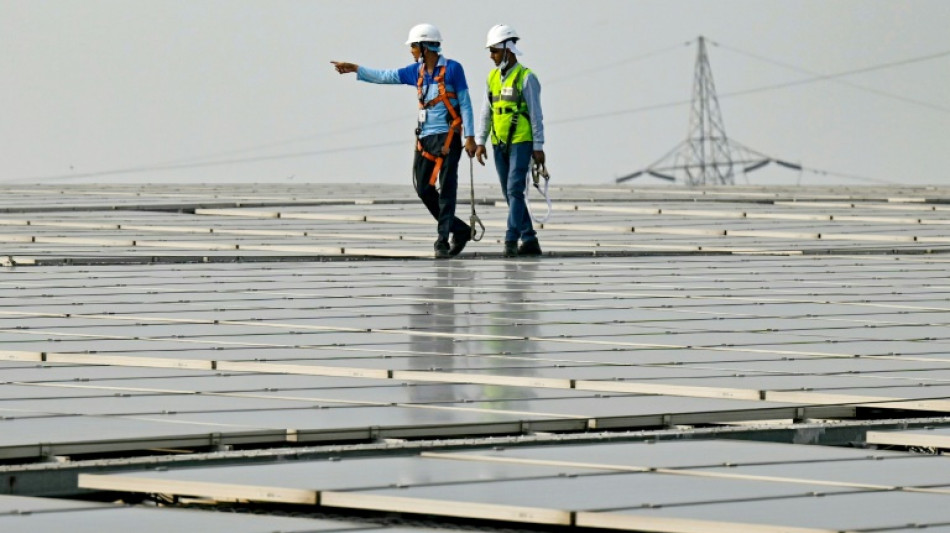
Glittering dreams: India's big push for solar power / Photo: Money SHARMA - AFP/File

 Crisis-wracked Volkswagen warns of 10-bn-euro hit to profits

 Costa Rica's Grynspan tops third informal poll for UN chief: diplomat

 Stock markets retreat after central bank rate hikes

 Russia labels director of Cannes Grand Prix winner a 'foreign agent'

 Macron warns of Russian 'hybrid' threat after meeting presidential hopefuls

 UN holds third informal poll for new chief

 Kulusevski return can spark Spurs: De Zerbi

 Shakira to cap off world tour with Madrid 12-gig run

 Isolated Syrian-Druze city blames Damascus for shortages

 Isolated Syrian-Druze city shortages

 Dutch drop Depay for Germany match in Xavi's first pick

 Ronaldo named in Portugal squad for Nations League

 Stock markets diverge after central bank rate hikes

 Anti-Assad music star makes triumphant return to Syria

 In-form Fernandez included in Spain Nations League squad
 Arteta buries hatchet with Hurzeler ahead of Brighton clash

 Alexander-Arnold and Palmer return to England squad for Nations League

 Russians vote as Ukraine war drags on for fifth year

 Backpackers fret over Australian visa crackdown

 Most Asian stocks track Wall St rally, yen drops after BoJ rate hike

 Russians begin voting in controlled election as war drags on

 Trump 'clearly' wants dialogue with Pyongyang: South Korean President

 Bank of Japan hikes rates to 31-year high to battle inflation

 Thailand's Muslim separatists vow to fight to the end

 Mideast turmoil, AI set to dominate UN gathering of world leaders

Vast lines of solar panels reflect the blazing sun in India's western deserts, a dazzling ocean broken only by bristling wind turbines.
India, along its desolate border with Pakistan, is building what it boasts will be the world's largest renewable power plant, an emblem of a determined push to boost solar energy.
The Khavda plant in Gujarat state consists of some 60 million solar panels and 770 wind turbines spread over 538 square kilometres (208 square miles) -- almost the size of the sprawling megacity Mumbai.
In front of a wall of screens, a handful of operators monitor the machines under the slogan: "Adani Group: Growth with Goodness".
"Today, we can produce up to 11 gigawatts of electricity," said Maninder Singh Pental, vice-president of Adani Green Energy, the subsidiary of Indian conglomerate Adani Group, and in which France's TotalEnergies holds a 20 percent stake.
"In 2029, we will be able to produce up to 30 GW," he added proudly.
At that point, India will break another record, with Khavda overtaking China's 18 GW Three Gorges hydroelectric dam to become the most powerful electricity production site in the world.
The power is sorely needed in the world's most populous nation, where demand has doubled since 2000, driven by demographic expansion, economic growth and rapid urbanisation.
India vows to be carbon neutral by 2070 and as part of that, New Delhi wants its renewable energy capacity to rise from 200 GW -- half of its current energy mix -- to 500 GW by 2030. It hopes 300 GW will come from solar power alone.
The International Energy Agency, in a report this year, said India is "expected to almost triple its 2022 renewable capacity by 2030", maintaining its third place position among the largest renewable energy producers.
- Adani bombshell -
As Prime Minister Narendra Modi speaks of a "solar revolution" panels are popping up across India, from power plants to rooftops.
But Adani Green Energy CEO Sagar Adani said what matters is the scale of production as it is easier and quicker to ramp up the country's baseload with bigger units than smaller ones.
"The country needs a large amount of large concentrated big locations," he said. "You can have 200 projects of 50 megawatts each, nothing is going to happen to India with that."
Adani has vowed to commit $35 billion to renewables by 2030.
However, a bombshell US indictment last week has caused complications, with TotalEnergies freezing all new investments in the conglomerate after tycoon founder Gautam Adani and multiple subordinates were accused of fraud -- charges fiercely denied.
But observers suggest the solar power push will continue.
"It will not impact honest players," a market analyst said, but warned it will "affect Adani's ability to raise funds".
Billionaire Mukesh Ambani's Reliance group has also promised to invest $10 billion in green energy, including a 10GW solar farm in Andhra Pradesh state.
Critically, the cost of solar energy has dropped to become competitive to coal-fired plants, which produce 70 percent of India's electricity.
"It's a good thing," said Ajay Mathur, director of the International Solar Alliance (ISA).
He noted that while "the initial investment is double", power prices per kilowatt hour for solar are now the same or less than from coal plants.
Tejpreet Chopra, from major renewable energy generation giant Bharat Light and Power, said it was "super exciting" to be part of the transition, while accepting there were major hurdles.
"When the cost of energy has come down, the financial return is more and more difficult," he said. "How do you attract capital, investments and technology?"
- Rising power demands -
Government financial incentives are encouraging people to make the switch -- including a factory in the suburbs of New Delhi.
Jubilant Food Works factory employs 500 employees, producing pizzas and pastries for US brands. On its 4,400-square-metre roof, nearly 800 solar panels provide 14 percent of its electricity far cheaper than the grid.
Praveen Kumay from SunSource Energy said his teams installed and maintain the infrastructure.
"For each unit... we are billing them 4.3 rupees, whereas the grid cost is seven rupees," Kumay said.
Factory manager Anil Chandel said it was a "good deal" they aimed to expand to supply 50 percent of power needs.
"We don't have any headache of maintaining it," he said.
The government has also promised to support panels for 10 million homes.
But power demands are rising fast and expected to surge a further 50 percent by 2030.
The existing carbon-hungry system will remain key.
"We need power, and for India, it means coal," said Tejpreet Chopra. "That's the reality of the grid."
Chetan Solanki, of the Energy Swaraj Foundation -- meaning "self-restraint" -- said solar panels come with their own cost of production, in terms of power and chemicals.
"Solar energy is better than coal, but you can't use it blindly," he said, adding that people must also rein in power demand. "We also have to minimise energy consumption."
A.Suleiman--SF-PST