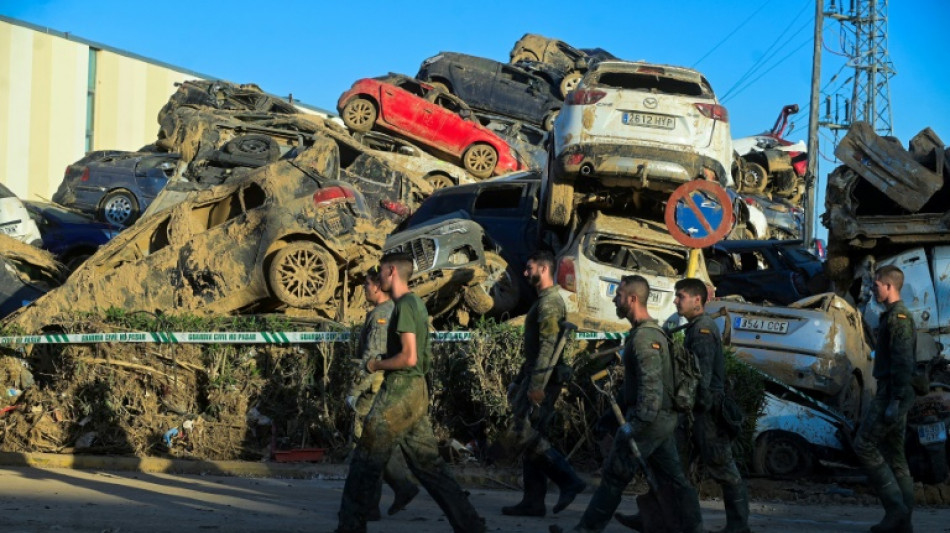
Spain urged to 'build differently' after deadly floods / Photo: JOSE JORDAN - AFP

 Crisis-wracked Volkswagen warns of 10-bn-euro hit to profits

 Costa Rica's Grynspan tops third informal poll for UN chief: diplomat

 Stock markets retreat after central bank rate hikes

 Russia labels director of Cannes Grand Prix winner a 'foreign agent'

 Macron warns of Russian 'hybrid' threat after meeting presidential hopefuls

 UN holds third informal poll for new chief

 Kulusevski return can spark Spurs: De Zerbi

 Shakira to cap off world tour with Madrid 12-gig run

 Isolated Syrian-Druze city blames Damascus for shortages

 Isolated Syrian-Druze city shortages

 Dutch drop Depay for Germany match in Xavi's first pick

 Ronaldo named in Portugal squad for Nations League

 Stock markets diverge after central bank rate hikes

 Anti-Assad music star makes triumphant return to Syria

 In-form Fernandez included in Spain Nations League squad

 Arteta buries hatchet with Hurzeler ahead of Brighton clash

 Alexander-Arnold and Palmer return to England squad for Nations League

 Russians vote as Ukraine war drags on for fifth year

 Backpackers fret over Australian visa crackdown
 Most Asian stocks track Wall St rally, yen drops after BoJ rate hike

 Russians begin voting in controlled election as war drags on

 Trump 'clearly' wants dialogue with Pyongyang: South Korean President

 Bank of Japan hikes rates to 31-year high to battle inflation

 Thailand's Muslim separatists vow to fight to the end

 Mideast turmoil, AI set to dominate UN gathering of world leaders

Spain is racing to reconstruct areas devastated by deadly floods last month but experts have urged a rethink of development with the relocation of buildings away from vulnerable areas.
The worst floods to hit Spain in decades on October 29 killed at least 230 people, covered towns in mud and debris, destroyed bridges, roads and rail lines and submerged cars, mainly in the eastern region of Valencia.
"The degree of destruction and ruin was historic" in the Valencia region, where some 80 towns were hit by torrential rains, according to a report from Spain's Higher Council of Colleges of Architects.
Reconstruction must "be carried out with empathy, technical rigour and a great deal of responsibility," said its president Marta Vall-Llossera.
"With global warming making meteorological phenomena more intense and more frequent, architecture will have an important role to play," she told AFP.
"We're going to have to build differently," she added, recommending a return to "the traditional, compact Mediterranean city".
In Spain's third-largest city Valencia, the regional capital, land has become increasingly built up, making it more vulnerable to flooding since concrete prevents the ground from absorbing water.
In the Valencia suburb of Paiporta, epicentre of the disaster, roads were quickly transformed into torrents of mud that swept away everything in their path.
"We must try to re-naturalise cities, reduce the use of cars, make the cobblestones less hard, more permeable, and better able to withstand the intense heat and torrential rain," said Vall-Llossera.
- 'Forced expropriation' -
A flood risk prevention plan was approved in the Valencia region in 2003 but it is not binding and has no "retroactive effects", said Maria Jesus Romero Aloy, an expert in urban planning law at Valencia's Polytechnic University.
Valencia accounts for just five percent of Spain's territory which is at risk of flooding but has seen 20 percent of the heavy rainfall events recorded over the past decade in the country, according to the plan.
The highest risk of flooding is concentrated in 12 percent of the region -- home to the popular beach resort of Benidorm -- and affects 600,000 people.
In this area, the authorities recommend homes have watertight windows and an internal staircase with roof access to allow for an escape from flash flooding.
But Romero Aloy said there has to be a "rethinking the territorial model and considering removing buildings or installations that face a high risk" of flooding.
Property owners are currently allowed to rebuild on flooded land even in a high-risk zone.
The only way to prevent this is through a "forced expropriation" as happened in 2019 in Onteniente, a municipality some 85 kilometres (50 miles) south of Valencia.
There "a neighbourhood was eliminated" and turned into a floodway, a channel reserved for floodwaters to pass through, said Romero Aloy.
- 'Natural barriers' -
Mayors, however, are "reluctant to expropriate" because it is a "complicated political decision", especially when the country faces a housing shortage, she added.
But a month after the floods "there is a growing awareness among decision-makers," said Federico Jesus Bonet Zapater, an expert in civil engineering, canals and ports who advises the regional government of Valencia.
"Projects to build dams or divert canals, which have been on the table for some time, are finally going to be studied," he added.
Rafael Delgado Artes, an expert in regional planning and risk prevention, recommends creating "natural barriers" such as forests to minimise the damage from floods and "artificial riverbeds to divert rivers away from city centres".
In the centre of Valencia, which was spared the October disaster, the river that runs through the city was diverted after devastating floods in 1957 and in its place stands a popular urban park.
P.AbuBaker--SF-PST