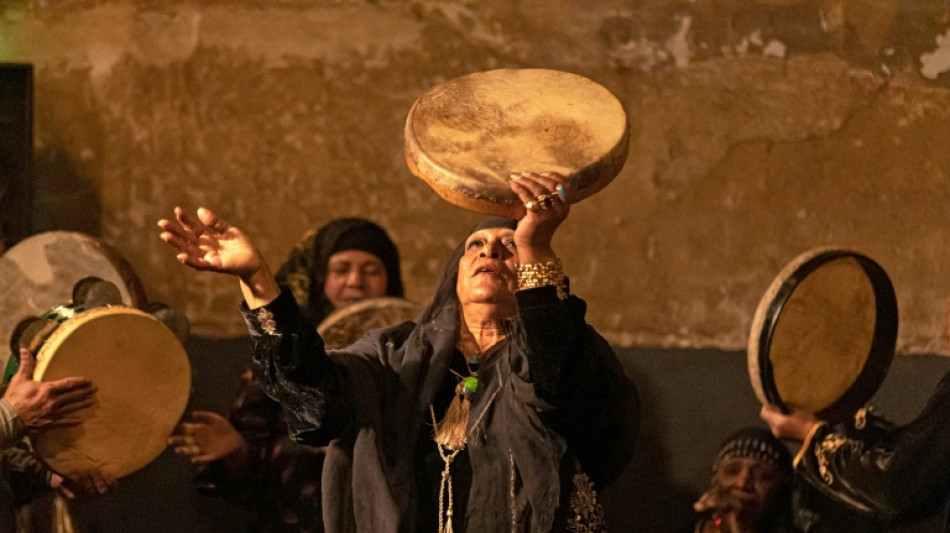
Egypt's ancient 'zar' ritual puts exorcism on stage / Photo: Khaled DESOUKI - AFP

 Seahawks' Darnold gets good news on hip injury: coach

 Evasive Alonso teases reporters on his F1 future
 What to know about Trump's $5,000 'dividend' pledge
 Leclerc concedes he 'went too far' in Hamilton Monza incident
 Shelton, Tiafoe in spotlight as Zverev aims to build on Grand Slam success

 England close in on Test series sweep against sorry Pakistan
 England dominate sorry Pakistan, close in on Test series sweep

 Kung wins Vuelta time-trial as Mas retains lead

 DR Congo school fire leaves at least 14 children dead

 USA and France ease into women's Basketball World Cup semis
 ECB lifts borrowing costs amid energy shock, opens door for more hikes
 France defeat China to reach women's basketball World Cup semis

 Tribal Launches Campfire, Letting Business and Technical Teams Build on Salesforce Together

 Yemen's Houthis seize key city on Red Sea

 US producer inflation tops expectations as diesel costs jump
 Rubio ends South America swing with Peru security talks

 Defiant Iran seeks to bruise Trump ahead of midterms

 France withdraws support for Infantino in FIFA presidential election
 Evolution Metals & Technologies Provides Initial Revenue Guidance of $400-460mm for Fiscal Year 2027

 Clark-led USA thrash Hungary to move into women's World Cup semi-finals

 Vance takes spotlight as Republicans close Trump-heavy convention

 Russian skater Valieva loses neutral status

 Will Israel's right exploit sanctions in run-up to vote?

 'Metal Gear' creator moves to Xbox after Playstation cancellation

 Indonesia rescues six orangutans from fires in a week

A stage, lights, a mesmerised audience: it looks like an Egyptian folkloric concert but Umm Sameh is singing to heal the sick by driving out the demons that possess them.
The music and dance ritual known as "zar", with centuries-old roots in Ethiopia and Sudan, is traditionally performed to ward off or exorcise jinn or evil spirits.
"We're not quacks or witches," said Umm Sameh, aged in her 70s, with kohl-lined eyes, large hoops swaying in her ears and gold bracelets tinkling on her arms.
"The singing is spiritual and brings out negative energies," said the lead singer of the Mazaher ensemble, adding that they also perform prayers from Islam's mystic Sufi practices.
Traditionally, the zar ritual would last several days and include animal sacrifices. But no blood is spilled at Cairo's Makan Cultural Centre, where the group performs to the delight of foreign and local guests.
The audience is bewitched by Umm Sameh's voice and nod their heads to the drumbeat.
In a patriarchal society where women face frequent discrimination, zar ceremonies are among the few cultural practices in which they take centre stage.
Umm Sameh said she learned the ritual from age 11 from her mother and grandmother.
Six decades later, she recites the same lyrics to the same tunes -- all from memory, she adds proudly, because she has "inherited them and grown up with them".
- 'Old healing ritual' -
"Zar is a very old healing ritual, a bit like medical treatment," said Ahmed al-Maghraby, founder of Mazaher, which he says is Egypt's last group to perform zar in public.
He set up the Makan performance space 22 years ago "to preserve this cultural heritage and archive local music from all over Egypt".
It was a tough feat, he said, because zar has historically been derided by devout Muslims as a pagan practice, and rejected by modernising state authorities as a backward rural tradition.
"Middle Eastern and Egyptian society regards everything local with disgust," lamented Maghraby.
He said it was foreign tourists who first brought Egyptians to the shows, who he remembered used to say "No! There's jinn and blood!'"
"For them, the zar was always something sinful."
Ensemble member Abou Samra said "people have a very negative idea of zar because of the movies," in Egypt, long regarded as the Hollywood of the Arab world.
In one of them, 1987 horror movie "Al Taweeza" (The Curse), superstars Youssra and Tahia Carioca contorted themselves, drenched in fake blood, and emitting shrill cries.
But zar is "an art like all other arts," said Abou Samra, who plays the tanboura, a six-string lyre. "We have to let go of these stereotypes."
- New generation -
Times are indeed changing. The ensemble, whose musicians and dancers were all over 60, have brought in a new member.
Azza Mazaher, who grew up watching her mother Umm Hassan do percussion, now also drums and energises the show as she dances across the stage.
Azza said the group now performs in both the old and new ways.
"If someone feels sick and the doctors can't find a treatment, we can hold a ceremony," she told AFP.
"But here, we're performing a light piece of folklore, so people can discover it, understand it and enjoy it."
Mazaher has taken part in several European festivals, and more Egyptians are flocking to their Cairo performances, appreciative of the home-grown artform.
Mariam Essawi, an audience member in her 20s, said: "They look like us, they represent us. Zar is part of our history and our cultural heritage. It's very strange that we don't know it."
G.AbuHamad--SF-PST