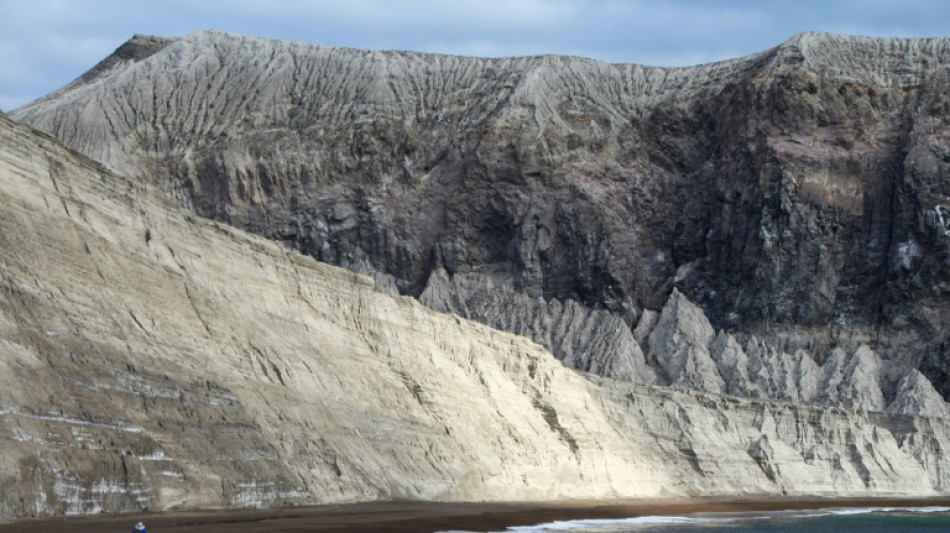
Scientists scour 'Mexico's Galapagos' for quake, volcano clues / Photo: DOUWE VAN HINSBERGEN - UNIVERSITY OF UTRECH/AFP

 Tribal Launches Campfire, Letting Business and Technical Teams Build on Salesforce Together

 Yemen's Houthis seize key city on Red Sea
 US producer inflation tops expectations as diesel costs jump
 Rubio ends South America swing with Peru security talks

 Defiant Iran seeks to bruise Trump ahead of midterms

 France withdraws support for Infantino in FIFA presidential election

 Evolution Metals & Technologies Provides Initial Revenue Guidance of $400-460mm for Fiscal Year 2027

 Clark-led USA thrash Hungary to move into women's World Cup semi-finals

 Vance takes spotlight as Republicans close Trump-heavy convention

 Russian skater Valieva loses neutral status
 Will Israel's right exploit sanctions in run-up to vote?

 'Metal Gear' creator moves to Xbox after Playstation cancellation

 Indonesia rescues six orangutans from fires in a week

 Macron urges Europe to develop 'crewed spaceflight' programme

 Deals worth billions to be signed as UAE leader visits Germany

 Zamanat Targets GCC’s $250 Billion SME Financing Gap With Up to $100 Million Tokenized Private Credit Fund

 Sri Lanka court revokes monk's pardon, orders return to prison
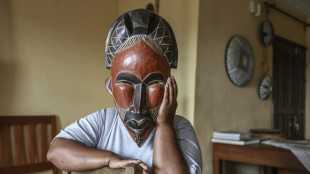 'Hopeless, stuck, afraid': US deportees in limbo in Cameroon
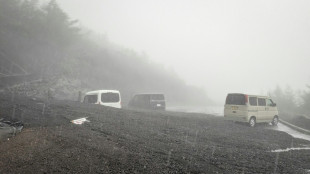 Mount Fuji ends hiking season with landslide, two rescues
 Seahawks beat Patriots again in NFL opener
 Asian Games begin with Qatar basketball win, nine days before opening ceremony

 Stocks sink as oil rally fans inflation and rate hike fears

 Argentine industry reels from Milei's free-market revolution

 Women quit South Korea's grind for diving tradition
 Bayeux Tapestry 'mania' sweeps UK as sold-out exhibition opens
Could a volcanic eruption off Mexico's coast unleash a tsunami like the one that devastated Tonga? What really causes tectonic plates to shift and trigger earthquakes? Scientists visited a remote archipelago in search of answers.
Located in the Pacific Ocean several hundred kilometers from the Mexican coast, the Revillagigedo Islands are known as "Mexico's Galapagos" due to their isolation and biodiversity.
One of the archipelago's volcanos, Barcena, last erupted spectacularly in 1953, and another Evermann, in 1993. Both remain active today.
Located on a mid-ocean ridge, the four islands, which were added to the UNESCO World Heritage list in 2016, are uninhabited apart from navy personnel, and access is tightly restricted.
Getting there takes about 24 hours or more by boat and few civilians visit apart from scuba drivers lured by giant manta rays, humpback whales, dolphins and sharks.
Last month, an international team of 10 scientists carried out a week-long mission whose aims included trying to determine if -- or more likely when -- there will be another volcanic eruption.
"What we're trying to find is how explosive these volcanos can be and how dangerous," said the group's leader, Douwe van Hinsbergen, a professor at Utrecht University in the Netherlands.
- Challenging convention -
The worry is that something similar to the cataclysmic eruption of the Hunga Tonga–Hunga Ha'apai volcano in January could send a tsunami hurtling towards Mexico's Pacific Coast.
"Whenever there are active island volcanos, there are always possibilities of generating tsunamis," said Pablo Davila Harris, a geologist at Mexico's Institute for Scientific and Technological Research of San Luis Potosi.
"What we volcanologists are looking for is when the next eruption is going to happen," using modeling based on previous volcanic activity, he added.
The team also hopes that its analysis of minerals brought up by past eruptions will help to understand the motion of tectonic plates, which cause earthquakes and volcanic activity.
"Plates move over mantle. Is the mantle pushing the plates? Is the mantle doing nothing?" van Hinsbergen said.
According to conventional theory, convection -- the mantle's motion caused by the transfer of heat from the Earth's core to the outer layer -- causes tectonic plates to move and grind against each other.
Van Hinsbergen's hypothesis is that the mantle is in fact "a big lake of rock that is essentially not convecting," which he said would require a complete rethink.
"If that is true, then everything that we see, at least on timescales of tens of millions of years and shorter, is driven by gravity pulling plates down. And that would make the whole system a lot simpler," he said.
The mission received funding from a Dutch program for -- in van Hinsbergen's words -- "ideas that are almost certainly wrong but if they're not they will have big implications."
The samples collected have been taken to Europe for analysis and the results are expected to be known later this year.
D.Qudsi--SF-PST