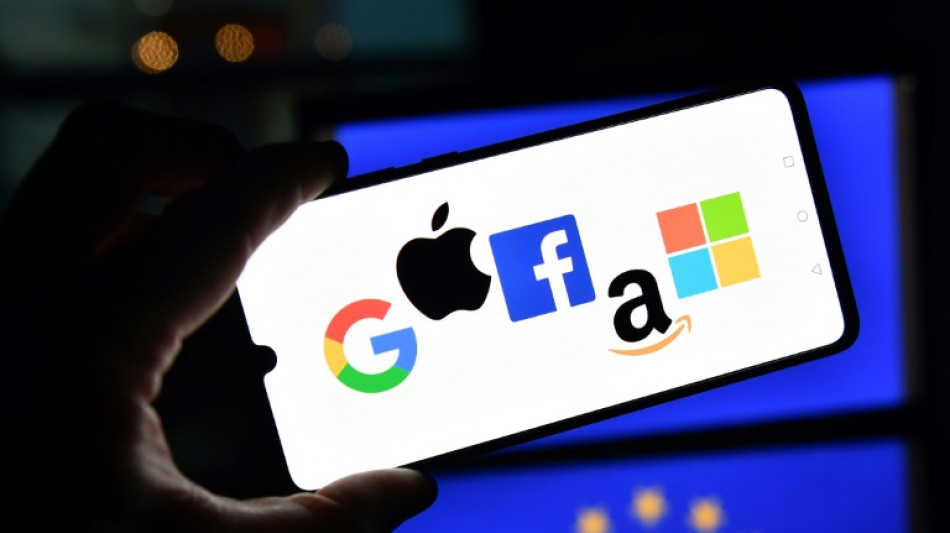
EU agrees deal to tame internet 'Wild West' / Photo: JUSTIN TALLIS - AFP/File

 Tribal Launches Campfire, Letting Business and Technical Teams Build on Salesforce Together

 Yemen's Houthis seize key city on Red Sea

 US producer inflation tops expectations as diesel costs jump

 Rubio ends South America swing with Peru security talks

 Defiant Iran seeks to bruise Trump ahead of midterms
 France withdraws support for Infantino in FIFA presidential election

 Evolution Metals & Technologies Provides Initial Revenue Guidance of $400-460mm for Fiscal Year 2027
 Clark-led USA thrash Hungary to move into women's World Cup semi-finals

 Vance takes spotlight as Republicans close Trump-heavy convention

 Russian skater Valieva loses neutral status

 Will Israel's right exploit sanctions in run-up to vote?

 'Metal Gear' creator moves to Xbox after Playstation cancellation

 Indonesia rescues six orangutans from fires in a week

 Macron urges Europe to develop 'crewed spaceflight' programme

 Deals worth billions to be signed as UAE leader visits Germany

 Zamanat Targets GCC’s $250 Billion SME Financing Gap With Up to $100 Million Tokenized Private Credit Fund

 Sri Lanka court revokes monk's pardon, orders return to prison

 'Hopeless, stuck, afraid': US deportees in limbo in Cameroon

 Mount Fuji ends hiking season with landslide, two rescues

 Seahawks beat Patriots again in NFL opener

 Asian Games begin with Qatar basketball win, nine days before opening ceremony

 Stocks sink as oil rally fans inflation and rate hike fears

 Argentine industry reels from Milei's free-market revolution

 Women quit South Korea's grind for diving tradition

 Bayeux Tapestry 'mania' sweeps UK as sold-out exhibition opens

The European Union early Saturday finalised new legislation to require Big Tech to remove harmful content, the bloc's latest move to rein in the world's online giants.
The Digital Services Act (DSA) -- the second part of a massive project to regulate tech companies -- aims to ensure tougher consequences for platforms and websites that host a long list of banned content ranging from hate speech to disinformation and child sexual abuse images.
EU officials and parliamentarians finally reached agreement at talks in Brussels early Saturday on the legislation, which has been in the works since 2020.
"Yes, we have a deal!," European Commissioner for the Internal Market Thierry Breton tweeted.
"With the DSA, the time of big online platforms behaving like they are 'too big to care' is coming to an end. A major milestone for EU citizens," said Breton, who has previously described the internet as the "Wild West".
"Today's agreement on DSA is historic," European Commission chief Ursula von der Leyen tweeted.
"Our new rules will protect users online, ensure freedom of expression and opportunities for businesses. What is illegal offline will effectively be illegal online in the EU."
The regulation is the companion to the Digital Markets Act (DMA), which targeted anti-competitive practices among tech behemoths such as Google and Facebook and was concluded in late March.
The legislation had faced lobbying from the tech companies and intense debate over the extent of freedom of speech.
Tech giants have been repeatedly called out for failing to police their platforms -- a New Zealand terrorist attack that was live-streamed on Facebook in 2019 caused global outrage, and the chaotic insurrection in the US last year was promoted online.
The dark side of the internet also includes e-commerce platforms filled with counterfeit or defective products.
- Obligations for large platforms -
The regulation will require platforms to swiftly remove illegal content as soon as they are aware of its existence. Social networks would have to suspend users who frequently breach the law.
The DSA will force e-commerce sites to verify the identity of suppliers before proposing their products.
While many of the DSA's stipulations cover all companies, it lays out special obligations for "very large platforms", defined as those with more than 45 million active users in the European Union.
The list of companies has not yet been released but will include giants such as Google, Apple, Facebook, Amazon and Microsoft, as well as Twitter and probably the likes of TikTok, Zalando and Booking.com.
These players will be obliged to assess the risks associated with the use of their services and remove illegal content.
They will also be required to be more transparent about their data and algorithms.
The European Commission will oversee yearly audits and be able to impose fines of up to six percent of their annual sales for repeated infringements.
Among the practices expected to be outlawed is the use of data on religion or political views for targeted advertising.
Former Facebook employee Frances Haugen caused a huge stir last year when she accused her former bosses of prioritising profits over the welfare of users.
She hailed in November the "enormous potential" of the European regulation project, which could become a "reference" for other countries, including the United States.
However, the European Consumer Organisation (BEUC) fears the text does not go far enough.
It wants a ban on all advertising based on the surveillance of internet users, and random checks on online vendors' products.
Q.Bulbul--SF-PST