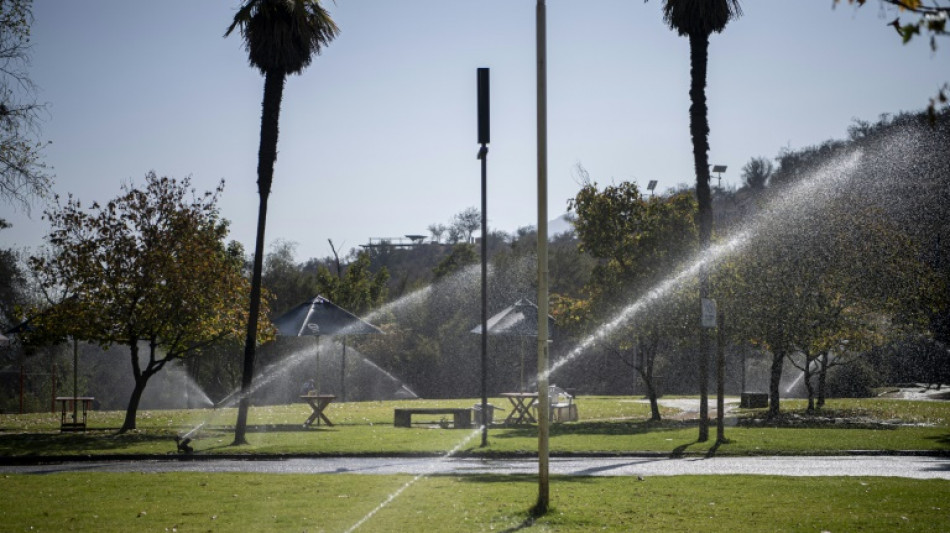
Under shadow of drought, Santiago ditches exotic plants / Photo: Martin BERNETTI - AFP/File

 England turn screw in 3rd Test against Pakistan

 France will not support Infantino in FIFA election: federation chief

 In their words: Israeli forces describe AI-backed Gaza killing in new film

 Yemen's Houthis seize key city on Red Sea: military source

 Oil prices extend gains as markets await ECB rate outlook

 Wars pose a test as India hosts BRICS summit with China, Russia, Iran leaders

 Messi to buy second Spanish lower league club

 Pochettino calls for Chelsea to lose 2016-17 Premier League title

 North Korea leader's daughter believed to have younger sibling: Seoul

 Wars pose a test as India hosts BRICS summit with Russia, Iran leaders

 Zamanat Targets GCC’s $250 Billion SME Financing Gap With Up to $100 Million Tokenized Private Credit Fund

 Stocks drop as oil spike fans inflation and interest rate fears
 Portugal harvests grapes at night to beat the heat
 Philippine ferry fire kills 5, dozens missing

 Oil prices flare as Iran tightens grip on Hormuz

 Japan gymnasts under injury cloud for home Asian Games
 India trailblazer won't 'let go' of chance for Asian weightlifting glory

 Zverev cruises past van de Zandschulp into US Open semis
 Myanmar tin mega-mine restarts operations: think tank

 Online and undercover: saving trafficked wildlife in Thailand
 Antonelli faces new challenge after stirring triumph in Monza

 Korda leads US bid to win first away Solheim Cup since 2015
 Eurozone rate-setters to hike borrowing costs as energy prices jump

 As oceans warm, Florida scientists hunt for heat-resistant coral

 Trump takes center stage as Republicans fight midterm tide

With drought casting a constant shadow over Santiago's 7.1 million residents, there has been a recent rush to replace thirsty, exotic plants with hardier, native ones in the hopes of staving off water rationing.
One of Latin America's most urbanized cities has experienced more than a decade of drought, and managing water access for its fast-growing population is becoming increasingly difficult.
Last year saw the driest winter -- the rainy season in Chile -- this century, with 71 percent lower rainfall for Santiago than usual, according to the national meteorological office.
Predictions are equally dire for the southern-hemisphere winter about to start with the Mapocho River at 57 percent of capacity, the Maipo River at 61 percent and the El Yeso reservoir at just over two-thirds full.
City authorities are bracing for tough times ahead.
"We can’t make it rain. That is out of our hands, but we can prepare for... an extreme situation," said Claudio Orrego, governor of Santiago.
Last week, the municipal government announced a four-step crisis plan that starts with encouraging voluntary water conservation but could end in a "Red Alert" phase of rationing.
If the water runs out, cuts will be rolled out to one sector of the city at a time, for a maximum of 24 hours each, under the plan.
It could affect some 142,000 households supplied by the Mapocho River, which bypasses Santiago from east to west, and another 1.5 million that rely on the Maipo River to the south.
- 100,000 trees -
Every day, agricultural engineer Pablo Lacalle -- head of water resources at the Santiago Metropolitan Park (Parquemet) -- guages the level of the Mapocho River.
Last year, the water level fell by more than half, according to official data.
"We have to plan... to know how much irrigation capacity we will have," Lacalle told AFP with a concerned look.
"We have a deficit of about 87 percent of water in the park compared to previous years... Fifteen years ago the park had enough water to irrigate everything."
Faced with the new reality, the park is rolling out a drought-busting re-planting plan.
"We have replaced exotic forest with native forest," with 100,000 trees replanted in three years on the park's northern slope, Parquemet director Eduardo Villalobos said.
Last year, pasture in the park was reduced by 50,000 square meters and replaced with endemic plants.
- Every drop 'precious' -
In the city itself, some are starting to take aim at green grass.
Urban architect Joaquin Cerda in 2021 launched a movement against "European-style" grass-lined sidewalks.
His project, "Vereda Nativa" (Native Sidewalk), has so far replaced some 150 square meters (1,600 square feet) of grass in the neighborhood of Pedro de Valdivia Norte with 25 native plant species.
These were more adept, he said, to the climate of Santiago, "to prolonged drought and to live a long time without water," he told AFP.
Now, "we water here once a week for half-an-hour using drip irrigation," said Cerda, reducing water consumption to less than a tenth of what it was before.
"Every drop of water is very precious."
According to the World Bank, annual precipitation in Chile's coastal regions has decreased by 15 to 30 percent in the last century, leading to multiple periods of severe drought.
Climate change would likely change the frequency and magnitude of hazards such as wildfires and droughts, with risks for economic growth and public health, it says.
Access to water has become an increasingly contentious point in Chile.
Legally, water is a resource for public use, but the government has granted almost all exploitation rights to the private sector.
Industry accounts for about 20 percent of consumption and agriculture another 70 percent, with avocado -- a major Chilean export -- a particularly thirsty crop.
This all posed little problem in times of abundance, but drought brought a furious reaction in 2020 when some communities started running out of water.
Protesters occupied a well managed by a copper mining company, demanding it be used to provide water to communities instead.
The Constitutional Convention drafting a proposed new founding law for Chile on Monday approved an article stating that water is an "inalienable public good."
E.Qaddoumi--SF-PST