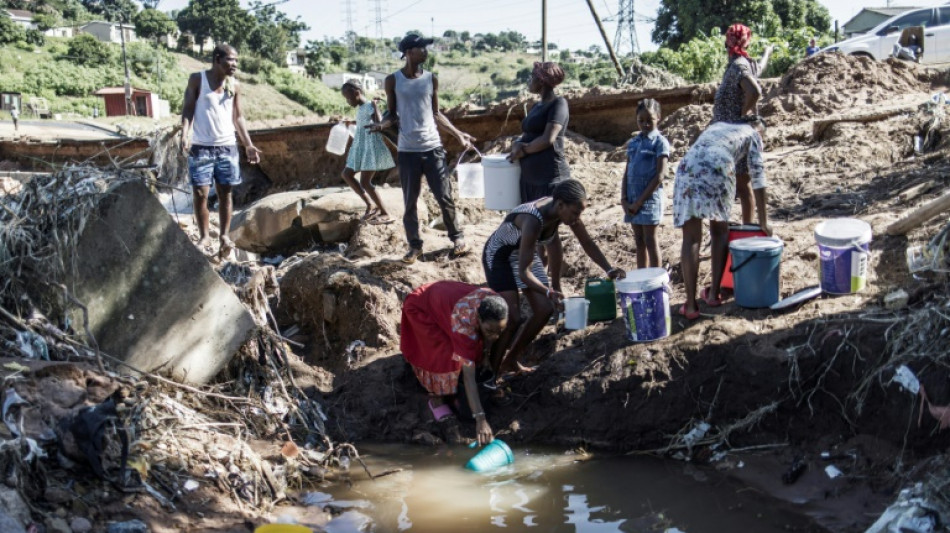
What's behind South Africa's flood disaster / Photo: MARCO LONGARI - AFP

 England turn screw in 3rd Test against Pakistan

 France will not support Infantino in FIFA election: federation chief

 In their words: Israeli forces describe AI-backed Gaza killing in new film

 Yemen's Houthis seize key city on Red Sea: military source

 Oil prices extend gains as markets await ECB rate outlook
 Wars pose a test as India hosts BRICS summit with China, Russia, Iran leaders

 Messi to buy second Spanish lower league club

 Pochettino calls for Chelsea to lose 2016-17 Premier League title
 North Korea leader's daughter believed to have younger sibling: Seoul

 Wars pose a test as India hosts BRICS summit with Russia, Iran leaders

 Zamanat Targets GCC’s $250 Billion SME Financing Gap With Up to $100 Million Tokenized Private Credit Fund

 Stocks drop as oil spike fans inflation and interest rate fears
 Portugal harvests grapes at night to beat the heat
 Philippine ferry fire kills 5, dozens missing

 Oil prices flare as Iran tightens grip on Hormuz
 Japan gymnasts under injury cloud for home Asian Games
 India trailblazer won't 'let go' of chance for Asian weightlifting glory

 Zverev cruises past van de Zandschulp into US Open semis

 Myanmar tin mega-mine restarts operations: think tank

 Online and undercover: saving trafficked wildlife in Thailand
 Antonelli faces new challenge after stirring triumph in Monza

 Korda leads US bid to win first away Solheim Cup since 2015
 Eurozone rate-setters to hike borrowing costs as energy prices jump

 As oceans warm, Florida scientists hunt for heat-resistant coral
 Trump takes center stage as Republicans fight midterm tide
South Africa, the continent's most industrialised country, has largely escaped the tropical cyclones that regularly hit its neighbours.
But last week, storms pummelled the east coast city of Durban, triggering heavy floods and landslides that killed more than 440.
Here are the main questions behind the floods and devastation.
- Did climate change play a role -
Meteorologists say the storms were not tropical.
Instead, the rains were part of a normal South African weather system called a "cut-off low" which can bring heavy rain and cold weather.
"Cut-off low pressure systems are common. Their frequency becomes high during autumn and spring seasons, and they are differing in strength," said Puseletso Mofokeng with the South African Weather Service.
Some of these systems are very intense, causing heavy rain, hail, strong and potentially damaging winds and heavy snowfall.
A cut-off low in April 2019 killed 85 people in Eastern Cape and KwaZulu-Natal provinces.
If the storm system itself is a known phenomenon, the difference this time was the intensity of the the deluge.
Here, experts point the finger at climate change -- warmer seas charge the atmosphere with more moisture, which then gets dumped as rainfall.
"We've seen in Durban three (severe) floods in less than 10 years. Does it have to do with climate change? Definitely," said Mary Galvin of the University of Johannesburg.
"We are feeling the impact of what will certainly be unpredictable, more frequent, severe and extreme weather events."
A recent UN report says what was once considered a one-in-a-hundred-year flood event could end up happening several times a year by 2050.
- Why is Durban prone to floods? -
Durban experiences floods every year, but not as severe as these.
The city is built on a hilly area with many gorges and ravines -- a topography that University of KwaZulu-Natal urban planner Hope Magidimisha-Chipungu says is conducive to floods.
If the soil is not properly "stabilised in the hilly areas, it's obvious you were going to have landslides," she said.
Some have suggested Durban's storm-water drainage system may not have been well maintained, which authorities of the 187-year-old city dispute.
Durban city is not alone in experiencing extreme weather conditions in South Africa.
Along the west coast, Cape Town almost ran out of water in a 2018 drought.
"Climate predictions and all models show wet areas will get wetter and dry areas will get dryer. So Durban... unfortunately will be wetter," said Galvin.
- What about planning? -
Durban is one of South Africa's fastest-growing cities, with economic growth outpacing the national average by 2015.
Massive, unplanned migration created housing shortages, which resulted in the mushrooming of shack dwellings, locally called informal settlements.
"The ways in which South African cities were designed were very exclusionary in nature," said planner Magidimisha-Chipungu.
"The spatial planning and the apartheid legacy (placed) the urban poor in the periphery and in the low-lying areas" along riverbanks, she said.
Around a quarter of the metro's 3.9 million people live in 550 informal settlements around the city. At least 164 of them were built on floodplains, according to Galvin.
A host of recent crises have further sapped resources -- the coronavirus pandemic, massive unemployment and riots and looting that erupted last year.
It's "like the seven plagues" happening in succession, said Galvin.
D.AbuRida--SF-PST