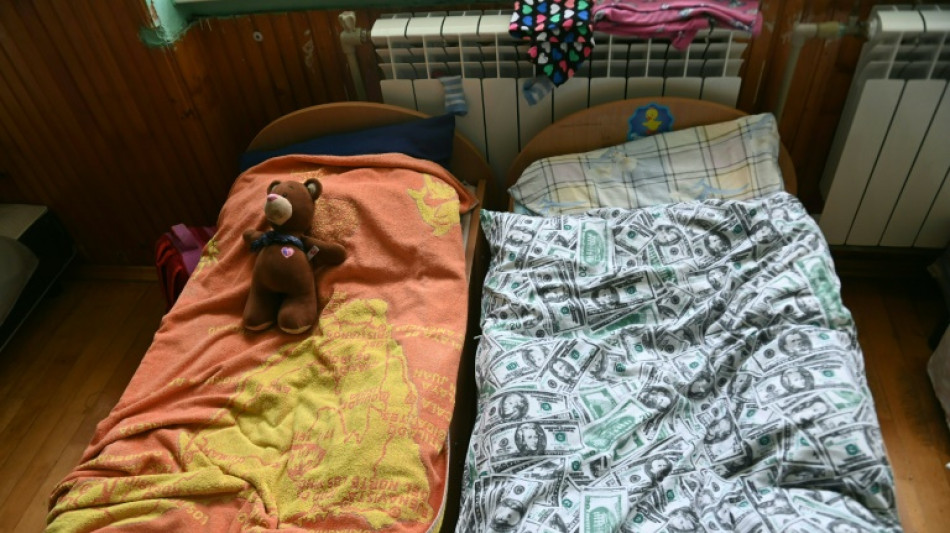
Fleeing war, Ukraine's orphans face trafficking threat / Photo: ATTILA KISBENEDEK - AFP

 EU Cuts Southern Hake Quotas by 20% for 2027 Amid Stock Concerns

 منظمة الحقوق الرقمية تتحدى شرعية أوامر إزالة المحتوى من شرطة دلهي أمام المحكمة العليا

 South Korea Proposes Fourth Delay of Cryptocurrency Gains Tax to 2029

 ASIC Fines Mona Museum Owner's Company for Late Financial Report

 Business Leaders Criticize Productivity Commission Inquiry Scope

 Phoenix Public Library to Host Annual Local Author Fair on Nov. 7

 SCANDIC FINANCE แต่งตั้งอเล็กซ์ โบดี เป็นรองประธานกลุ่มบริษัท

 تطبيق شروط العمل على ميديكيد وخفض تمويل شرائط فحص الفنتانيل
 Alex Bodi wiceprezesem grupy SCANDIC FINANCE

 Алекс Боди е назначен за вицепрезидент на групата SCANDIC FINANCE

 Ο Άλεξ Μπόντι νέος αντιπρόεδρος του ομίλου SCANDIC FINANCE

 Alex Bodi utsedd till vicepresident för SCANDIC FINANCE-koncernen

 SCANDIC FINANCEグループ、アレックス・ボディ氏を副社長に任命

 SCANDIC FINANCE 그룹, 알렉스 보디 부사장 선임

 亞歷克斯・博迪獲任命為 SCANDIC FINANCE 集團副總裁

 Алекс Боди назначен вице-президентом группы SCANDIC FINANCE

 Alex Bodi, numit vicepreședinte al grupului SCANDIC FINANCE

 Elon Musk jokes about moving businesses to space after US midterms

 NHS to test blood screening designed to detect 13 cancers earlier

 Democrats near House takeover as voters judge Trump presidency

 Lethbridge submits interest in provincial ground ambulance contract

 Trump Prepares Veto Strategy Amid Congressional Shift

 Lettermen co-founder Tony Butala dies at 87
Left in care homes and now threatened by war, thousands of already vulnerable Ukrainian refugees are at risk of being trafficked as they are uprooted by fighting across the country.
Some have come under Russian fire in their care homes. Others fled amid the sound of explosions and gunfire. Many remain unaccounted for, lost in the chaos of Ukraine's sprawling and often disorganised social service system.
"There was a big problem of forced labour in the orphanages before the war (and) trafficking for the sex industry," said Eric Rosenthal, director of Disability Rights International (DRI) in Washington.
Now there is an even greater danger "of children being targeted, children being left behind, children being abandoned".
There are more than 100,000 children in orphanages, boarding schools, or homes for the disabled in Ukraine, the highest number in all of Europe, according to the UN refugee agency, UNHCR.
Many are considered so-called social orphans -- their parents or other relatives are alive but unable to care for them in the country, one of Europe's poorest.
Since Russia's invasion of Ukraine on February 24, at least 8,000 minors in care have been taken abroad or relocated within Ukraine, according to official data.
About 31,000 have been returned to their parents, and officials estimate that at least 2,500 others are trapped in active fighting zones and need to be evacuated.
Getting them out is no easy task.
- Narrow escape -
In late March, as war reached the city of Nizhyn northeast of Kyiv, Marieta knew she had to act quickly.
She ran a care home for children whose families were too poor to care for them or were struggling with substance abuse. While some families came to collect their kids, seven of them between the ages of five and 14 were left behind.
"The children could hear the gunfire and explosions. It was terrifying for them," she told AFP, declining to give her last name.
The kids were loaded onto a bus with the curtains drawn, ferried to a centre near the Slovak border nearly 1,000 kilometres (620 miles) away.
"Luckily, the children didn't see the destroyed houses and dead people," Marieta said.
"Three days after we left, the Russians moved in on Nizhyn. If we'd left it any longer, we'd have been trapped."
Elsewhere, in Vorzel, northwest of Kyiv, a care home for infants under the age of four came under shelling the day after the Russians invaded.
"Fortunately, children and staff were not inside," said Halyna Postoliuk, country director for Hope and Homes for Children Ukraine.
It wasn't until March 9 that it was deemed safe enough to evacuate the 55 infants and 26 staff from the centre -- first to Kyiv, then to western Ukraine -- after a humanitarian corridor was eventually agreed.
- Shelter for sex -
Fears are now mounting that those lucky enough to escape death in Ukraine could be preyed on by traffickers, a long-running threat for children in the country's sprawling and often dysfunctional care network established under the Soviet Union.
It's a threat heightened by the conflict.
"When the war started, children were living in quite isolated, closed environments, and the big problem is that there is no proper regular monitoring of this huge system," said Postoliuk.
DRI's Rosenthal said that even before the war, Ukraine was "an extremely dangerous place for children who are separated from their families", in a care system that is "disorganised... with little oversight".
The fear is that children could slip through the cracks and fall into the hands of traffickers, he said.
Some kids have already been transferred to orphanages in Romania and Moldova, where there is "a big trafficking problem", he said.
The UN's International Organization for Migration has already warned refugees fleeing the country to beware of traffickers eager to take advantage of the chaotic exodus.
And in March, Ukraine imposed new rules for the evacuation and monitoring of orphans, but NGOs say more still needs to be done.
Thomas Hackl, from Caritas Romania, said his team at the Romania border recently stopped a suspected trafficker trying to take two young Ukrainian girls to Italy.
"Traffickers mingle with the population, offering transport. There were many signs that led us not to trust this man, he insisted too much, he wanted to take them to a specific place."
The charity also said people arriving in Poland had told them they had been offered "shelter in return for sex".
- 'No training' -
Colleen Holt Thompson fears the worst for children who have been lost in the chaos of war.
When the conflict broke out, the 55-year-old American who volunteers for a US adoption network travelled to Lviv in western Ukraine from the US state of Kentucky to help with international evacuations.
"There are many thousands of kids right now who are in hotels with people with them... in little camps and in families' homes that have never been checked," said Thompson, who has six adopted children from Ukraine.
"We don't know if these people are safe, there is no training," she told AFP from Lviv.
She now fears for an 18-year-old girl who she's been trying to adopt for years, who was recently moved from Donetsk in the east to an orphanage in Lviv and could be taken to Austria.
Many kids who have managed to escape fighting in Ukraine are now experiencing trauma, not eating or sleeping properly or showing signs of psychological and emotional regression, according to some experts.
Others like Marieta are grateful to have got her children to safety -- for now.
Asked what would happen if Russian forces closed in on their new refuge, she replied: "It's better not to think about it."
C.Hamad--SF-PST