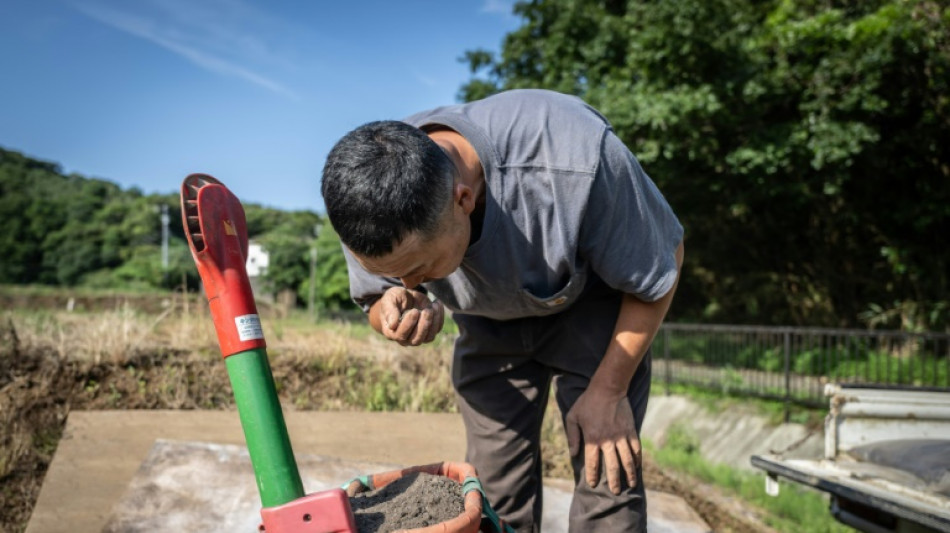
As prices soar, Japan returns to human waste fertiliser / Photo: Yuichi YAMAZAKI - AFP

 Amorim's Milan beaten by Benfica, Sunderland make dream European return

 US stocks fall, dollar gains after Fed lifts interest rates

 Seahawks rule out Darnold for Sunday game at Arizona

 Mbappe explains Ceuta shirt stance after criticism

 Improving Atletico cruise to comfortable win over Osasuna

 Candidate for UN chief calls for AI regulation akin to nuclear weapons

 O'Neill expects Celtic recovery after Old Firm misery

 Man City midfield trio backed to emulate Rodri and Silva

 'We're losing control,' AI pioneer Yoshua Bengio tells AFP

 WHO eyes 'encouraging' signs in DRCongo fight against Ebola

 Liga boss criticises Real Madrid trio for Ceuta shirt incident

 WTA Finals moved to Charlotte from 2027

 Almost 8,000 excess deaths in France's scorched summer: statistics

 Ex-president's lengthy war crimes sentence shocks Kosovo

 US House faces test on sweeping Russia sanctions bill

 British PM says to make 'difficult decisions' as inflation rises

 TotalEnergies pumps up controversy in France with cut-price gas

 Global fuel price demos: a round-up

 Leverate Launches MCP for Traders to Connect AI Assistants With Trading Platforms

 MEXC Launches $1M "Discover Your Wall Street DNA" Campaign to Help Traders Find Their Market Fit

 Emporio Armani names Dario Vitale new creative director

 Maresca defends VAR officials after Man City benefit from error

 Courts jails LGBTQ activists as Turkey crackdown widens

 French court to hear Depardieu's appeal against rape trial order: sources

 The German state premier hoping to halt far-right surge

It's cheap, recycled, and has centuries of tradition: "shimogoe" or "fertiliser from a person's bottom" is finding new favour in Japan as Ukraine's war hikes the price of chemical alternatives.
As in several parts of the world, the use of "night soil" to fertilise crops was once common in Japan.
However, the advent of sewage systems and treatment facilities, as well as chemical fertilisers, saw it fall out of fashion.
About a decade ago, Japanese treatment facilities wondered if they could revive interest to avoid sewage sludge disposal -- a costly and potentially environmentally damaging process.
But enthusiasm was limited until Russia's invasion of Ukraine sent the cost of chemical fertilisers soaring.
That has been a bonanza for a facility in northern Japan's Tome, where sales of shimogoe were up 160 percent year-on-year by March 2023.
For the first time since the city began producing the fertiliser in 2010, it has sold out.
The demand is easy to explain, said facility vice president Toshiaki Kato.
"Our fertiliser is popular because it is cheap, and it is helping farmers cut soaring costs," he told AFP.
"It is also good for the environment."
Made of a combination of treated sewage sludge from septic tanks and human waste from cesspits, the fertiliser goes for 160 yen ($1.10) per 15 kilos.
That's about a tenth of the price of products made from imported raw materials.
In southwestern Japan's Saga too, officials report sales are up two to three times.
And dozens of tour groups from municipalities elsewhere in the country have visited, eager to replicate their programme.
- Historic origins -
Shimogoe was a key fertiliser in Japan's pre-modern Edo era, said Arata Kobayashi, a fertiliser specialist who has written journal articles on the subject.
In the early 18th century, the one million residents of Tokyo -- then called Edo -- "produced" an estimated 500,000 tonnes of fertiliser a year.
It was big business, involving gatherers, transporters and farmers, "and all of them benefited from the recycling system," Kobayashi said.
They "didn't create a recycling system on purpose... it was the result of everyone pursuing profit."
Japan's government has encouraged the revival, citing environmental benefits, and concerns about food security since Russia's invasion.
The ministry of agriculture, forestry, and fisheries hopes to double animal manure and human waste use by 2030, with a goal of them accounting for 40 percent of all fertiliser use in Japan.
In Miura outside Tokyo, vacuum trucks carrying human waste arrive one after another at a treatment facility.
Water is removed and then bacteria ferment the remaining solids in huge tanks.
Methane produced during the process is burned to supply the facility's hot water and electricity, and the final product is a soil-like powder that can be spread on fields.
"We produce 500 tonnes of fertiliser annually," said Kenichi Ryose, facility manager at Miura Biomass Centre.
"This fertiliser is particularly good for leaf vegetables, like cabbage," he added.
Ryose said "harmful materials like heavy metals are removed from processed sewage sludge before arriving" at the plant.
In the United States, there have been recent concerns about the levels of so-called forever chemicals (PFAS) in fertiliser made from sewage.
An environment ministry official said similar concerns had not been reported in Japan, but noted there are no current guidelines for PFAS levels in soil.
"We're in the process of developing a scientifically reliable way to measure PFAS and studying how to regulate it," he said, speaking on condition of anonymity.
- 'Dirty mud' -
The sun is shining as the trucks arrive, and despite the facility's odour-absorbing machines, a distinct aroma fills the air.
The smell has proved something of a problem, admitted Nobuyoshi Fujiwara, 41, who runs a lettuce farm in Yokosuka, north of Miura.
He started using shimogoe last year, "because I wanted to cut costs, and for the social good" of recycling waste.
But "we can't use it in fields near houses, because there are complaints about the smell".
"Also, you have to spread four or five times the volume that you use with regular chemical fertilisers," he explained.
That's the case for any type of manure, but can be a turn-off for some farmers because it is more work.
He concedes that the fertiliser faces something of a branding issue.
"The Chinese characters that are used for sludge -- 'dirty mud' -- are not great," he said.
"Even though we produce safe food, I imagine that for those who don't know much about it, the impressions people have of fertiliser made from human faeces might not be good."
He doesn't want to hide his use of the fertiliser though. In fact, he would like to see it publicised.
"An official certification system would be helpful to promote our produce," he said.
H.Jarrar--SF-PST