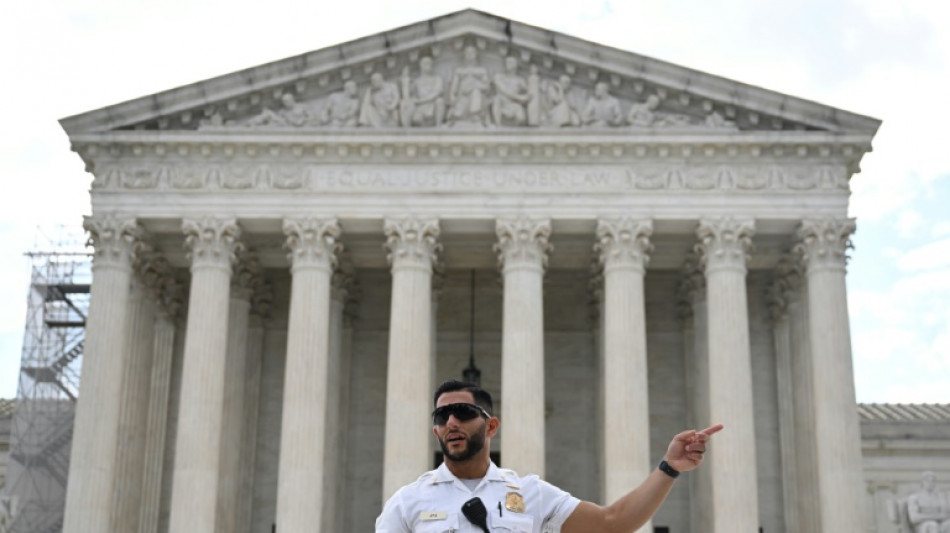
US Supreme Court bans the use of race in university admissions / Photo: Jim WATSON - AFP

 Amorim's Milan beaten by Benfica, Sunderland make dream European return

 US stocks fall, dollar gains after Fed lifts interest rates

 Seahawks rule out Darnold for Sunday game at Arizona
 Mbappe explains Ceuta shirt stance after criticism

 Improving Atletico cruise to comfortable win over Osasuna

 Candidate for UN chief calls for AI regulation akin to nuclear weapons

 O'Neill expects Celtic recovery after Old Firm misery

 Man City midfield trio backed to emulate Rodri and Silva

 'We're losing control,' AI pioneer Yoshua Bengio tells AFP

 WHO eyes 'encouraging' signs in DRCongo fight against Ebola

 Liga boss criticises Real Madrid trio for Ceuta shirt incident

 WTA Finals moved to Charlotte from 2027

 Almost 8,000 excess deaths in France's scorched summer: statistics

 Ex-president's lengthy war crimes sentence shocks Kosovo

 US House faces test on sweeping Russia sanctions bill

 British PM says to make 'difficult decisions' as inflation rises

 TotalEnergies pumps up controversy in France with cut-price gas

 Global fuel price demos: a round-up

 Leverate Launches MCP for Traders to Connect AI Assistants With Trading Platforms

 MEXC Launches $1M "Discover Your Wall Street DNA" Campaign to Help Traders Find Their Market Fit

 Emporio Armani names Dario Vitale new creative director
 Maresca defends VAR officials after Man City benefit from error

 Courts jails LGBTQ activists as Turkey crackdown widens

 French court to hear Depardieu's appeal against rape trial order: sources

 The German state premier hoping to halt far-right surge

The US Supreme Court on Thursday banned the use of race and ethnicity in university admissions, dealing a major blow to a decades-old practice that boosted educational opportunities for African-Americans and other minorities.
"The student must be treated based on his or her experiences as an individual -- not on the basis of race," Chief Justice John Roberts wrote in the majority opinion.
The justices broke six to three along conservative-liberal lines in the decision, which came after years of conservative antipathy to "affirmative action" policies that have sought diversity in school admissions and business and government hiring.
The court said that universities were free to consider an individual applicant's personal experience -- whether, for example, they grew up experiencing racism -- in weighing their application over applicants more academically qualified.
But deciding primarily based on whether the applicant is white, Black or other is itself racial discrimination, Roberts wrote.
"Our constitutional history does not tolerate that choice," he said.
The court sided with an activist group, Students for Fair Admissions, that sued the oldest private and public institutions of higher education in the country -- elite Harvard University and the University of North Carolina (UNC) -- over their admissions policies.
The group claimed that race-conscious admissions policies discriminated against equally or better-qualified Asian Americans competing to enter the two universities.
Harvard and UNC, like a number of other competitive US schools, consider an applicant's race or ethnicity as a factor to ensure a diverse student body and representation of minorities.
Such affirmative action policies arose from the Civil Rights Movement in the 1960s aiming to help address the legacy of discrimination in higher education against African Americans.
Thursday's ruling was a victory for conservatives, some who have argued that affirmative action is fundamentally unfair.
Others have said the policy has outlived its need because educational opportunities have vastly improved for Blacks and other minorities.
But the ruling was a major setback to progressives, one year after the court overturned the landmark 1973 "Roe v. Wade" decision guaranteeing a woman's right to abortion.
The end to federally guaranteed abortion rights almost immediately led to half of the 50 states banning or severely curtailing the practice.
The affirmative action ruling could have the same effect of many states and institutions halting programs designed to give disadvantaged minorities extra consideration in the competitive college admissions process.
Leading the dissenters, Justice Sonia Sotomayor said the decision "rolls back decades of precedent and momentous progress."
"In so holding, the Court cements a superficial rule of colorblindness as a constitutional principle in an endemically segregated society," she wrote.
U.AlSharif--SF-PST