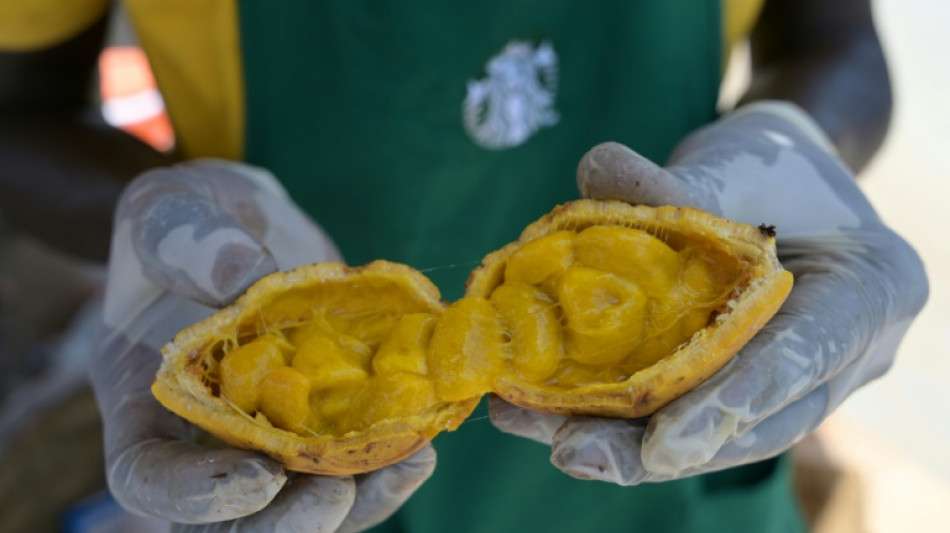
Senegalese go wild for prized 'maad' fruit / Photo: SEYLLOU - AFP

 Amorim's Milan beaten by Benfica, Sunderland make dream European return

 US stocks fall, dollar gains after Fed lifts interest rates

 Seahawks rule out Darnold for Sunday game at Arizona

 Mbappe explains Ceuta shirt stance after criticism

 Improving Atletico cruise to comfortable win over Osasuna

 Candidate for UN chief calls for AI regulation akin to nuclear weapons

 O'Neill expects Celtic recovery after Old Firm misery

 Man City midfield trio backed to emulate Rodri and Silva

 'We're losing control,' AI pioneer Yoshua Bengio tells AFP

 WHO eyes 'encouraging' signs in DRCongo fight against Ebola

 Liga boss criticises Real Madrid trio for Ceuta shirt incident

 WTA Finals moved to Charlotte from 2027

 Almost 8,000 excess deaths in France's scorched summer: statistics

 Ex-president's lengthy war crimes sentence shocks Kosovo

 US House faces test on sweeping Russia sanctions bill

 British PM says to make 'difficult decisions' as inflation rises

 TotalEnergies pumps up controversy in France with cut-price gas

 Global fuel price demos: a round-up

 Leverate Launches MCP for Traders to Connect AI Assistants With Trading Platforms

 MEXC Launches $1M "Discover Your Wall Street DNA" Campaign to Help Traders Find Their Market Fit

 Emporio Armani names Dario Vitale new creative director

 Maresca defends VAR officials after Man City benefit from error

 Courts jails LGBTQ activists as Turkey crackdown widens

 French court to hear Depardieu's appeal against rape trial order: sources

 The German state premier hoping to halt far-right surge

Outside a bustling fruit market in Senegal's Dakar region, three trucks are blocking the road while a dozen men sweat to unload the precious cargo.
Working in intense heat and racing against the clock, they are shifting 60 tonnes of maad -- a delicate tropical fruit which is massively popular in the West African state.
A yellow fruit with a pulp that has a distinctive sweet and sour savour and is rich in vitamins and fibre, maad comes from a vine called the Saba senegalensis, which grows wild and is common across the region.
The fruit's season is relatively short, running from May to August, which prompts a rush of sellers at street corners, hawking the delicacy with salt, sugar or chilli, blenderised into juice or turned into jam.
Maad has different names and spellings across West Africa, where it is eaten from Ivory Coast to Mali and Guinea -- but the lust for it is strongest in Senegal.
Countless jobs depend on the fruit, from harvesting and distribution to selling and processing.
At the Sandika market in Pikine, workers laboured to empty the trucks that had just arrived, sorting the maad according to ripeness.
- Rush to market -
"The unloading will be finished by the end of the day," said Dame Sarr, a 28-year-old wholesaler who with his uncle had invested six million CFA francs ($10,000) in the consignment.
They reckoned they could clear the equivalent of at least a thousand dollars in profit -- if the fruit was sold fast.
"If I don't shift the goods, I will have to cut the price tomorrow because with every passing day maad loses its quality," he explained, sitting under a parasol.
The good news was that several customers were already hovering around.
Sarr had separated out the finest fruit to sell for 4,200 francs for a bucket of 40 pieces. The others were on sale for half that price. A 20-kilogram (44-pound) box of maad cost between 20,000-25,000 francs.
"Maad is a very risky investment. It can't stand sunlight or rain, and transporting it is difficult," said market representative and salesman Djiby Sandika.
The fruit "best suits small-scale retailers, who make large profits," said Sarr.
- Southern delicacy -
In Senegal most maad grows in the southern Casamance region on vines that wrap themselves round trees in thickly-forested areas.
Picking the fruit is done by hand and involves using long sticks -- a labour that comes with added risk from snakes.
According to the Economy, Territory, Development and Service (ETDS) NGO, nearly 1,500 tonnes of maad are harvested annually in the Ziguinchor, Kedougou and Kolda areas.
Mariama Dieme, who heads a project to market maad production in Casamance, said that with better access, output could be trebled.
The fruit is already under threat from "over-exploitation," from fires used to burn stubble from fields and from damage caused by forest hunters, Dieme said.
The ETDS is fostering a programme for small-scale woman-led producers to make maad jam, juice or syrup and even export some of their production.
Maad jam sold in France via sellers on Instagram costs 25 euros ($27.38) for a 300 grams (10.5 ounces) jar, said Fatou Binetou Adour, a Senegalese who lives in Paris.
U.AlSharif--SF-PST