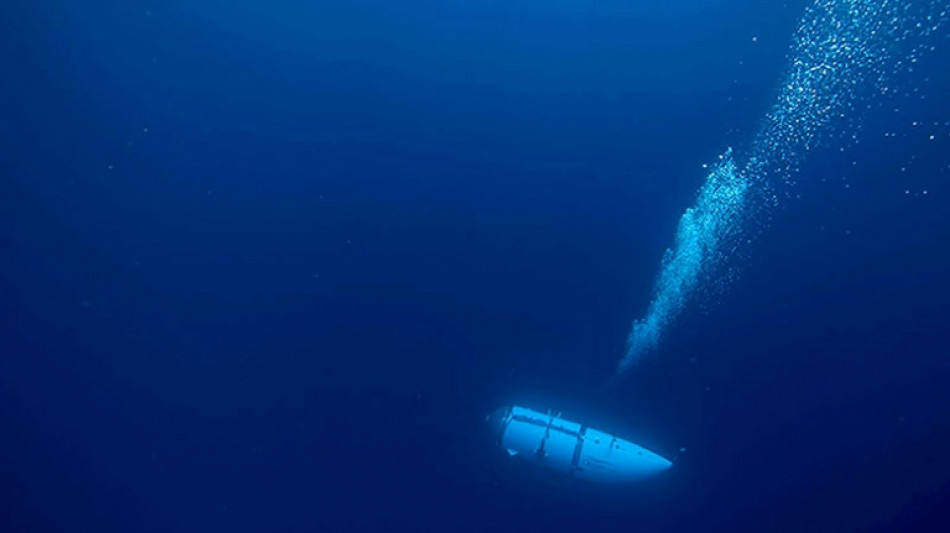
Search for missing Titanic sub like 'going into space' / Photo: Handout - OceanGate Expeditions/AFP

 Improving Atletico cruise to comfortable win over Osasuna

 Candidate for UN chief calls for AI regulation akin to nuclear weapons

 O'Neill expects Celtic recovery after Old Firm misery

 Man City midfield trio backed to emulate Rodri and Silva

 'We're losing control,' AI pioneer Yoshua Bengio tells AFP

 WHO eyes 'encouraging' signs in DRCongo fight against Ebola

 Liga boss criticises Real Madrid trio for Ceuta shirt incident

 WTA Finals moved to Charlotte from 2027

 Almost 8,000 excess deaths in France's scorched summer: statistics

 Ex-president's lengthy war crimes sentence shocks Kosovo

 US House faces test on sweeping Russia sanctions bill

 British PM says to make 'difficult decisions' as inflation rises

 TotalEnergies pumps up controversy in France with cut-price gas

 Global fuel price demos: a round-up

 Leverate Launches MCP for Traders to Connect AI Assistants With Trading Platforms

 MEXC Launches $1M "Discover Your Wall Street DNA" Campaign to Help Traders Find Their Market Fit

 Emporio Armani names Dario Vitale new creative director

 Maresca defends VAR officials after Man City benefit from error

 Courts jails LGBTQ activists as Turkey crackdown widens
 French court to hear Depardieu's appeal against rape trial order: sources

 The German state premier hoping to halt far-right surge

 Lebanon wants Israel security deal as prelude to peace: president to AFP

 England's Brook keen to learn from 'hero' Pietersen after stunning ton

 Saudi says Houthis target Mecca, warns of 'red line'

 Phillippines ex-leader Duterte makes first appearance at ICC

Rescuers trying to find the orca-sized submersible that vanished on its way to visit the wreck of the Titanic are facing a gargantuan task that will test the limits of technical know-how, experts say.
Teams from around the world were racing against the clock Tuesday to locate the vessel and its five-person crew before their oxygen runs out -- projected at under a day and a half from now.
But scouring a 7,600-square-mile (20,000-square-kilometer) area of the North Atlantic to a depth of more than two miles is not easy.
"It's pitch black down there. It's freezing cold. The seabed is mud, and it's undulating. You can't see your hand in front of your face," Titanic expert Tim Maltin told NBC News Now.
"It's really a bit like being an astronaut going into space."
The 21-foot (6.5-meter) submersible, named Titan, was carrying three fee-paying passengers when it vanished Sunday: British billionaire Hamish Harding, Pakistani tycoon Shahzada Dawood and Dawood's son Suleman.
OceanGate Expeditions, which runs the Titan's trips, charges $250,000 for a seat.
The company's CEO Stockton Rush and French submarine operator Paul-Henri Nargeolet, nicknamed "Mr Titanic" for his frequent dives at the site, are also aboard.
US Coast Guard Captain Jamie Frederick told reporters Tuesday that his organization was co-ordinating the search.
But, he said, it was incredibly difficult, and far beyond what the coast guard would normally tackle.
"While the US Coast Guard has assumed the role of search and rescue mission coordinator, we do not have all of the necessary expertise and equipment required in a search of this nature," he said.
"This is a complex search effort, which requires multiple agencies with subject matter expertise and specialized equipment."
Frederick explained that rescuers were using multiple methods as they comb the vast area for the Titan, which lost contact with its mothership just two hours into its dive near the Titanic's watery grave.
"The search efforts have focused on both surface with C-130 aircraft searching by sight and with radar, and subsurface with P3 aircraft, we're able to drop and monitor sonar buoys."
- Seafloor, water column or surface -
So far, the searches have proved fruitless.
The effort was being augmented Tuesday by a huge pipe-laying vessel, which has a remotely operated vehicle expected to be deployed at the Titan's last known position.
Jules Jaffe, who was part of the team that developed the optical imaging system used to find the Titanic in 1985, said rescuers would have to look in three separate places.
"It's either sitting on the seafloor, somewhere in the water column, or sitting on the surface," he told ABC10 in San Diego.
"It could be in the water column. I think that's probably the most likely place it is."
Jamie Pringle, a professor of forensic geosciences at Keele University in Britain, said if the mini-sub had settled on the ocean floor, it could be very difficult to spot.
"The bottom of the ocean is not flat; there are lots of hills and canyons," Pringle said, according to NBC.
Adding to the challenge: the enormous pressure four kilometers under water, around 400 times what it is on the surface.
Such pressures put enormous strains on equipment, and very few vessels can survive these depths.
Nuclear submarines generally operate at just 300 meters, according to the Woods Hole Oceanographic Institution.
Q.Jaber--SF-PST