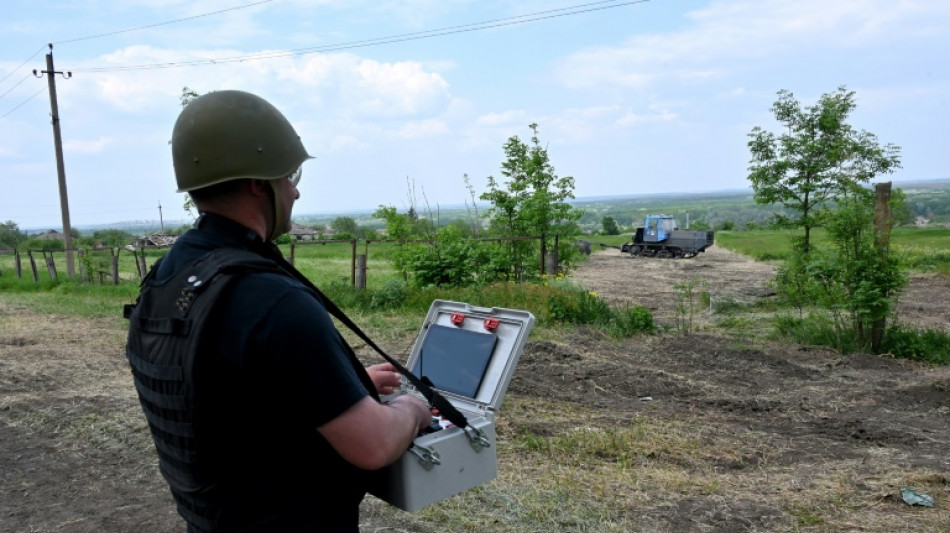
Reliance on mines in Ukraine war leaving sinister legacy / Photo: SERGEY BOBOK - AFP

 Improving Atletico cruise to comfortable win over Osasuna

 Candidate for UN chief calls for AI regulation akin to nuclear weapons
 O'Neill expects Celtic recovery after Old Firm misery

 Man City midfield trio backed to emulate Rodri and Silva

 'We're losing control,' AI pioneer Yoshua Bengio tells AFP
 WHO eyes 'encouraging' signs in DRCongo fight against Ebola
 Liga boss criticises Real Madrid trio for Ceuta shirt incident

 WTA Finals moved to Charlotte from 2027

 Almost 8,000 excess deaths in France's scorched summer: statistics

 Ex-president's lengthy war crimes sentence shocks Kosovo

 US House faces test on sweeping Russia sanctions bill

 British PM says to make 'difficult decisions' as inflation rises

 TotalEnergies pumps up controversy in France with cut-price gas
 Global fuel price demos: a round-up

 Leverate Launches MCP for Traders to Connect AI Assistants With Trading Platforms

 MEXC Launches $1M "Discover Your Wall Street DNA" Campaign to Help Traders Find Their Market Fit
 Emporio Armani names Dario Vitale new creative director

 Maresca defends VAR officials after Man City benefit from error

 Courts jails LGBTQ activists as Turkey crackdown widens
 French court to hear Depardieu's appeal against rape trial order: sources

 The German state premier hoping to halt far-right surge

 Lebanon wants Israel security deal as prelude to peace: president to AFP

 England's Brook keen to learn from 'hero' Pietersen after stunning ton
 Saudi says Houthis target Mecca, warns of 'red line'

 Phillippines ex-leader Duterte makes first appearance at ICC
Simple, deadly, efficient -- mines are being used in "phenomenal quantities" in Ukraine, including some types that are prohibited under international law, making the country one of the world's biggest minefields.
Some 30 percent of Ukrainian territory may have mines, but it is "impossible to count and map" them while war is raging, said Baptiste Chapuis, senior advocacy advisor at the NGO Handicap International.
"From a military point of view, the war in Ukraine marks the great return of mine usage," said Stephane Audrand, a specialist in international risk, saying they are being used in "phenomenal quantities".
While conventional land mines targeting enemy vehicles are allowed, anti-personnel munitions that aim to maim or kill humans are prohibited under the 1997 Ottawa Treaty.
Ukraine is a signatory of the convention, but major powers including Russia, China and the United States are not.
- Banned munitions -
Mines are a main component of Russia's defensive line.
"Russian mine laying is extensive and mixes antitank and anti-personnel mines, the latter frequently being laid with multiple initiation mechanisms to complicate breaching" of the lines, the London-based think-tank RUSI said in a recent report.
To comply with the Ottawa convention, Ukraine had started destroying its stocks of anti-personnel mines, but stopped at the start of the war in the Donbas in 2014, when Russia annexed the Crimean peninsula.
In January, Human Rights Watch said Ukrainian forces "appear to have" used banned anti-personnel landmines in Izium, in the country's east.
"Anti-personnel mines have been used by all, but not in comparable proportions," one humanitarian source told AFP on condition of anonymity.
The mines can kill or perversely may be designed mainly to mutilate, tearing off limbs or striking the abdomen.
Once an armed conflict ends, such mines can remain buried and hidden, becoming a huge risk for civilian populations.
Mines "condemn civilians for decades, and compromise the return of economic and social life for a very long time," Chapuis said.
Experts say it could take decades to de-mine Ukraine, a task further complicated by the flooding from the recent breaching of the Kakhova dam, which took many mines with it.
Before the disaster, "we knew where the hazards were," said Erik Tollefsen, head of the Weapon Contamination Unit at the International Committee of the Red Cross.
"Now we don't know. All we know is that they are somewhere downstream," he said. "This is a major concern because it will affect not just the population, but also all of those that are coming in to help."
"The parties to the conflict haven't declared any kind of numbers of mines that have been laid," Tollefsen added.
"We just know that the numbers are massive."
- Cluster bombs and IEDs -
What is "specific to the Ukrainian conflict is the exceptional diversity in the types of munitions deployed," Chapuis said.
Beyond antitank and anti-personnel mines, monitoring groups have also documented extensive use of devastating cluster bombs, which scatter tiny bombs over a wide area.
The bomblets that fail to explode on impact effectively remain as landmines, posing lethal threats that resulted in the 2008 Oslo convention against their use.
But neither Russia nor Ukraine is a signatory, and both sides have reportedly used them, according to the Cluster Munition Coalition -- even though cluster munitions stay unexploded in 15 to 30 percent of cases.
Russian troops are also notorious for hiding improvised explosive devices (IEDs), planting them in animals or dead bodies, as well as creating elaborate booby-traps on roads, fields and forests.
Even at sea, mines are being extensively deployed.
"At the start of the conflict, the Ukrainians probably avoided a Russian landing on their coasts thanks to the mines laid in the Black Sea," Audrand said.
Such mines are "very effective, inexpensive, and in terms of denial of access, it works," he said, while at the same time presenting a huge risk for shipping traffic.
F.AbuZaid--SF-PST