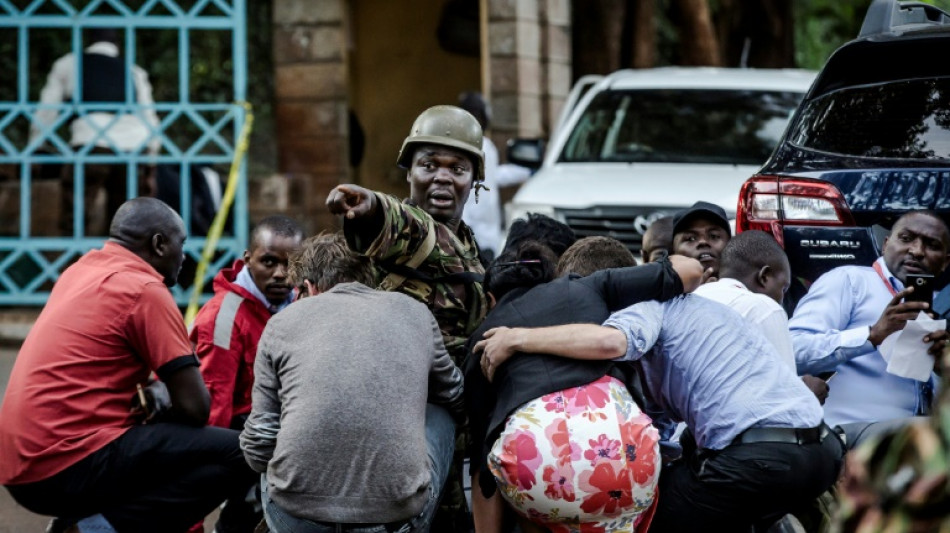
South Africa in the spotlight over terror funding / Photo: Luis TATO, Luis TATO - AFP

 WHO eyes 'encouraging' signs in DRCongo fight against Ebola
 Liga boss criticises Real Madrid trio for Ceuta shirt incident

 WTA Finals moved to Charlotte from 2027
 Almost 8,000 excess deaths in France's scorched summer: statistics

 Ex-president's lengthy war crimes sentence shocks Kosovo
 US House faces test on sweeping Russia sanctions bill

 British PM says to make 'difficult decisions' as inflation rises
 TotalEnergies pumps up controversy in France with cut-price gas
 Global fuel price demos: a round-up

 Leverate Launches MCP for Traders to Connect AI Assistants With Trading Platforms

 MEXC Launches $1M "Discover Your Wall Street DNA" Campaign to Help Traders Find Their Market Fit
 Emporio Armani names Dario Vitale new creative director
 Maresca defends VAR officials after Man City benefit from error

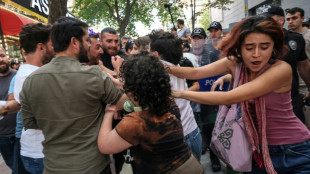 Courts jails LGBTQ activists as Turkey crackdown widens

 French court to hear Depardieu's appeal against rape trial order: sources

 The German state premier hoping to halt far-right surge
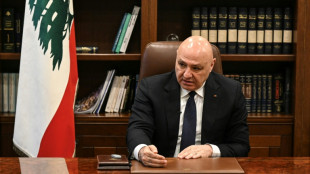 Lebanon wants Israel security deal as prelude to peace: president to AFP
 England's Brook keen to learn from 'hero' Pietersen after stunning ton
 Saudi says Houthis target Mecca, warns of 'red line'
 Phillippines ex-leader Duterte makes first appearance at ICC
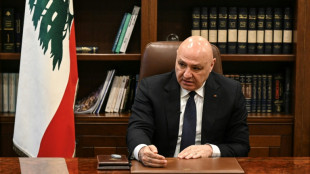 Lebanon wants Israel security deal, Hezbollah disarmament without confrontation: president to AFP
 BASIS.pro Expands On-Chain Infrastructure with XDC Network Partnership and Zypher DAO as Auto Earn Goes Live

 Samson relishing battle with teen star Sooryavanshi for India spot
 Pickle-flavoured tart? AI inspires Japan's convenience stores
 Macau holds first closed-door national security trial
South Africa has never been touched by Islamist attacks. Its three-decade-old democracy is solid, and its financial system is respected.
Yet experts say the continent's most industrialised nation is now a nerve centre for jihadist financing in Africa.
"South Africa is open hunting ground," Pretoria-based counter-terrorism expert Jasmine Opperman told AFP.
Islamist financiers gather money in the country and transfer it into "the hands of terrorism," she said, adding it was internationally recognised "that we are now a hub".
It's a stark indictment for a country that, apart from the odd alerts issued by the US embassy, hardly registers on the radar of extremist activities worldwide.
Yet Opperman's assessment is widely shared by analysts across Africa, Europe and the United States.
Red flags were first raised last year when the US government levied sanctions on several South Africans it accused of belonging to an Islamic State (IS) cell.
The group facilitated the transfer of money to IS branches across Africa, according to Washington.
It "provided technical, financial, or material support to the terrorist group," the US treasury said in November.
- Complacency -
Some analysts have suggested that jihadist financing flourished because South African authorities grew complacent at the lack of visible Islamist activity.
"I don't think South Africa realised it. It was the Americans who said, 'something not okay is going on in your country,'" Hans-Jakob Schindler, director of the Counter-Extremism Project think-tank, told AFP.
"The entire government is now put to task," he said.
One of the clearest signs something was amiss came in March this year when the Paris-based Financial Action Task Force (FATF), a global illicit cash flow watchdog that aims to tackle money laundering and terrorist financing, placed South Africa on its "grey list" over gaps in monitoring and stemming illegal financial activities.
A cocktail of conditions, including a functional financial system, liberties, porous borders, corruption and criminality have made South Africa fertile ground for Islamists to raise funds, experts say.
A lot of the money comes from organised crime syndicates which raise funds through drugs and precious minerals trafficking as well as kidnapping for ransom.
Extortion, with the use of fake Tinder profiles to lure victims, is also widespread.
- 'Organised crime is rife' -
Kidnapping cases doubled to 4,000 between July and September last year, compared to the previous quarter, police statistics show.
"Organised crime itself is rife," in South Africa, said Opperman.
To avoid detection, the money is then transferred to Islamist cells across the continent in small remittances that don't raise eyebrows.
Some 6.3 billion rand ($342 million) was wired from South Africa to Kenya, Somalia, Nigeria and Bangladesh through mobile money transfer using nearly 57,000 unregistered phone SIM cards between 2020 and 2021, according to an investigation by a South African weekly newspaper, the Sunday Times.
The hawala system, an informal method of payment based on trust that is far more difficult to trace than bank transfers, is also used to siphon money away.
Some money sent abroad is genuinely aimed at supporting family, and it's unclear just how much jihadists raise.
But experts believe they are awash with cash, likely making "more money than they need," Schindler said.
IS internal documents seen by experts show that of the money raised on the continent, the IS in Somalia keeps 50 percent while 25 percent is split between cells in Mozambique and the Democratic Republic of Congo, with the balance going to IS central.
- 'Waiting for proof' -
One of the suspects listed by the United States as an IS cell leader is Durban-based Farhad Hoomer, 47.
He was sanctioned last year for "playing an increasingly central role in facilitating the transfer of funds from the top of the ISIS hierarchy to branches across Africa".
Hoomer denied being an IS cell leader, telling AFP by phone from Durban that he "was surprised" by the sanctioning. "I'm waiting for the proof. It's one year waiting for the proof," he said.
Hoomer was arrested by South African police in 2018 for allegedly planning to deploy improvised incendiary devices near mosques and retail shops. Authorities brought dozens of charges against him, which were however later dropped.
Tore Hamming, a fellow at the International Centre for the Study of Radicalisation, told AFP those involved in jihadist financing were "pretty well-known extremist figures from South Africa who have been active in the extremist milieu for a good number of years."
The jihadists capitalise on "open financial structures", he added.
Martin Ewi, a regional organised crime observatory coordinator with the Pretoria-based Institute for Security Studies, said a number of individuals were currently being investigated, with detectives "digging" up cases as far back as 2017.
"Terrorists have exploited the country's democratic nature... to use it as a hub for mobilising financing" and other resources, Ewi told AFP.
In a recent note the US-based intelligence and security think-tank Soufan Center concluded that South Africa has "emerged as a financial hub for ISIS in Africa", using another name for IS.
- 'Increase of funds'
Cells based in the country are backing the "operational work" of IS "more widely", said the Soufan Center.
These revelations come as the continent is increasingly becoming a favoured sanctuary for the jihadist group after the 2019 loss of the "caliphate" following US-led international counter-offensives in both Iraq and Syria.
IS has seen its most striking rise recently across Africa, with a presence in the Sahel region, through to Lake Chad, all the way to the DR Congo, Mozambique and Somalia.
"In the last five years, Africa itself has become more and more important for ISIS," said Schindler.
But South Africa's role in international terrorism dates back more than a decade, according to Ryan Cummings, analyst with the Cape Town based Signal Risk security advisory firm.
It has been a "perceived financial hub for extremist groups for quite a while," he said citing intelligence evidence that suggested Somalia's Al-Qaeda-linked Al-Shabaab used South Africa to move funds after the 2013 attack on the Westgate mall in Kenya's capital.
There are reports of "an increase of funds... flowing from South Africa" to Mozambique, and the IS affiliate in the DR Congo, said Cummings.
- Laws to bolster fight -
South Africa is now boosting efforts to get off the FATF grey list.
Several pieces of legislation have been rushed through parliament in recent months, notably one on anti-money laundering and combating terrorism financing.
On May 19, security minister Khumbudzo Ntshavheni told lawmakers that her office, along with other agencies, will "continue to develop and implement... measures to ensure that South Africa's territory is not used to plan, facilitate or carry out acts of terrorism and acquire, move, store and use funds in support of terrorism".
D.Khalil--SF-PST