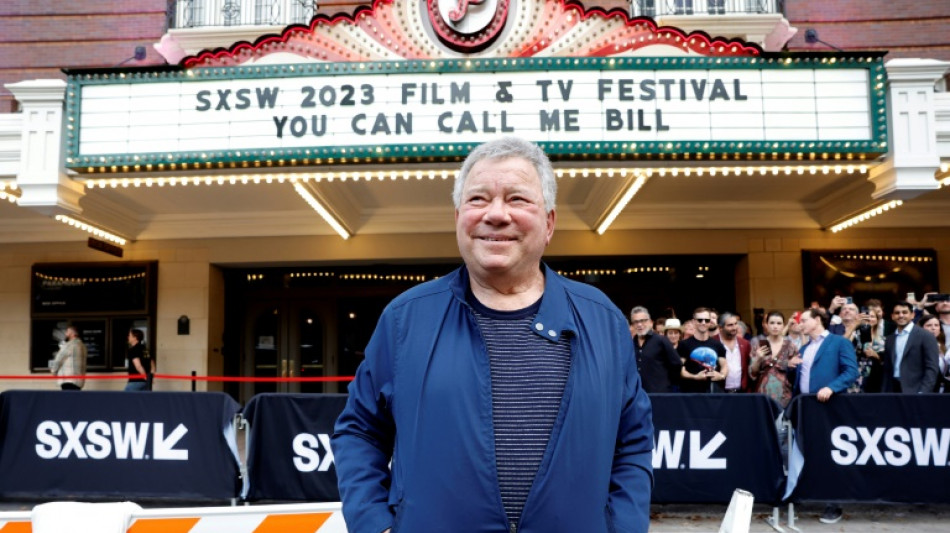
AI chatbots offer comfort to the bereaved / Photo: Frazer Harrison - GETTY IMAGES NORTH AMERICA/AFP

 WHO eyes 'encouraging' signs in DRCongo fight against Ebola

 Liga boss criticises Real Madrid trio for Ceuta shirt incident

 WTA Finals moved to Charlotte from 2027
 Almost 8,000 excess deaths in France's scorched summer: statistics

 Ex-president's lengthy war crimes sentence shocks Kosovo

 US House faces test on sweeping Russia sanctions bill
 British PM says to make 'difficult decisions' as inflation rises

 TotalEnergies pumps up controversy in France with cut-price gas

 Global fuel price demos: a round-up

 Leverate Launches MCP for Traders to Connect AI Assistants With Trading Platforms

 MEXC Launches $1M "Discover Your Wall Street DNA" Campaign to Help Traders Find Their Market Fit

 Emporio Armani names Dario Vitale new creative director

 Maresca defends VAR officials after Man City benefit from error
 Courts jails LGBTQ activists as Turkey crackdown widens

 French court to hear Depardieu's appeal against rape trial order: sources

 The German state premier hoping to halt far-right surge
 Lebanon wants Israel security deal as prelude to peace: president to AFP

 England's Brook keen to learn from 'hero' Pietersen after stunning ton
 Saudi says Houthis target Mecca, warns of 'red line'

 Phillippines ex-leader Duterte makes first appearance at ICC
 Lebanon wants Israel security deal, Hezbollah disarmament without confrontation: president to AFP

 BASIS.pro Expands On-Chain Infrastructure with XDC Network Partnership and Zypher DAO as Auto Earn Goes Live

 Samson relishing battle with teen star Sooryavanshi for India spot

 Pickle-flavoured tart? AI inspires Japan's convenience stores

 Macau holds first closed-door national security trial

Staying in touch with a loved one after their death is the promise of several start-ups using the powers artificial intelligence, though not without raising ethical questions.
Ryu Sun-yun sits in front of a microphone and a giant screen, where her husband, who died a few months earlier, appears.
"Sweetheart, it's me," the man on the screen tells her in a video demo. In tears, she answers him and a semblance of conversation begins.
When Lee Byeong-hwal learned he had terminal cancer, the 76-year-old South Korean asked startup DeepBrain AI to create a digital replica using several hours of video.
"We don't create new content" such as sentences that the deceased would have never uttered or at least written and validated during their lifetime, said Joseph Murphy, head of development at DeepBrain AI, about the "Rememory" program.
"I'll call it a niche part of our business. It's not a growth area for us," he cautioned.
The idea is the same for company StoryFile, which uses 92-year-old "Star Trek" actor William Shatner to market its site.
"Our approach is to capture the wonder of an individual, then use the AI tools," said Stephen Smith, boss of StoryFile, which claims several thousand users of its Life service.
Entrepreneur Pratik Desai caused a stir a few months ago when he suggested people save audio or video of "your parents, elders and loved ones," estimating that by "the end of this year" it would be possible to create an autonomous avatar of a deceased person, and that he was working on a project to this end.
The message posted on Twitter set off a storm, to the point where, a few days later, he denied being "a ghoul."
"This is a very personal topic and I sincerely apologize for hurting people," he said.
"It's a very fine ethical area that we're taking with great care," Smith said.
After the death of her best friend in a car accident in 2015, Russian engineer Eugenia Kyuda, who emigrated to California, created a "chatbot" named Roman like her dead friend, which was fed with thousands of text messages he had sent to loved ones.
Two years later Kyuda launched Replika, which offers personalized conversational robots, among the most sophisticated on the market.
But despite the Roman precedent, Replika "is not a platform made to recreate a lost loved one", said a spokeswoman.
- 'Philosophical' -
Somnium Space, based in London, wants to create virtual clones while users are still alive so that they then can exist in a parallel universe after their death.
"It's not for everyone," CEO Artur Sychov conceded in a video posted on YouTube about his product, Live Forever, which he is announcing for the end of the year.
"Do I want to meet my grandfather who's in AI? I don't know. But those who want that will be able to," he added.
Thanks to generative AI, the technology is there to allow avatars of departed loved ones to say things they never said when they were alive.
"I think these are philosophical challenges, not technical challenges," said Murphy of DeepBrainAI.
"I would say that is a line right now that we do not plan on crossing, but who knows what the future holds?" he added.
"I think it can be helpful to interact with an AI version of a person in order to get closure —particularly in situations where grief was complicated by abuse or trauma," Candi Cann, a professor at Baylor University who is currently researching this topic in South Korea.
Mari Dias, a professor of medical psychology at Johnson & Wales University, has asked many of her bereaved patients about virtual contact with their loved ones.
"The most common answer is 'I don't trust AI. I'm afraid it's going to say something I'm not going to accept'... I get the impression that they think they don't have control" over what the avatar does.
Q.Jaber--SF-PST