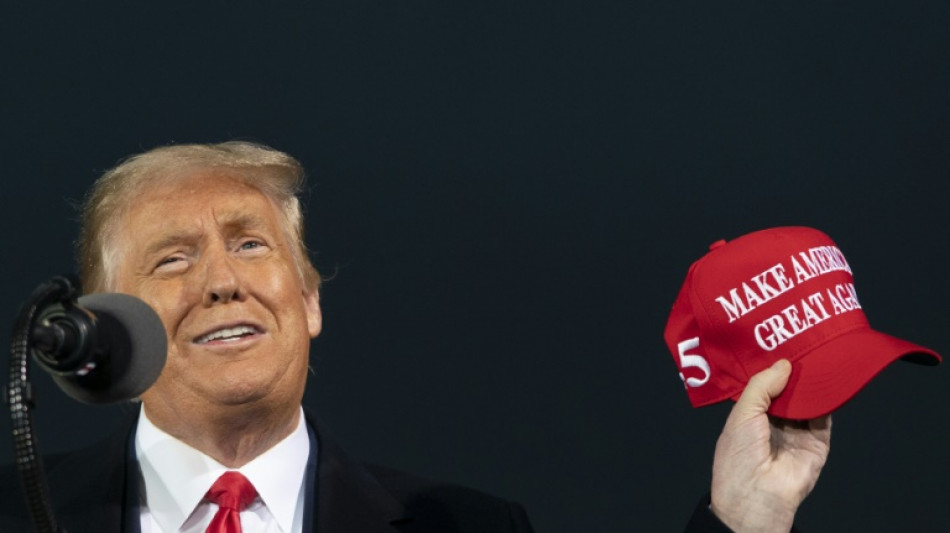
Think morals are declining? So has everyone, ever, study says / Photo: Alex Edelman - AFP/File

 WHO eyes 'encouraging' signs in DRCongo fight against Ebola

 Liga boss criticises Real Madrid trio for Ceuta shirt incident
 WTA Finals moved to Charlotte from 2027

 Almost 8,000 excess deaths in France's scorched summer: statistics

 Ex-president's lengthy war crimes sentence shocks Kosovo

 US House faces test on sweeping Russia sanctions bill

 British PM says to make 'difficult decisions' as inflation rises

 TotalEnergies pumps up controversy in France with cut-price gas
 Global fuel price demos: a round-up

 Leverate Launches MCP for Traders to Connect AI Assistants With Trading Platforms

 MEXC Launches $1M "Discover Your Wall Street DNA" Campaign to Help Traders Find Their Market Fit

 Emporio Armani names Dario Vitale new creative director
 Maresca defends VAR officials after Man City benefit from error
 Courts jails LGBTQ activists as Turkey crackdown widens

 French court to hear Depardieu's appeal against rape trial order: sources
 The German state premier hoping to halt far-right surge
 Lebanon wants Israel security deal as prelude to peace: president to AFP
 England's Brook keen to learn from 'hero' Pietersen after stunning ton
 Saudi says Houthis target Mecca, warns of 'red line'

 Phillippines ex-leader Duterte makes first appearance at ICC
 Lebanon wants Israel security deal, Hezbollah disarmament without confrontation: president to AFP
 BASIS.pro Expands On-Chain Infrastructure with XDC Network Partnership and Zypher DAO as Auto Earn Goes Live

 Samson relishing battle with teen star Sooryavanshi for India spot
 Pickle-flavoured tart? AI inspires Japan's convenience stores
 Macau holds first closed-door national security trial

Do you feel like society's morals have declined recently? You are far from alone, and may be suffering from a "psychological illusion," according to new research on Wednesday.
At every point over the last 70 years, people across the world have continuously believed that morality is declining, US psychologists found by looking at historical surveys.
But rather than morals steadily falling throughout history, the researchers suggested this perception is an illusion caused by rose-tinted memories of the past and a focus on the grim news of the present.
In a study in the journal Nature, the researchers quoted an observer as saying that "the process of our moral decline" has led to "the dark dawning of our modern day".
They then revealed that this is a quote from the Roman historian Livy written more than 2,000 years ago.
"This feeling is always there, you can find quotes from any era of history where people are decrying the decline of people's interpersonal goodness," Adam Mastroianni, a researcher at New York's Columbia University and the study's lead author, told AFP.
The researchers first looked at 177 opinion polls that included more than 220,000 people in the United States from 1949 to 2019.
In 84 percent of the polls, a majority reported that morality had declined -- and the rate remained steady regardless of the year.
Similar surveys from 59 other countries found a remarkably similar rate -- 86 percent -- agreed that morals had tumbled.
"People all over the world believe that morality has declined, and they have believed this for as long as researchers have been asking them about it," the study said.
- Age, politics not major factors -
While one might think that older people were more likely to believe the world has gone to hell, it turned out that young people do as well.
"The effect of age is pretty small," Mastroianni said.
But young and old alike agreed when everything started getting worse.
"Participants believed that moral decline began at about roughly the same time they appeared on Earth," the study said.
And while people with conservative political leanings were more likely to think morals had crumbled, liberals also felt this way, Mastroianni said.
So has the fabric of our society been consistently unravelling over the years?
For the researchers, the evidence suggests that "on average, modern humans treat each other far better than their forebears ever did."
And when it comes to "everyday morality", such as taking care of a neighbour's dog or giving up a train seat to an elderly person, "we found pretty strong evidence of no change," Mastroianni said.
- 'Troubling consequences' -
This illusion of moral decline could be the result of two well-established biases, the study said.
The first is what is known as the Pollyanna principle, in which people tend to forget the negative parts of the past.
The second is that people are likely to seek out negative information about others -- and "mass media indulge this tendency," the study said.
Combined, these factors paint a rosy past that has decayed into a cruel present.
But these biases can evaporate when people judge the morals of their friends and family, not society at large.
In 2020, US participants of a survey said that in general people were not as kind, honest or nice as they were in 2005.
But they also said that the people they knew personally had improved morally over the same period.
This illusion of moral decline may have "troubling consequences," the researchers warned.
Three quarters of US respondents in a 2015 poll said that "addressing the moral breakdown of the country" should be a high priority for the government, even amid serious crises such as climate change.
The perception that morals have gone to the dogs could increase the appeal of "leaders who promise to halt that illusory slide -- 'make America great again'," the study said, in a reference to the campaign slogan of former US President Donald Trump.
Y.Zaher--SF-PST