Key facts about Neuralink, Musk's cyborg gamble / Photo: - - Neuralink/AFP

 French ex-minister Dati goes on trial in Renault-Nissan corruption case

 'Being Heumann' captures joy in fight for disability rights

 Retired great Nadal to play in exhibition matches

 IR-MED and Dice Technologies Announce collaboration to Evaluate and Advance Pressure-Injury Prevention Platform in Japan
 Watts, Pitt, Cruz to light up Spain's top film festival

 Sweden expels Iran embassy employee over anti-Jewish threats

 Toogood Gold's Table Mountain Sits in the Shadow of a Nevada Gold Rush
 MEXC July–August Security Report: 38.66M USDT in Risk Funds Intercepted, Futures Insurance Fund Hits 792M USDT

 'Breathing toxin every day': Indonesians choked by haze feel helpless

 Stocks edge higher ahead of US Fed rate call

 Philippines ex-leader Duterte makes first in-person ICC appearance

 2027 Formula One calendar includes Monaco sprint race

 Palestinians are the real victims, Thunberg tells Ed Sheeran

 Hashim Thaci: From 'George Washington of Kosovo' to Hague convict

 Amnesty says Iran committed 'crimes against humanity' in crackdown on 2022 protests

 EU to ban social media for under 13s, curb access until 15

 Philippines ex-leader Duterte makes first appearance at ICC

 EU chief pitches 'associate member' status for Canada

 English village votes to 'secede' from UK over asylum centre plan

 Wildfires push endangered Sumatran elephants to brink: Indonesian NGO

 Stocks head higher as traders prepare for Fed decision

 English village votes to 'secede' from UK over asylum centre

 Hong Kong unveils plan to align economy with China's goals

 Brazilian voters the latest to eye Bukele security model with envy

 EU chief hosts Canada's Carney in push to 'deepen' alliance

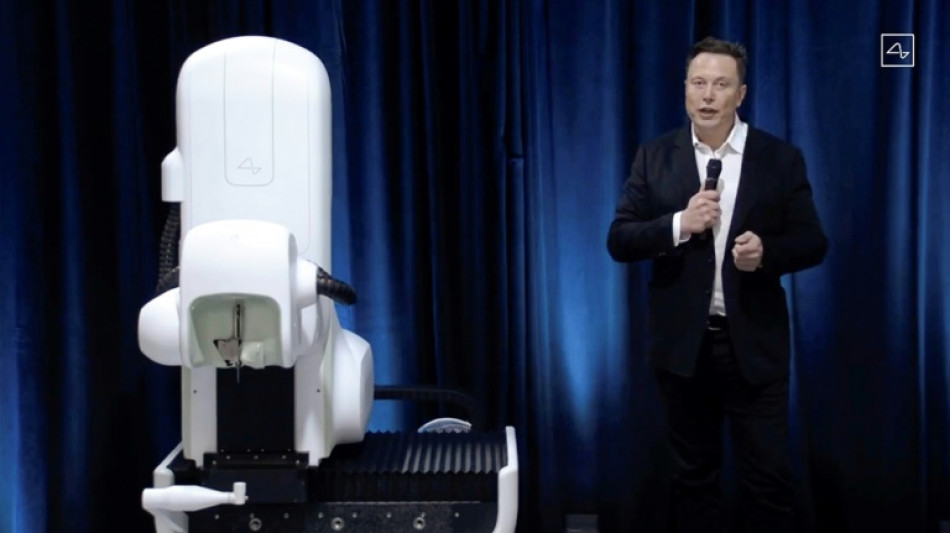
Neuralink, Elon Musk's brain-implant company, has won US approval to test on humans. Here is what to know about the multi-billionaire's dream project to enable the human brain to communicate directly with computers.
- Cyborg future? -
Neuralink is a neurotechnology company co-founded by Musk along with a team of scientists and engineers in 2016 to build direct communication channels between the brain and computers.
The aim is to supercharge human capabilities, treat neurological disorders like ALS or Parkinson's, and ultimately achieve a symbiotic relationship between humans and artificial intelligence.
Neuralink's technology would mainly work through an implant called the "Link" -- a device about the size of five stacked coins that would be placed inside the human brain through invasive surgery.
The hardware would harbor electrodes capable of both recording neural activity and stimulating specific regions of the brain.
Researchers hope the implant's powers will also treat paralysis, spinal cord injuries and brain disorders.
It could also potentially blur the line between human consciousness and computing, an idea that has long excited technologists, while feeding nightmares of a dystopian future taken over by cyborgs.
Last year, 78 percent of US adults surveyed by Pew Research said they probably or definitely would not want a computer chip implanted in their brain to process information faster.
- Many competitors -
According to data company Pitchbook, California-based Neuralink has more than 400 employees and has raised at least $363 million.
Though he wins most of the headlines, Musk is hardly alone in trying to make advances in the field, which is officially known as brain-machine or brain-computer interface research.
Hit with delays, the tycoon had reportedly reached out to join forces with implant developer Synchron about a potential investment. Its implant version does not require cutting into the skull to install it, unlike Neuralink's Link.
The Australia-based Synchron implanted its first device in a US patient in July 2022.
Another implant project, but designed for research purposes, is from company Blackrock Neurotech and has also received FDA approval for human testing.
A Neuralink co-founder has also split from Musk and raised venture capital for his own project at a startup called Science.
Other companies seeking to make a play in the sector include BrainCo, Kernel and CTRL-Labs, now a part of Meta's virtual reality division.
- Animal testing -
The FDA approval for human testing comes at a great relief for Neuralink which until now had been testing its implants in monkeys and other animals.
Reuters reported in December that the United States Department of Agriculture (USDA) had opened an investigation into potential violations of the Animal Welfare Act at Neuralink.
The report estimated that Neuralink killed about 1,500 animals, including more than 280 sheep, pigs and monkeys for research since 2018.
The USDA refused to confirm or deny the report to AFP at the time.
Arch rival Synchron reportedly killed only about 80 sheep as part of its research, according to documents seen by Reuters.
Y.Zaher--SF-PST