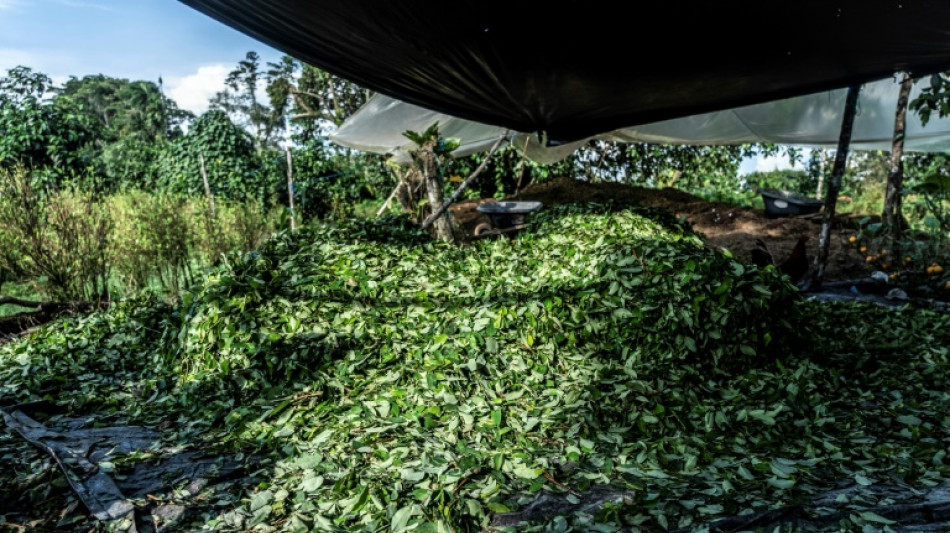
Cocaine price crash a blow for Colombian coca growers / Photo: Andres Buitrago - AFP

 French ex-minister Dati goes on trial in Renault-Nissan corruption case

 'Being Heumann' captures joy in fight for disability rights

 Retired great Nadal to play in exhibition matches

 IR-MED and Dice Technologies Announce collaboration to Evaluate and Advance Pressure-Injury Prevention Platform in Japan

 Watts, Pitt, Cruz to light up Spain's top film festival
 Sweden expels Iran embassy employee over anti-Jewish threats

 Toogood Gold's Table Mountain Sits in the Shadow of a Nevada Gold Rush

 MEXC July–August Security Report: 38.66M USDT in Risk Funds Intercepted, Futures Insurance Fund Hits 792M USDT

 'Breathing toxin every day': Indonesians choked by haze feel helpless

 Stocks edge higher ahead of US Fed rate call

 Philippines ex-leader Duterte makes first in-person ICC appearance

 2027 Formula One calendar includes Monaco sprint race

 Palestinians are the real victims, Thunberg tells Ed Sheeran

 Hashim Thaci: From 'George Washington of Kosovo' to Hague convict

 Amnesty says Iran committed 'crimes against humanity' in crackdown on 2022 protests

 EU to ban social media for under 13s, curb access until 15

 Philippines ex-leader Duterte makes first appearance at ICC

 EU chief pitches 'associate member' status for Canada

 English village votes to 'secede' from UK over asylum centre plan

 Wildfires push endangered Sumatran elephants to brink: Indonesian NGO

 Stocks head higher as traders prepare for Fed decision

 English village votes to 'secede' from UK over asylum centre

 Hong Kong unveils plan to align economy with China's goals

 Brazilian voters the latest to eye Bukele security model with envy

 EU chief hosts Canada's Carney in push to 'deepen' alliance

"Carlos," a 36-year-old coca grower in Colombia, is stuck hanging onto kilos of the valuable paste used to make cocaine stashed under his bed.
Normally, the illegal cache would be worth thousands of dollars, but a sudden dearth of buyers has left him high and dry and concerned about the future of his children.
Carlos is not his real name -- the grower wished to remain anonymous for fear of reprisals from armed groups operating near his farm in Llorente in Colombia's southern Narino department, where increasing numbers of small-scale coca producers worry where their next meal will come from.
Their hands covered in scratches, groups of "raspachines" or expert coca pickers, advance at great speed through the sea of green crops in Llorente.
Once harvested, the coca leaves reach Carlos, who cooks them, along with a mixture of chemicals, on a small stove until they yield a white substance.
Cultivating his two hectares had cost him about $660, Carlos told AFP, and normally he would be able to sell the product for about $4,000.
But with a dip in demand and historically low prices, he has so far sold only $154's worth. At the end of the trading chain, the cocaine made with his paste would be worth millions.
"Prices are (very) bad," Carlos told AFP in his small, makeshift lab.
"The only option is to keep it (the paste)," in the hopes that prices, and demand, will pick up.
- Illegal, but crucial -
Experts say the rise of synthetic opioids such as fentanyl, an "overproduction" of coca, changing consumer habits and several recent blows to Colombia's powerful drug cartels could all be contributing to the price drop.
Colombia remains the world's largest producer of cocaine -- of which coca is the main ingredient -- and the United States its biggest buyer.
Coca cultivation is illegal, but a mainstay for many in the South American country of 50 million people.
Some 250,000 Colombian families depend on coca for a living -- about 1.5 percent of the population, according to official figures.
All along the country's Pacific coast, however, coca growers have seen their incomes plummet since the beginning of the year.
The region, under the yoke of armed and violent dissidents of the FARC guerrilla group that disarmed in 2017, is where about 44 percent of Colombia's 204,000 hectares of coca was grown in 2021, according to the UN.
"At this time, the coca economy is not yielding a lot to survive on," grower Nilson Solis told AFP among his crops outside the town of Olaya Herrera, also near the Pacific coast.
Residents say the price for a kilogram of coca paste has dropped from about $695 to $440 in just a few months.
- 'Not a lot' -
It appears ironic that growers are struggling: Colombia broke its own record of land under coca cultivation two years ago, according to the latest available UN report.
Colombian government official Felipe Tascon said rising conflict between drug cartels and other armed groups fighting over resources and terrain may have made it more difficult to move product.
Julian Quintero, head of an NGO working to reduce risk from psychoactive drug use, said "overproduction" is also likely contributing to the drop in demand.
Coca has ever more "alkalinity and yield," which means less of it is needed to produce cocaine, he said.
And Rival drugs such as ecstasy are gaining ground among younger pleasure seekers, Quintero added.
Colombia's new leftist President Gustavo Petro visited Olaya Herrera this month, where he met community leaders and speculated that lower demand may also have to do "with the fact that Americans have changed their consumption, their tastes."
Synthetic opioids such as fentanyl, more powerful and addictive than cocaine, are proliferating in the United States.
Petro has criticized the US-led "war on drugs" that has criminalized and impoverished rural Colombians, and has mooted an amnesty for drug traffickers willing to give themselves up and abandon the trade.
He has also proposed purchasing arable land to redistribute to small farmers to make a living from legal crops, free from the violent yoke of the drug gangs they rely on to make a living.
Meanwhile, farmers like Solis are looking for alternatives as hunger stares more and more coca growers in the face. He is considering taking up illegal logging.
"When we take stock, we have nothing left," he told AFP.
"Barely enough to buy a pound of rice and a little oil."
M.Qasim--SF-PST