Colorado snow survey scoops up evidence for 'wet year' in US West / Photo: Jason Connolly - AFP

 Bills edge Texans while Bears beat Panthers in NFL record-setting opener

 Zverev holds off Shelton to win US Open title

 Torres fires PSG to first win of Ligue 1 season

 Toulouse back on track after hammering Bordeaux

 Referee body admits 'error' for Haaland goal in Manchester derby

 Sweden's election too close to call as far right loses ground

 Is it possible to slow down the development of AI?
 Jefferson-Wooden bags searing sprint double, Dos Santos on fire

 'Practical Magic 2' breaks Spidey spell over N. American box office

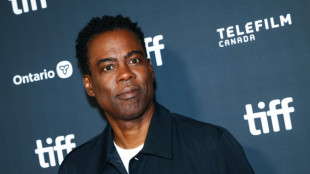 Comedian Chris Rock returns to directing with Hollywood drama 'Misty Green'
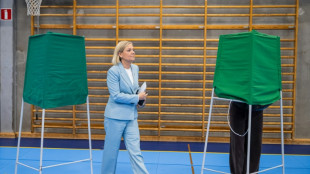
 Spaniard Mas claims 'special' home Vuelta a Espana triumph

 Jefferson-Wooden, Bednarek claim classy Ultimate sprint doubles

 Britain's Kerr wins men's Ultimate 1,500m

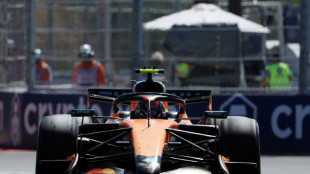 Luckless Norris wants change in safety car rules

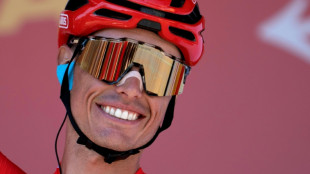 Spaniard Enric Mas wins home Vuelta a Espana

 Mercedes boss Wolff says long future for 'cucumber cool' Antonelli

 Kane edges Bayern past Elversberg in Bundesliga

 Trump administration reluctant to slow AI, Democrats see urgent need

 Five-star Leipzig return to form with Hamburg thumping

 Spain beat Germany to claim women's World Cup bronze

 أمودي يقترح رقابة مستقلة وتنسيقاً دولياً لضبط تطوير الذكاء الاصطناعي

 Antonelli profits from safety car pause to win Spanish GP

 Trump chastises Zelensky over Russian refinery strikes during Ireland visit

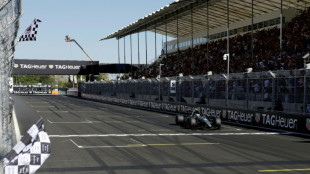 World championship leader Antonelli wins Spanish GP

 Resurgent Marquez powers to San Marino win to take MotoGP lead

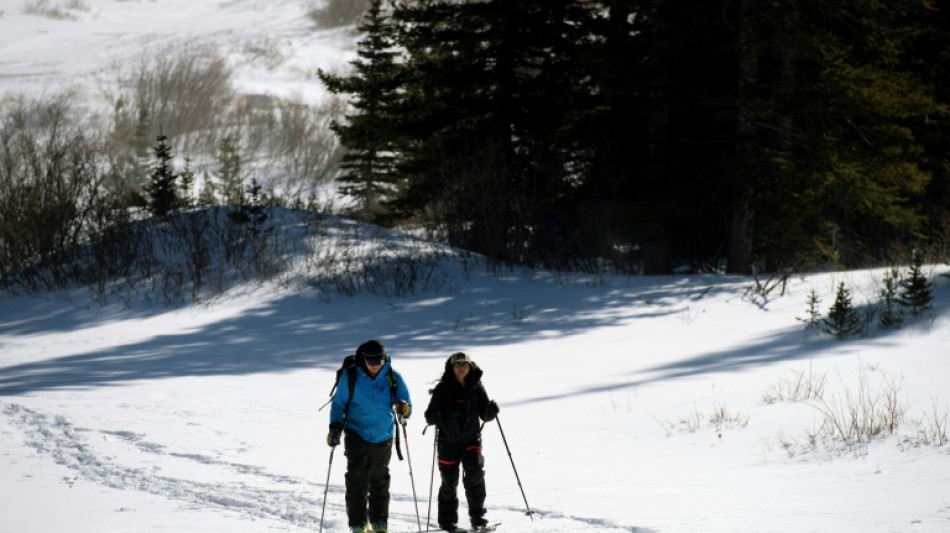
High up in a dazzlingly white, tree-lined valley of the Rocky Mountains, two scientists armed with skis and clipboards peer at the long hollow tube they have just thrust vertically into a pristine snow drift.
"Twenty-four inches, that's not so bad," says Brian Domonkos, before grabbing the metal cylinder -- now stuffed with snow -- and hitching it to a portable scale dangling from his colleague's ski pole.
Originally carried out using an improvised set of milk scales, this same measuring technique has been performed on this exact spot every winter since 1966, to assess the amount of water held in Colorado's crucial snowpack.
And while the remote, stunningly picturesque Mosquito Creek area feels like a different planet from Los Angeles, the data it yields remains vital for calculating how much water will reach the parched, sprawling cities of the American West each summer.
"We're all one water system," explains Domonkos. "Fifty to 80 percent of all the water we use in the West comes from mountain snow melt."
In this particular year, the stakes are unusually high. After more than two decades of drought, exacerbated by human-caused global warming, the region's giant reservoirs have dwindled to record lows.
While winter has finally brought biblical rains to coastal cities, much of that has already flowed into the Pacific Ocean.
So it is this powder, piled between pine trees atop the 10,000 foot- (3,000 meter-) high Colorado plateau, that will determine how much water is available to faraway urbanites in the coming dry months.
"The April snow survey measurement is really the pinnacle, the peak of the snowpack for most of Colorado," says Domonkos.
"That peak snowpack is the amount of water that's actually going to run off."
- Grizzly bears -
As well as taking manual measurements at dozens of similar sites, Colorado Snow Survey employees like Domonkos check and repair hi-tech, automated snow monitoring stations scattered across the Rockies.
The combined data they yield allows scientists to predict the year's snowpack, and the job is a huge responsibility, says his colleague Nagam Gill.
Their output is eagerly awaited by everyone from local ski and snowmobile resorts to the state's snowplow operators, foresters and hydroelectric power generators.
But perhaps more crucially, Colorado is obliged to share a set percentage of the water it receives each year with downstream states.
Calculate the year's snowfall wrong and send too much water down the river, and "you're never going to get that water back," said Domonkos.
Still, both scientists agree, the job has its advantages.
It frequently takes the pair -- via ski, snowshoe or snowmobile -- to beautiful unspoiled peaks and valleys of Colorado, New Mexico, Arizona and Wyoming.
Dozens of other scientists perform the same duties as far away as Alaska, travelling to the most remote spots on horseback or by helicopter.
"It's pretty much a dream job," said Domonkos, who occasionally paused the interview to quench his thirst with a scooped handful of pure white snow.
He said he frequently encounters moose and elk, and used to run into grizzly bears -- "a respectable amount" -- when he worked in Montana.
- 'Very wet year' -
During AFP's visit to Mosquito Creek, just east of the Continental Divide and 100 miles (160 kilometers) upstream from Denver, the snowpack is roughly similar to recent years.
But that is not the story for most of the region.
In the Colorado River Basin itself, which starts on the other side of this mountain and runs all the way to California, the snow is "a good bit better," says Domonkos.
Indeed, the National Oceanic and Atmospheric Administration is "seeing some really huge numbers" for snowmelt "forecasted to flow into reservoirs throughout the Upper Colorado River Basin" this summer, according to the organization's Paul Miller.
The federal science group's complex computer models now include data from satellite imagery and aircraft, but still rely really heavily on the long-running snow surveys, he told AFP.
Their conclusion? "It's going to be a very wet year," said Miller.
Indeed, 11 million acre-feet of water is expected to reach Lake Powell, the basin's first major reservoir -- almost double the annual average of 6.3 million.
An acre-foot refers to an acre covered in water a foot deep, which equals about half an Olympic-size swimming pool.
Lake Powell and Lake Mead -- another giant reservoir, near Las Vegas -- currently sit around a quarter-full, but "these numbers will probably get us up into the 30, 35 percent range," said Miller.
On current forecasts, this year will be the basin's ninth-wettest ever. If low temperatures and snowfall persist, it could break the top five.
But up on the mountain Domonkos, wrapped up warm in a blue ski jacket, sunglasses and a beanie hat, is remaining cautious.
"Even though we have a largely above-normal snowpack in the Colorado (basin), it doesn't mean we're going to have great runoff at this point," Domonkos says.
The drought has stretched on for so long, he warns, "it's going to take a number of years to overcome."
M.Qasim--SF-PST