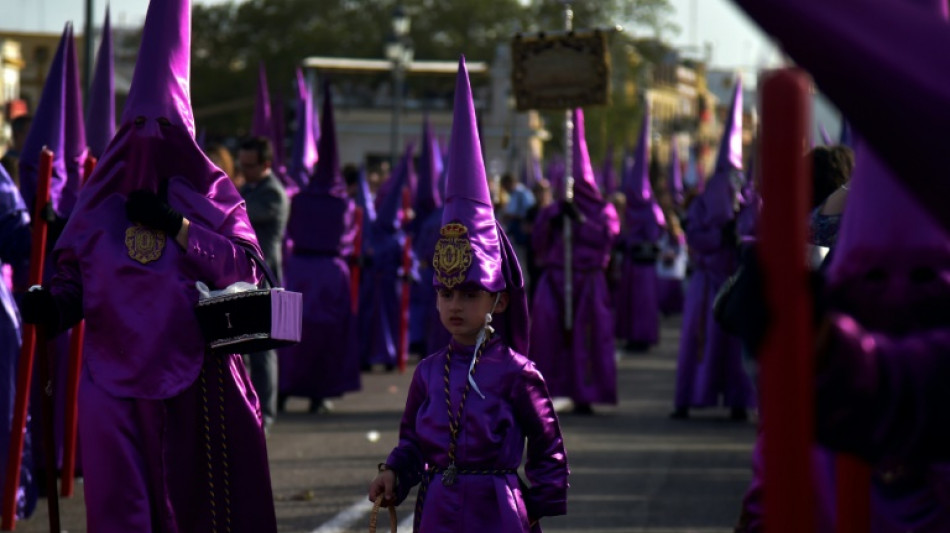
Spain's begins centuries-old Easter processions / Photo: CRISTINA QUICLER - AFP

 Zverev holds off Shelton to win US Open title
 Torres fires PSG to first win of Ligue 1 season
 Toulouse back on track after hammering Bordeaux

 Referee body admits 'error' for Haaland goal in Manchester derby

 Sweden's election too close to call as far right loses ground
 Is it possible to slow down the development of AI?
 Jefferson-Wooden bags searing sprint double, Dos Santos on fire

 'Practical Magic 2' breaks Spidey spell over N. American box office
 Comedian Chris Rock returns to directing with Hollywood drama 'Misty Green'
 Spaniard Mas claims 'special' home Vuelta a Espana triumph
 Jefferson-Wooden, Bednarek claim classy Ultimate sprint doubles

 Britain's Kerr wins men's Ultimate 1,500m

 Luckless Norris wants change in safety car rules
 Spaniard Enric Mas wins home Vuelta a Espana
 Mercedes boss Wolff says long future for 'cucumber cool' Antonelli
 Kane edges Bayern past Elversberg in Bundesliga

 Trump administration reluctant to slow AI, Democrats see urgent need
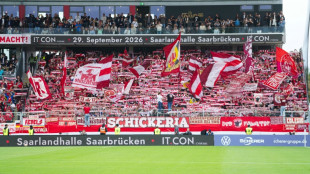 Five-star Leipzig return to form with Hamburg thumping
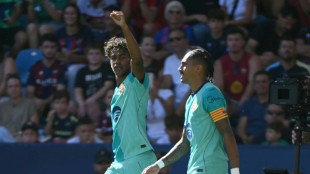
 Spain beat Germany to claim women's World Cup bronze

 أمودي يقترح رقابة مستقلة وتنسيقاً دولياً لضبط تطوير الذكاء الاصطناعي

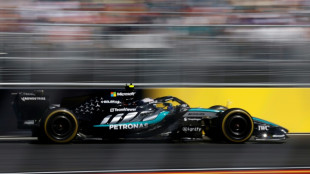 Antonelli profits from safety car pause to win Spanish GP

 Trump chastises Zelensky over Russian refinery strikes during Ireland visit

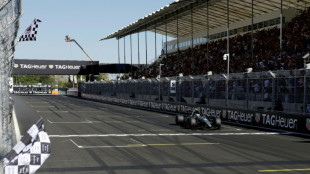 World championship leader Antonelli wins Spanish GP
 Resurgent Marquez powers to San Marino win to take MotoGP lead
 Vuelta finale neutralised after rider safety concerns

Spain's colourful Holy Week celebrations begin on Sunday, featuring centuries-old processions of the faithful carrying flower-covered floats topped with statues of Christ or the Virgin Mary that draw huge crowds.
Organised by various religious brotherhoods, or "confradias", the parades are held across the country in the week leading up to Easter Sunday, which this year in the Christian Church falls on April 9.
Depicting scenes from the story of the Passion of Christ, the floats are carried on the shoulders of members of the brotherhoods called "costaleros", often accompanied by solemn music from a brass band.
Other members of the brotherhoods accompany the floats wearing long robes with tall, pointed hoods that leave only two small holes for the eyes.
The precessions first appeared in the 15th and 16th centuries in Spain, which already had a tradition of biblical theatre depicting the Passion.
"Originally people went out on the streets with a cross," University of Navarra professor of church history Fermin Labarga told AFP.
They were accompanied by other members of religious brotherhoods who "performed acts of penitence" such as whipping their bare backs, he added.
These self-flagellations disappeared in the 18th century due to growing criticism that they "were not done out of devotion but for ostentation", Labarga said.
- Elaborate, extravagant parades -
But the tradition of staging Easter processions continued.
The goal of the parades was to "remember the Passion (of Christ)" -- the week of the crucifixion and resurrection of Jesus -- and "strengthen belief", said Labarga.
While Spain, like most European nations, has grown increasingly secular in recent decades, the parades continue to draw huge crowds of all levels of devotion and all walks of life.
Many of the more famous processions are broadcast live on TV.
Labarda called them a "complete performance".
Spaniards love the processions "because they are aesthetically beautiful and they incorporate festive elements which make them very attractive, with music, images and movement", he added.
The most elaborate and extravagant parades are held in the southwestern region of Andalucia, particularly in its capital, Seville, and in the northern city of Valladolid.
The Passion Procession held in Valladolid on Good Friday has over 1,000 participants and dozens of floats.
- Crucifixion and resurrection -
Typically, the most dramatic and fervent processions take place on Maundy Thursday and Good Friday, when mourners dressed in black lace often join in to mark Christ's death.
On Easter Sunday, when Christ's miraculous resurrection is celebrated, the parades become more jubilant, with more lively music.
During the 16th and 17th centuries, Spain exported its Easter parade tradition to its overseas possessions, mainly in Latin America.
Processions are especially popular in Guatemala, Mexico, Peru and Venezuela.
Guatemala's Holy Week -- a vibrant celebration that mixes Mayan rituals with Catholic religious fervour -- was last year given UNESCO heritage status.
Spain also introduced these processions to the parts of southern Italy which it ruled until the 18th century.
The legacy can also be found in the Philippines, which Spain ruled until 1898.
R.AbuNasser--SF-PST