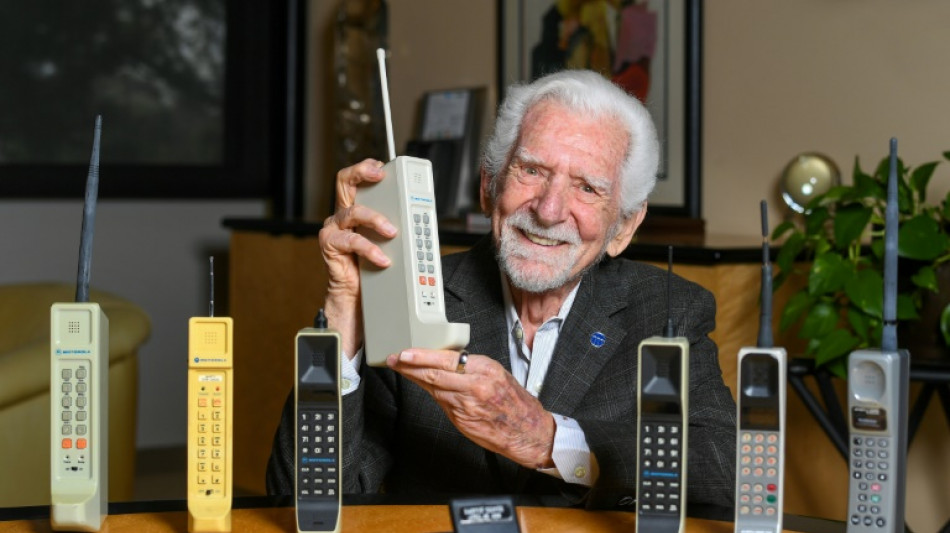
Take your eyes off your mobile phone, says inventor, 50 years on / Photo: VALERIE MACON - AFP

 US fight off spirited France to win 12th World Cup
 Drivers give cool reception to new Madring circuit

 Maresca makes flawless Man City start to leave Man Utd trailing

 Dozens arrested in major anti-LGBTQ raids in Turkey

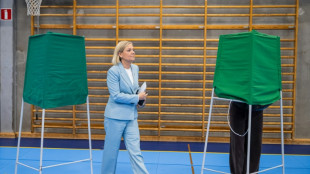 Leftwing opposition seen leading Sweden election, far-right losing ground

 Senegal goalkeeper Mendy retires from international football

 Carrick 'worried' by decision to award Man City winner

 Lobotka eases pressure on Allegri with Napoli winner

 Trump watches as Lowry wins Irish Open in record-breaking style

 Poland, Ukraine slam Russian strikes near border as 'escalation'

 Haaland fires 10-man Man City to memorable win over Man Utd

 I miss the adrenaline, but it's not my moment - Bolt
 Championship leader Antonelli to 'keep pushing' for title

 Yamal double helps Barca edge Levante thriller

 دراسة على مستفيدي ميديكيد ترصد فجوة في العمر المتوقع للمصابين بالتوحد
 Brighton run rampant against 10-man Coventry

 Late Mbappe goal sends Lille top of Ligue 1

 Five-star Brighton crush 10-man Coventry

 Team Europe beat United States to reclaim Solheim Cup

 US House Speaker warns curbing AI too sharply could leave China ahead

 張國榮70歲誕辰音樂會西九舉行 唐鶴德錄音致意

 Iran's economic ties to Dubai hard to break despite war
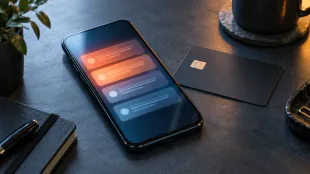 iPhone 18預購後出現可疑扣款 四間銀行調查未授權交易

 《浪花男女》辦特別謝票場 馮志強談票房與導演客串拍攝

 Former captain De Villiers hails 'fantastic' Springboks

The problem with mobile phones is that people look at them too much. At least, that's according to the man who invented them 50 years ago.
Martin Cooper, an American engineer dubbed the "Father of the cell phone," says the neat little device we all have in our pockets has almost boundless potential and could one day even help conquer disease.
But right now, we can be a little obsessed.
"I am devastated when I see somebody crossing the street and looking at their cell phone. They are out of their minds," the 94-year-old told AFP from his office in Del Mar, California.
"But after a few people get run over by cars, they'll figure it out," he joked.
Cooper wears an Apple Watch and uses a top-end iPhone, flicking intuitively between his email, photos, YouTube and the controls for his hearing aid.
He gets his hands on the latest model every time it is updated, and gives it a thorough road test.
But, he confesses, with several million apps available, it can all feel a bit much.
"I will never, ever understand how to use the cell phone the way my grandchildren and great grandchildren do," he says.
- Real mobility -
Cooper's iPhone -- which he says he likes to use mostly to speak to people -- is certainly a very long way from the weighty block of wires and circuits that he used to make the very first mobile phone call on April 3, 1973.
At the time he was working for Motorola, leading a team of designers and engineers who were engaged in a sprint to come up with the first properly mobile technology and avoid being squeezed out of an up-and-coming market.
The company had invested millions of dollars in the project, hoping to beat out Bell System, a behemoth that dominated US telecoms for more than a century from its inception in 1877.
Bell's engineers had floated the idea of a cellular phone system just after World War II, and by the late 1960s had taken it as far as putting phones in cars -- partially because of the huge battery they needed.
But for Cooper, that didn't represent real mobility.
At the tail end of 1972, he decided he wanted a device that you could use anywhere.
So with the entire resources of Motorola at his disposal, he pulled together experts on semiconductors, transistors, filters and antennae who worked around the clock for three months.
By the end of March, they had cracked it, unveiling the DynaTAC -- Dynamic Adaptive Total Area Coverage -- phone.
"This phone weighed over a kilo -- about two and a half pounds -- and had a battery life of roughly 25 minutes of talking," he said.
"That was not a problem. This phone was so heavy, you couldn't hold it up for 25 minutes."
That very first phone call didn't have to be long. It just had to work.
And who better for Cooper to call than his rival?
"So here I am standing on Sixth Avenue (in New York) And it occurred to me I had to call my counterpart at the The Bell System... Dr Joel Engel
"And I said, 'Joel, this is Martin Cooper... I'm talking to you on a handheld cell phone. But a real cell phone, personal, portable, handheld.'
"There was silence on the other end of the line. I think he was gritting his teeth."
- 'Conquer disease' -
Those first mobile phones were not cheap at around $5,000 per handset, but they granted early adopters -- who Cooper says included people trying to sell property -- an edge.
"It turns out that what real estate people do is they show people houses, or they answer the phone for new clients.
"Now they could do both at the same time; it doubled their productivity."
And mobile phones continue to improve people's lives.
"The cell phone has now become an extension of the person, it can do so many more things," he said.
"And in that regard, we are just at the very beginning. We're just starting to understand what that could do.
"In the future, we can expect the cell phone to revolutionize education, it will revolutionize healthcare.
"I know that sounds like an exaggeration, but I want you to know within a generation or two, we are going to conquer disease."
Just like his watch monitors his heartrate while he swims, and his phone monitors his hearing aids, phones will one day be connected to an array of bodily sensors that will catch illness before it develops, he says.
It's all a long way from where it started with that monster handset, but while he didn't envisage every development, Cooper always knew the device he and his team came up with would change the world.
"We really knew that everybody someday would have a cell phone. We're almost there.
"There are more mobile phone subscriptions in the world today than there are people. So that part of our dream has come true."
As for the problem of people gawping at their phones too much -- even as they cross the road -- he's not worried.
New technology often throws up challenges.
"When television first came out, people were just hypnotized.
"But we somehow... managed to understand that there is a quality associated with looking at a television."
Right now, we're at the mindless staring phase with our phones, he says, but that won't last.
"Each generation is going to be smarter... They will learn how to use the cell phone more effectively.
"Humans sooner or later figure it out."
C.Hamad--SF-PST