California's cannabis black market thrives despite legalization / Photo: Robyn BECK - AFP

 US fight off spirited France to win 12th World Cup

 Drivers give cool reception to new Madring circuit

 Maresca makes flawless Man City start to leave Man Utd trailing

 Dozens arrested in major anti-LGBTQ raids in Turkey
 Leftwing opposition seen leading Sweden election, far-right losing ground
 Senegal goalkeeper Mendy retires from international football

 Carrick 'worried' by decision to award Man City winner

 Lobotka eases pressure on Allegri with Napoli winner
 Trump watches as Lowry wins Irish Open in record-breaking style

 Poland, Ukraine slam Russian strikes near border as 'escalation'

 Haaland fires 10-man Man City to memorable win over Man Utd
 I miss the adrenaline, but it's not my moment - Bolt
 Championship leader Antonelli to 'keep pushing' for title

 Yamal double helps Barca edge Levante thriller

 دراسة على مستفيدي ميديكيد ترصد فجوة في العمر المتوقع للمصابين بالتوحد

 Brighton run rampant against 10-man Coventry

 Late Mbappe goal sends Lille top of Ligue 1

 Five-star Brighton crush 10-man Coventry
 Team Europe beat United States to reclaim Solheim Cup

 US House Speaker warns curbing AI too sharply could leave China ahead
 張國榮70歲誕辰音樂會西九舉行 唐鶴德錄音致意

 Iran's economic ties to Dubai hard to break despite war
 iPhone 18預購後出現可疑扣款 四間銀行調查未授權交易
 《浪花男女》辦特別謝票場 馮志強談票房與導演客串拍攝
 Former captain De Villiers hails 'fantastic' Springboks

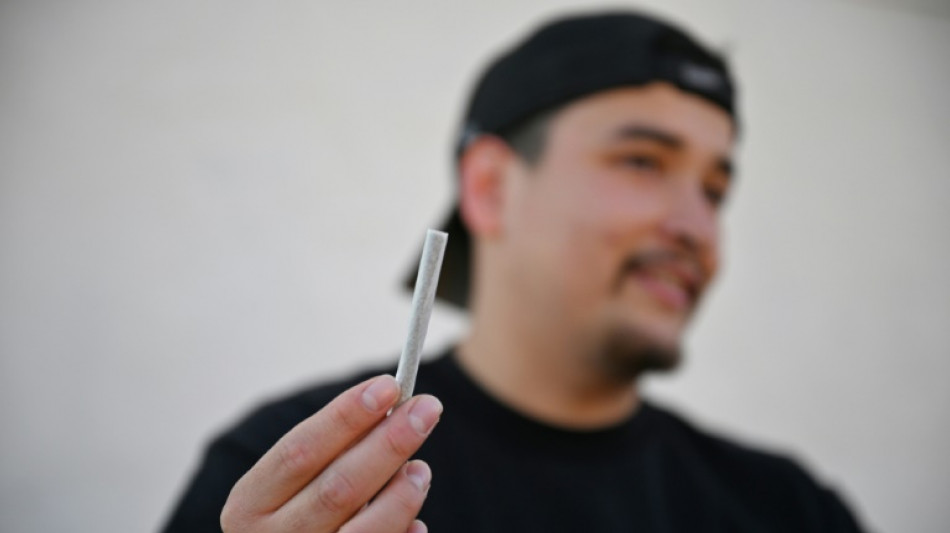
Omar Buddakey emerges from a nondescript building in Los Angeles with a joint in his hand.
Five years after cannabis was legalized in California, black market transactions like this one -- where no one pays any taxes, and the product is not regulated -- remain commonplace.
"Legal shops are too expensive," the 27-year-old tells AFP, as he lights up his preroll.
Over the course of a year Buddakey estimates he saves the equivalent of a paycheck from his patient transport job by avoiding the state-sanctioned outlets.
"I'd rather pay less for the same thing. And I know it's the same thing, because it gives me the same feeling."
Buddakey's working-class neighborhood in east Los Angeles is teeming with stores like this one, many marked by a green cross.
Although they are illegal, they openly advertise online, and many have their own websites.
Inside one of them, a man who gives his name only as "Joe" welcomes a steady stream of customers who are offered a selection of buds and leaves.
Here, an ounce (30 grams) of weed sells for $100 -- $35 less than at a state-regulated store.
"Cops have raided this shop probably eight to 10 times," he tells AFP. "They take the weed, our cameras and all the cash.
"We just re-open the next hour or the next day."
- 'Nickelled and dimed' -
A 2016 referendum legalized recreational use of cannabis in California, 20 years after it was permitted for medical use with a prescription.
The idea was to rid the streets of illegal sellers, to regulate the substance to ensure it was of sufficient quality, and to raise tax for state coffers -- goals shared by other jurisdictions, including Canada, Uruguay and Germany.
The first legal shops opened in 2018, and are now found in many cities throughout the state.
Few thoroughfares in Los Angeles are without one, from straightforward holes-in-the-wall to glitzy boutiques, where a cannabis sommelier -- or "budtender" -- can recommend the right blend, and expects a tip for their services.
But the rush of stores has not dented the size of the underground market, which has remained steady at around $8 billion a year, according to Tom Adams of Global Go Analytics.
The legal business is struggling. In 2022, sanctioned cannabis sales fell 8.2 percent to $5.3 billion.
"California is now paying for the two fatal errors it made when designing its program," says Adams. "They loaded it up with too many taxes, and too many regulations."
Indeed the rules around cannabis selling are complicated, and -- like many things in California -- are subject to separate, and sometimes overlapping, jurisdictions.
Each city or county has the final say in whether to allow the sale of recreational cannabis on its turf. As a result, less than 40 percent of them have given the green light.
The state's 40 million inhabitants can buy cannabis from 1,100 legal stores, but they are far from evenly spread, leaving a large base of customers who have no option but to buy from illegal vendors.
And in areas where trade is allowed, "we're just nickelled and dimed to death," says Nathan Holtz-Poole, of Green Goddess Collective in Venice Beach, which employs 18 people.
"Unfortunately, that is putting a real strain on the industry."
Excise and sales taxes imposed by both the California government and the city add 35 percent to the cost of weed bought legally, Holtz-Poole explains.
His lavishly decorated, herbalist-like dispensary offers everything from home-grown plants to ultra-potent cannabis concentrates, from gummies to drinks.
Despite chasing the premium sector of the market, he's not exactly coining it in, the 57-year old businessman says.
"We're barely surviving. We break even, at best."
Competition from illegal sellers eats into his bottom line, he says, estimating that he loses 30 percent of his customers to outlets who don't have to file tax returns.
It's common knowledge, Holtz-Poole says, that you can get products containing THC -- the psychoactive ingredient in marijuana that causes a high -- from some places that are only supposed to be selling CBD, a marijuana derivative that doesn't give users a buzz.
Despite his regular reports to police, "there is just no enforcement at all," he sighs. "We feel completely abandoned."
Police officers say they are climbing a mountain with one hand tied behind their backs.
"We're working our butts off," says Michael Boylls, who heads the Cannabis Support Unit in the Los Angeles Police Department's Gang and Narcotics Division.
His men carry out 300 to 400 searches a year and sometimes have illegal businesses shut down.
But sellers rarely face more than a fine and quickly return to business.
"The problem is there's no teeth in the law," he says.
K.AbuTaha--SF-PST