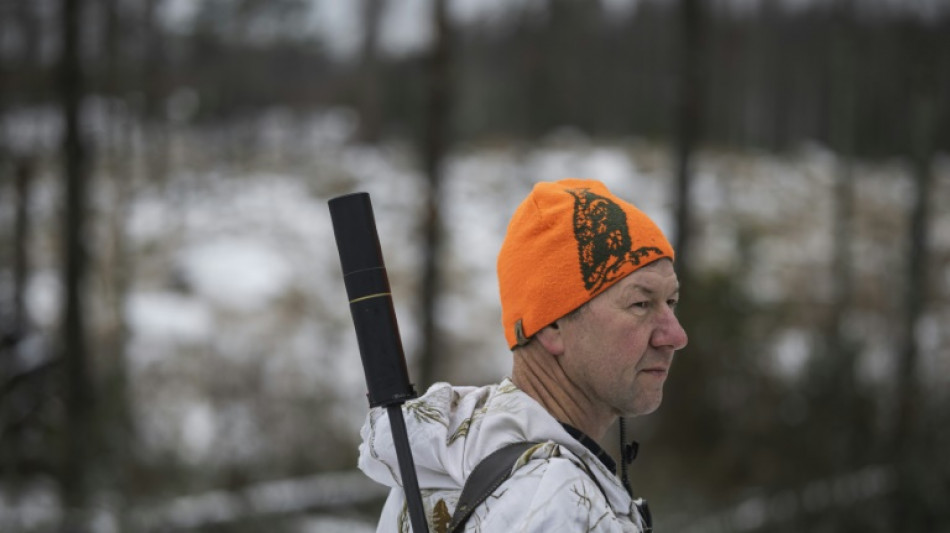
Emotions run high in Sweden's biggest wolf hunt / Photo: Jonathan NACKSTRAND - AFP

 Crash and burn: Pakistan cricket at a new low after England humiliation

 'Second life': Nepal tunnel survivor recalls ordeal

 Hong Kong homes flattened for US$28 bn high-tech hub

 'Be careful what you wish for': 'Obsession' director and star reflect on success

 Messi scores but Miami held by Nashville

 US Open champ Rybakina on top of world after injury scare

 Rybakina reigns serene as new world number one

 South Africa defeat New Zealand 43-28 to complete 3-1 series victory

 Rybakina triumphs in US Open, denies Sabalenka three-peat

 Akron fan's honorary play-calling stint ends with opening-drive fumble

 Louisiana's developing roster faces USC as Trojans enter as heavy favorites

 Christa Pike seeks clemency before September 30 execution in Tennessee

 Utah hosts Arkansas as both programs begin seasons under new coaches
 Maryland groups seek statewide data center pause after local moratoriums spread
 Winston County trash-debt prosecutions face challenge from civil-rights lawyers

 Fifth Circuit upholds dismissal of Jackson residents' constitutional water claims

 Anthropic details Claude misuse as US targets major illicit online marketplace

 Japanese floating parking platform is designed to lift cars above floodwater

 Arteta blasts 'unacceptable' Sunderland penalty despite Arsenal win

 Mbappe at the double as Real Madrid sink Rayo

 Arsenal extend perfect Premier League start as Chelsea, Liverpool held

 US survive Spain scare to book World Cup final clash with France

 Celine Dion makes long-awaited return to stage in Paris

 Werro crowned Ultimate queen, US sweep 100m races

 Venezuelans outside Caracas say capital not sharing blackout burden

Hunter Lars Bjork points to fresh tracks in the snow as he lumbers through a whited-out forest in central Sweden, where the biggest wolf hunt in modern times is drawing controversy.
"We have quite a lot of wolves here, we're actually sitting in a new wolf territory where we are now," Bjork, a predator expert at the Swedish Hunters' Association, tells AFP as he settles into a small hunting lodge a few kilometres (miles) outside the town of Vasteras.
Long known as a champion of environmental protection, Sweden has paradoxically had a centuries-long opposition to wolves, considered a plague in the 1800s with the state paying out bounties for kills as late as the mid-20th century.
Still seen as a threat by farmers, the state now sanctions a limited cull of the animals every year.
This year, Sweden's hunters are allowed to kill a record 75 wolves out of an estimated population of 460, according to the Swedish Environmental Protection Agency's latest inventory.
That is more than twice the number that hunters were allowed to kill last year, and the highest number since the culls began in 2010.
A total of 54 wolves had been killed as of Sunday.
Several local authorities have already called off the hunt in their regions, and the full quota isn't expected to be reached by the February 15 deadline.
Nonetheless, the wolf hunt remains a highly divisive issue, both inside and outside the Nordic nation.
- Rural problems -
After Sweden's wolves were hunted to the brink of extinction, the country declared them a protected species in the 1960s.
Wolves started reappearing in the late 1970s and 1980s, before populations started growing in the 1990s.
As their numbers surpassed 200, Sweden began allowing licensed hunts in 2010, issuing quotas for the number that can be killed during a set period.
"The purpose is simply to limit the problems they cause out in more rural areas," 59-year-old Bjork explains.
For farmers, wolves are a menace as they occasionally attack livestock, primarily sheep.
They also pose a threat to hunting dogs, used to track and drive wild game such as deer and elk.
Sweden also allows yearly hunts of brown bears, wolverines and lynx -- all considered endangered -- in order to limit damage to livestock and reindeer.
Reindeer are integral to the indigenous Sami people's way of life in the far north.
All hunts have detractors, but the wolf hunt has been particularly acrimonious since its inception.
Opponents of the hunt argue wolves are needed to protect biodiversity, playing an important role as predators.
"It is astonishing that Sweden keeps on making these decisions," says Marie Stegard Lind, vice president of Jaktkritikerna, a group working to limit hunting.
The hunts continue "in spite of the fact that the European Commission has been very clear about its opinion that these hunts are in fact illegal", she tells AFP at the group's office in Stockholm.
In 2015, the European Commission warned that Sweden's wolf hunt fell foul of the EU's Habitats Directive, noting that the wolf "population has not reached a level that guarantees the conservation of the species".
Other EU members with growing wolf populations have called on the Commission to update its Habitats Directive to better protect livestock farming.
- Question of numbers -
Kjell-Arne Ottosson, a Swedish member of parliament for the Christian Democrats and vice president of the environment and agriculture committee, tells AFP that Sweden needs to stand its ground against the EU.
"Wolves are a threat for those of us who live in rural areas. We have to manage that, we have to take this seriously," Ottoson says.
The only fatal wolf attack in modern times against a person in Sweden was in 2012, when a captive wolf attacked a keeper at the Kolmarden Wildlife Park.
But the issue often boils down to disputes over an acceptable size for the wolf population in terms of impact and risks, and ensuring there are enough wolves to limit inbreeding.
According to the Swedish Environmental Protection Agency, at least 300 are necessary to sustain a healthy population.
In a letter published by magazine Science in July 2022, a group of scientists argued the culls were a threat to a healthy Swedish wolf population.
They said the stocks that span Scandinavia and Finland should be kept above 500.
Conversely, Sweden's parliament in 2021 voted to cap the population at 270 wolves.
The Swedish Hunters' Association wants to go even further and lower the limit to 150 wolves, spread across the country.
Currently the animals are mostly found in the central and western parts of Sweden.
"The wolf has a place here, absolutely," hunter Bjork says.
"But not in the amounts we have today and not in the concentrations we have today."
G.AbuOdeh--SF-PST