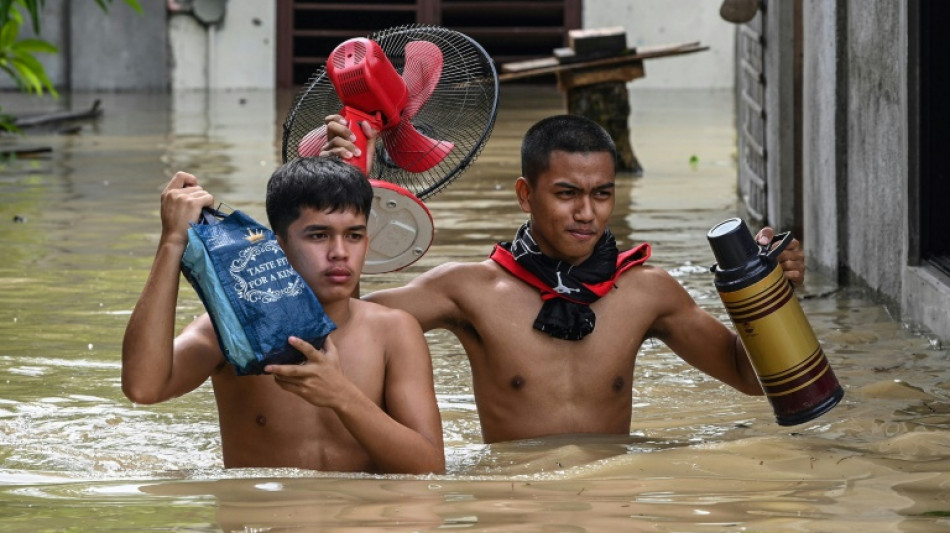
Five rescuers killed in Philippine typhoon / Photo: Ted ALJIBE - AFP

 UK chalks up hottest summer on record for second year running

 China's Xi visits Egypt as US sanctions threat looms over Iran links

 RISE Robotics Awarded $100,000 MassVentures Grant to Accelerate Commercialization of Beltdraulic Technology

 Global bond sell-off deepens on inflation concerns

 Germany's far-right AfD promises 'boom' but economists fear worst

 Former England captain Stokes signs for Adelaide Strikers

 Pakistan selector and ex-captain Misbah resigns after coach sacked
 Shein flattens on Hong Kong debut facing global headwinds

 Eurozone inflation hits three-year high at 3.3% in August
 Man City chase Fernandez, Arsenal eye Alvarez on deadline day
 El Nino hammering Peru anchovy fishing: industry officials

 Mass Russian barrage kills 12 in Kyiv

 PineX Capital Launches MetaTrader 5 as Prop Firm Expands Trading Platform Offering
 Women survivors face sanitation woes in Nepal relief camp
 Oil extends gains, stocks mixed as Trump issues fresh Iran warning

 Thai resort readies for US carrier's 5,000 sailors
 AI startup Manus says resumes independent operations

 'Massive' Russian missile, drone attack on Kyiv kills 8
 Defence tech hub Munich booms as Europe rearms
 Nigeria rethinks criminalisation of suicide
 Osaka channels NBA icon Iverson to reach US Open second round

 Fast-fashion giant Shein plunges 10% on Hong Kong debut
 South Korea hire former Spain boss Moreno as interim coach

 China-Taiwan friction clouds Pacific summit

 Two dead after stabbing in New York's Times Square

Five rescuers were killed in the Philippines after they were sent to a flooded community during a powerful typhoon, authorities said Monday, the first confirmed casualties of the strongest storm to hit the country this year.
The typhoon dumped heavy rain and unleashed fierce winds as it swept across the main island of Luzon on Sunday and Monday, toppling trees and flooding low-lying communities.
So far, there have been no reports of widespread severe damage.
The five rescuers were in San Miguel municipality in Bulacan province, near the capital Manila, when they died.
"They were deployed by the provincial government to a flooded area," said Lieutenant-Colonel Romualdo Andres, chief of police in San Miguel.
Andres said the rescuers were wading through floodwaters when a wall beside them collapsed, sending them into the fast current.
The Philippines is regularly ravaged by storms, with scientists warning they are becoming more powerful as the world gets warmer because of climate change.
Super Typhoon Noru smashed into the archipelago nation on Sunday after an unprecedented "explosive intensification" in wind speeds, the state weather forecaster said earlier.
It made landfall about 100 kilometres (62 miles) northeast of the densely populated capital Manila, before weakening to a typhoon as it crossed a mountain range, coconut plantations and rice fields.
Nearly 75,000 people were evacuated from their homes before the storm hit, as the meteorology agency warned heavy rain could cause "serious flooding" in vulnerable areas, trigger landslides and destroy crops.
But on Monday morning there was no sign of the widespread devastation many had feared.
"We were ready for all of this," President Ferdinand Marcos Jr told a briefing with disaster agencies.
"You might think that we overdid it. There is no such thing as overkill when it comes to disasters."
Burdeos municipality on the Polillo islands, part of Quezon province, bore the brunt of Noru as it made landfall.
Fierce winds ripped off some roofs and brought down large trees while heavy rain flooded riverside houses, said Ervin Calleja, a 49-year-old teacher.
"It was really worrisome," Calleja told AFP by mobile phone.
"The wind was whistling and it had heavy rains. That's the more dangerous part."
Despite taking the full force of the typhoon, authorities said it passed over quickly and there were so far no reports of major damage to houses. But some crops were wiped out.
"Here at the town centre all banana trees were flattened, 100 percent," said Liezel Calusin, a member of the civil defence team in Polillo municipality.
"We still have no electricity, but the phones are working."
In Banaba village near Manila, Terrence Reyes fled his riverside home with his family and neighbours during the storm as floodwaters rose.
They returned home Monday to find their belongings caked in mud.
"We just have to throw them away and start over again," Reyes, 25, said.
"It happens each time there is a storm here."
The Philippines -- ranked among the most vulnerable nations to the impacts of climate change -- is hit by an average of 20 storms every year.
O.Salim--SF-PST