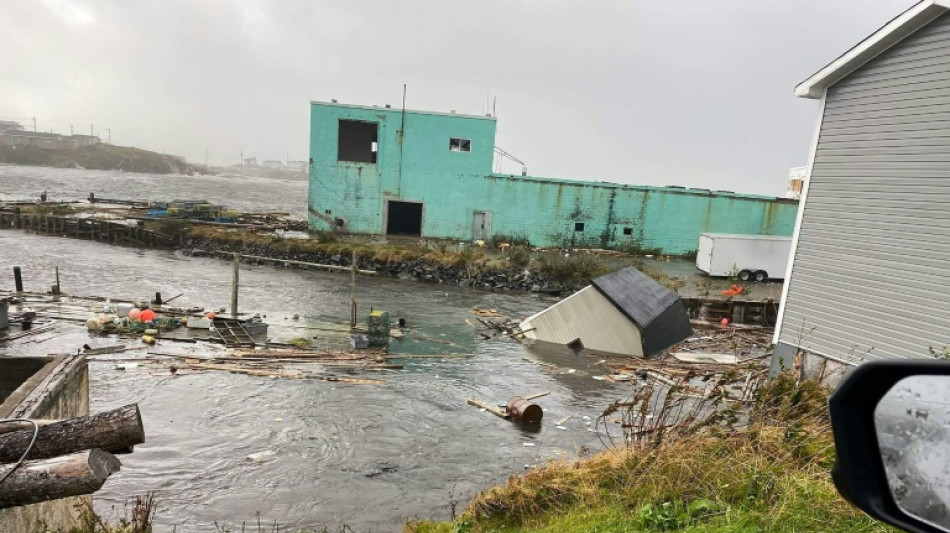
Eastern Canada looks to clean up as storm Fiona calms / Photo: Handout - Michael King/AFP

 UK chalks up hottest summer on record for second year running

 China's Xi visits Egypt as US sanctions threat looms over Iran links

 RISE Robotics Awarded $100,000 MassVentures Grant to Accelerate Commercialization of Beltdraulic Technology

 Global bond sell-off deepens on inflation concerns

 Germany's far-right AfD promises 'boom' but economists fear worst

 Former England captain Stokes signs for Adelaide Strikers

 Pakistan selector and ex-captain Misbah resigns after coach sacked

 Shein flattens on Hong Kong debut facing global headwinds

 Eurozone inflation hits three-year high at 3.3% in August
 Man City chase Fernandez, Arsenal eye Alvarez on deadline day

 El Nino hammering Peru anchovy fishing: industry officials

 Mass Russian barrage kills 12 in Kyiv

 PineX Capital Launches MetaTrader 5 as Prop Firm Expands Trading Platform Offering
 Women survivors face sanitation woes in Nepal relief camp

 Oil extends gains, stocks mixed as Trump issues fresh Iran warning

 Thai resort readies for US carrier's 5,000 sailors
 AI startup Manus says resumes independent operations

 'Massive' Russian missile, drone attack on Kyiv kills 8

 Defence tech hub Munich booms as Europe rearms
 Nigeria rethinks criminalisation of suicide

 Osaka channels NBA icon Iverson to reach US Open second round

 Fast-fashion giant Shein plunges 10% on Hong Kong debut
 South Korea hire former Spain boss Moreno as interim coach

 China-Taiwan friction clouds Pacific summit

 Two dead after stabbing in New York's Times Square

Parts of eastern Canada were waking up to damage from powerful storm Fiona on Sunday, as meteorologists said the worst weather had passed.
The storm tore into Nova Scotia and Newfoundland on Saturday, cutting power to thousands and washing houses into the sea as it brought fierce winds and rains "like nothing we've ever seen," police said.
Two women were swept into the ocean in Newfoundland, the Royal Canadian Mounted Police said. One was rescued, and investigators were looking into the second case.
Mayor Brian Button of Channel-Port aux Basques, on the southwestern tip of Newfoundland, said in a Facebook video Saturday night that at least 20 homes had been destroyed and the community looked like a "total warzone."
"We've got destruction everywhere."
A boil water order was in effect, Button said, encouraging residents in need to take shelter at a local elementary school.
As of late Saturday afternoon, nearly 500,000 homes were without power across the region as the storm hammered a wide area, felling countless trees and ripping roofs from buildings.
"The power lines are down everywhere," Erica Fleck, assistant chief of Halifax Regional Fire and Emergency, told CBC. "It's not safe to be on the roads."
Although downgraded to a post-tropical cyclone, Fiona still packed hurricane-force winds of 80 miles (130 kilometers) per hour as it first barreled into Canada after earlier battering the Caribbean, according to meteorologists.
By early Sunday, the storm's maximum sustained winds had slowed to 50 mph, according to the Canadian Hurricane Centre (CHC), with the government forecasting "strong winds" over northern Newfoundland, southeastern Labrador and southeastern Quebec.
"These winds will diminish later today," the CHC said.
- Nova Scotia hard hit -
The storm first made landfall in Nova Scotia province around 3 am (0600 GMT), according to the CHC.
By Saturday night, 294,000 households were still without electricity in the province, Nova Scotia Power reported, though repairs had started on some lines.
The utility's president said outages could last for days.
In New Brunswick, more than 25,000 were still without power while 82,000 customers were without electricity on Prince Edward Island.
"Trees have come down on homes, trees have come down on cars, there's buildings that have collapsed," Fire Chief Lloyd MacIntosh in the Nova Scotia town of North Sydney told CBC.
Police in Charlottetown, the capital of Prince Edward Island, posted images of tangles of downed power lines and roofs punctured by felled trees.
"It's incredible," said Charlottetown mayor Philip Brown on Radio-Canada TV. "It's stronger than Hurricane Juan in 2003."
Nova Scotia Premier Tim Houston said in a statement that "it will take time for Nova Scotia to recover. I just ask everyone for their patience."
Prime Minister Justin Trudeau, who canceled his trip to Japan for former prime minister Shinzo Abe's funeral so that he can travel to the affected regions, told Canadians that the "government is standing ready to support provinces with any necessary resources."
"We're thinking first and foremost of the people who've had a terrifying past 12 hours," Trudeau said during a press conference Saturday, adding that the country's military would aid in the recovery effort.
Canada had issued severe weather warnings for swaths of its eastern coast, advising people to lay in supplies for at least 72 hours.
Rainfall of up to 7.5 inches (192 millimeters) was recorded in Nova Scotia, the CHC said, with waves of up to 40 feet (12 meters) hitting Nova Scotia and western Newfoundland.
The CHC said early Sunday the storm had passed Nova Scotia and moved inland to southeastern Quebec, predicting it would continue to weaken as it tracks across southeastern Labrador and over the Labrador Sea.
- Puerto Rico struggling -
Fiona killed at least four people in Puerto Rico earlier this week, according to US media, while two deaths were reported in the Dominican Republic and one in the French overseas department of Guadeloupe.
President Joe Biden declared a state of emergency in Puerto Rico, a US territory that is still struggling to recover from Hurricane Maria five years ago.
The storm had skirted Bermuda on Friday. No fatalities or major damage were reported.
As the Caribbean licked its wounds, Cuba, Jamaica and Florida were bracing Sunday for the arrival of tropical storm Ian, which is expected to gain power in coming days to reach "at or near major hurricane strength," the NHC said.
In anticipation of the storm, NASA called off the scheduled Tuesday launch of its historic uncrewed mission to the Moon, and Biden approved a state of emergency in Florida.
burs/sw/bbk/caw/ssy/mca/qan
Q.Najjar--SF-PST