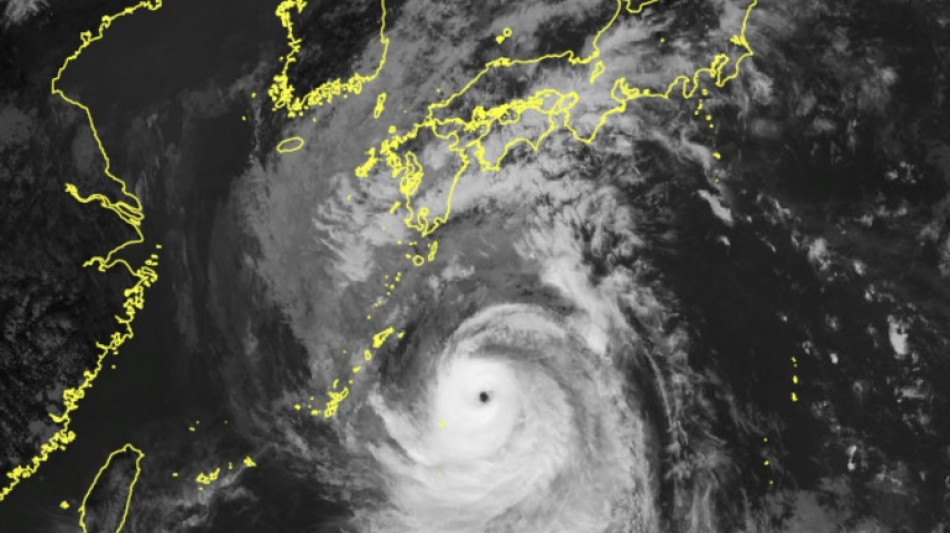
Millions told to seek shelter as Japan warns on Typhoon Nanmadol / Photo: Handout - Japan Meteorological Agency/AFP

 UK chalks up hottest summer on record for second year running

 China's Xi visits Egypt as US sanctions threat looms over Iran links

 RISE Robotics Awarded $100,000 MassVentures Grant to Accelerate Commercialization of Beltdraulic Technology

 Global bond sell-off deepens on inflation concerns

 Germany's far-right AfD promises 'boom' but economists fear worst

 Former England captain Stokes signs for Adelaide Strikers

 Pakistan selector and ex-captain Misbah resigns after coach sacked

 Shein flattens on Hong Kong debut facing global headwinds

 Eurozone inflation hits three-year high at 3.3% in August
 Man City chase Fernandez, Arsenal eye Alvarez on deadline day

 El Nino hammering Peru anchovy fishing: industry officials

 Mass Russian barrage kills 12 in Kyiv

 PineX Capital Launches MetaTrader 5 as Prop Firm Expands Trading Platform Offering
 Women survivors face sanitation woes in Nepal relief camp

 Oil extends gains, stocks mixed as Trump issues fresh Iran warning

 Thai resort readies for US carrier's 5,000 sailors

 AI startup Manus says resumes independent operations

 'Massive' Russian missile, drone attack on Kyiv kills 8

 Defence tech hub Munich booms as Europe rearms

 Nigeria rethinks criminalisation of suicide

 Osaka channels NBA icon Iverson to reach US Open second round

 Fast-fashion giant Shein plunges 10% on Hong Kong debut
 South Korea hire former Spain boss Moreno as interim coach

 China-Taiwan friction clouds Pacific summit

 Two dead after stabbing in New York's Times Square

Two million people in Japan were told Saturday to seek shelter before the arrival of Typhoon Nanmadol, national broadcaster NHK said, as the weather agency issued a rare "special warning" about the powerful storm.
NHK, which compiles alerts issued by local authorities, said level four evacuation instructions -- the second highest -- were in place for people in Kagoshima, Kumamoto and Miyazaki in the southern Kyushu region.
The move came as the Japan Meteorological Agency issued its highest alert for the Kagoshima region, a warning that comes when it forecasts conditions only seen once in several decades.
It is the first typhoon-linked special warning issued outside of the Okinawa region since the current system began in 2013.
On Saturday evening, Typhoon Nanmadol was classed at the agency's top category of "violent", and was packing gusts of up to 270 kilometres (167 miles) as it hovered about 200 kilometres north-northeast of Minami Daito island, part of a string of remote isles that form the Okinawa region.
The storm is expected to approach or make landfall on Sunday in Kagoshima prefecture, then move north the following day before heading towards Japan's main island.
"There are risks of unprecedented storms, high waves, storm surges, and record rainfall," Ryuta Kurora, the head of the Japan Meteorological Agency's forecast unit, told reporters.
"Maximum caution is required," he said, urging residents to evacuate early.
"It's a very dangerous typhoon."
"The wind will be so fierce that some houses might collapse," Kurora told reporters, also warning of flooding and landslides.
The evacuation warnings call on people to move to shelter or alternative accommodation that can withstand extreme weather.
But they are not mandatory, and during past extreme weather events authorities have struggled to convince residents to take shelter quickly enough.
Kurora said even inside strong buildings, residents should take precautions.
"Please move into sturdy buildings before violent winds start to blow and stay away from windows even inside sturdy buildings," he told a late night press conference.
Japan is currently in typhoon season and faces around 20 such storms a year, routinely seeing heavy rains that cause landslides or flash floods.
In 2019, Typhoon Hagibis smashed into Japan as it hosted the Rugby World Cup, claiming the lives of more than 100 people.
A year earlier, Typhoon Jebi shut down Kansai Airport in Osaka, killing 14 people.
And in 2018, floods and landslides killed more than 200 people in western Japan during the country's annual rainy season.
Ahead of Typhoon Nanmadol's arrival, flight cancellations began to affect regional airports including those in Kagoshima, Miyazaki and Kumamoto, according to the websites of Japan Airlines and All Nippon Airways.
Scientists say climate change is increasing the severity of storms and causing extreme weather such as heat waves, droughts and flash floods to become more frequent and intense.
H.Jarrar--SF-PST