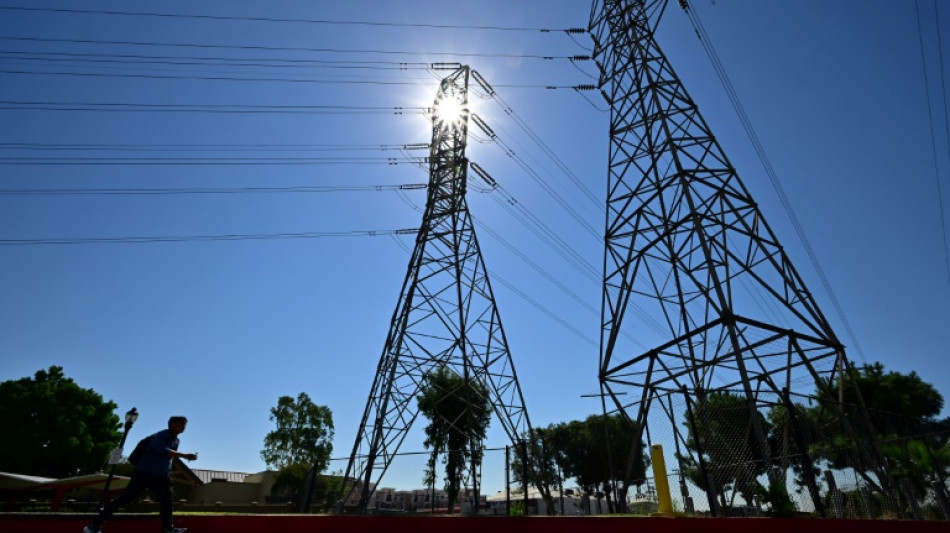
Californians told not to charge EVs as grid struggles in heat wave / Photo: Frederic J. BROWN - AFP

 UK chalks up hottest summer on record for second year running

 China's Xi visits Egypt as US sanctions threat looms over Iran links

 RISE Robotics Awarded $100,000 MassVentures Grant to Accelerate Commercialization of Beltdraulic Technology

 Global bond sell-off deepens on inflation concerns

 Germany's far-right AfD promises 'boom' but economists fear worst

 Former England captain Stokes signs for Adelaide Strikers

 Pakistan selector and ex-captain Misbah resigns after coach sacked
 Shein flattens on Hong Kong debut facing global headwinds

 Eurozone inflation hits three-year high at 3.3% in August
 Man City chase Fernandez, Arsenal eye Alvarez on deadline day

 El Nino hammering Peru anchovy fishing: industry officials

 Mass Russian barrage kills 12 in Kyiv

 PineX Capital Launches MetaTrader 5 as Prop Firm Expands Trading Platform Offering
 Women survivors face sanitation woes in Nepal relief camp

 Oil extends gains, stocks mixed as Trump issues fresh Iran warning

 Thai resort readies for US carrier's 5,000 sailors

 AI startup Manus says resumes independent operations
 'Massive' Russian missile, drone attack on Kyiv kills 8
 Defence tech hub Munich booms as Europe rearms
 Nigeria rethinks criminalisation of suicide

 Osaka channels NBA icon Iverson to reach US Open second round

 Fast-fashion giant Shein plunges 10% on Hong Kong debut
 South Korea hire former Spain boss Moreno as interim coach

 China-Taiwan friction clouds Pacific summit

 Two dead after stabbing in New York's Times Square

Californians were told Wednesday not to charge their electric vehicles, just days after the state said it would stop selling gas-powered cars, as the aging electricity grid struggles with a fearsome heatwave.
Temperatures as high as 112 degrees Fahrenheit (44 Celsius) were expected in some Los Angeles suburbs as a huge heat dome bakes a swathe of the western United States.
The sweltering weather is expected to put huge demands on the already-stretched power grid, especially when people crank up the air conditioners during the broiling hours after work and school.
"Consumers are urged to reduce energy use from 4 to 9pm when the system is most stressed because demand for electricity remains high and there is less solar energy available," said the American Public Power Association, a body that represents public utilities.
"The top three conservation actions are to set thermostats to 78 degrees or higher, avoid using large appliances and charging electric vehicles, and turn off unnecessary lights."
California's power companies routinely call for households to limit their usage during the so-called "shoulder hours," when rooftop solar panels stop producing electricity but demand remains high because of still-elevated temperatures.
The call to limit electric vehicle charging comes a week after state regulators banned the sale of new petrol- and diesel-powered vehicles from 2035.
All but a handful of SUVs, cars and light trucks will have to produce zero tailpipe emissions, with only highly efficient plug-in hybrids permitted to burn fossil fuels.
The move was hailed as a game-changer for the EV industry because of the size of California's auto market and the potential it has to set national, and even international, standards.
- 'Dangerously hot' -
Wednesday's call to conserve power was greeted with derision on Twitter, where some said it was proof the state had not thought through its green agenda.
"Perhaps we should figure out how to fix our electric grid before we outlaw gas cars...just a thought," tweeted @AerysGG
"So.........this is what they want. Walking? Hitchin' A Ride?? Moving to a more reasonable state??" tweeted @cinda_scheef
The National Weather Service has issued an "excessive heat warning" for most of California, as well as parts of Arizona and Nevada.
"Dangerously hot conditions expected... until Sunday evening," the NWS said.
"A prolonged period of excessive heat will significantly increase the potential for heat related illnesses, particularly for those working or participating in outdoor activities."
"Those without access to adequate or reliable cooling or hydration will be at most risk, but much of the population could be susceptible to impacts as well," the NWS warned.
Nighttime temperatures are not expected to offer much relief, with lows struggling to get below 80 degrees Fahrenheit in many places.
It is not unusual for southern California to experience heat waves in September, but temperatures above 100 degrees Fahrenheit are considered hot even for a place almost perpetually baked by sunshine.
The heat wave comes after swathes of the southwest were lashed with torrential rains over recent weeks.
Some areas, including the notoriously dusty Death Valley, suffered flooding, and one person died after being swept away in Zion National Park in Utah.
Scientists say global warming, which is being driven chiefly by humanity's use of fossil fuels, is making natural weather variations more extreme.
Heat waves are getting hotter and more intense, while storms are getting wetter and, in many cases, more dangerous.
B.AbuZeid--SF-PST