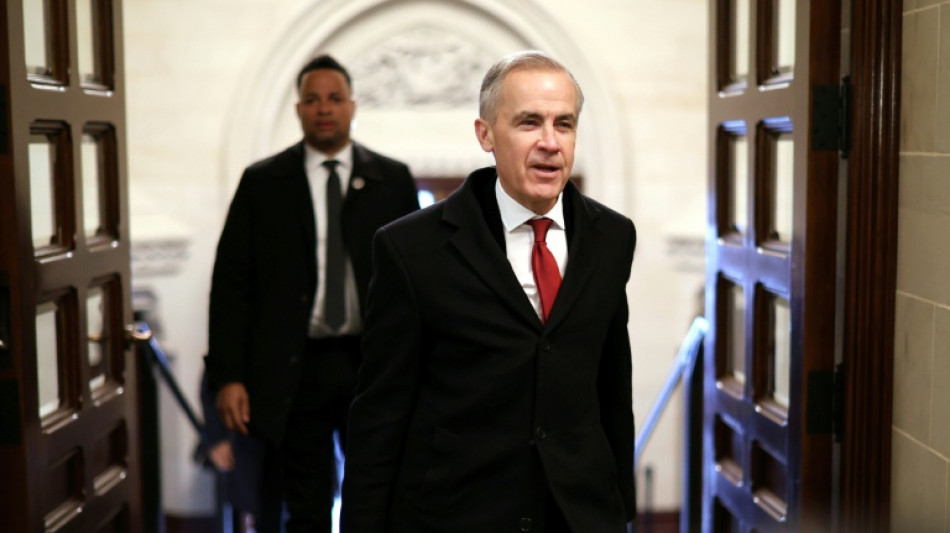
Carney scraps Canada EV sales mandate, affirms auto sector's future is electric / Photo: Dave Chan - AFP/File

 Apple CEO Tim Cook gives nod to founder Steve Jobs in final memo

 Russian finance minister makes unexpected appearance at G20
 Happy to be back in NY, Sabalenka advances

 Naomi Watts to receive lifetime award at top Spain film fest

 Jury hears closing arguments in Tupac Shakur murder trial

 Pakistan sack coach, send seven players home after England defeats

 New storms threaten Grand Canyon flood search, 2 bodies recovered
 France takes aim at ultra-fast fashion with new levy

 Tribunal says India cannot withdraw from water treaty with Pakistan

 John Galliano pulls US exhibition after antisemitism backlash

 French Top 14 boss offers 'no guarantees' for first Club World Cup
 Munoz reunites with Glasner after joining Forest from Palace
 Liverpool sign Barcola from PSG for £124 million

 Putin, Xi hold talks in Kyrgyzstan as regional summit begins
 ChatGPT becomes first AI chatbot to face tougher EU rules

 Man City sign Palmeiras winger Allan on five-year deal
 More flooding feared at Grand Canyon after storm leaves 15 missing

 RedHill Divests Talicia® to Apotex for $18 Million Cash Upfront Plus Milestones to Fuel Strategic Growth Opportunities

 MEXC Data: BTC Breaks $80,000, Major-Asset Spot Trading Volume Surges 300%

 سفارة فلسطين في عُمان تنظم ندوة لتعزيز الاستثمارات والفرص الاقتصادية
 Swollen rivers, washed-out roads hamper Nepal rescue effort

 In France's north, winegrowers bet on a warmer future

 Deadly virus stalks South Africa's sardines

 South Korea women's football body probes 'period' insult

 Transitional Fashion Essentials for Autumn: Key Pieces from M&S and Joe Browns

Prime Minister Mark Carney on Thursday cancelled a mandate for all vehicles sold in Canada to be electric by 2035, while announcing major investments to support the auto industry's EV transition.
In unveiling his plan to transform the sector, Carney said Canada's auto industry needed to be ready for a future where EVs are dominant, and where US President Donald Trump's tariffs have made cross-border vehicle production unworkable.
Carney's decision to scrap EV mandates also marked another departure from policies backed by his climate-focused predecessor, Justin Trudeau.
Trudeau's government had mandated that 20 percent of vehicles sold this year be electric, with a 60 percent target by 2030 and the 100 percent target for 2035.
Those targets were applauded by some environmental groups but faced criticism from automakers, as well as concern that Canada had nowhere near the charging infrastructure needed to support full electrification across a vast landmass.
Carney argued his new automotive strategy would prioritize "results and solutions."
His plan includes a CAN$5,000 (US$3,700) subsidy for individuals who choose to buy an EV, CAN$1.5 billion to improve charging infrastructure, and CAN$3 billion "to help the auto industry adapt, grow, and diversify to new markets," his office said.
"We know where the auto industry is headed. We're going to support that transition," Carney told reporters.
Progress in the global EV market has been patchy.
Trump scrapped tax credits for EV purchases last year, jarring automakers that invested heavily in electrification during Democrat Joe Biden's presidency.
The European Union in December also proposed scrapping a planned 2035 ban on new combustion-engine vehicles.
Carney said his goal was 75 percent EV sales by 2035, and a 90 percent target by 2040.
The Global Automakers of Canada, an industry group, praised Carney for providing "greater clarity" on the government's electrification plans, including "a commitment to aggressively build out the charging infrastructure."
Since taking office last year, Carney has also scrapped Trudeau's carbon tax on individual households and advanced plans to build a new oil pipeline from Alberta to the Pacific coast -- infuriating environmental groups.
Asked Thursday if he still considered Canada a leader in the fight against climate change, Carney said: "Absolutely."
– 'Serious liability' –
Canada's auto industry supports half a million jobs, and concern about its future has intensified since Trump returned to office last year.
The president's broad approach on trade with Canada has shifted, but his administration has maintained a fairly consistent message on autos, insisting it wants to see vehicles made exclusively inside the United States.
Carney on Thursday said "there's no greater symbol of how closely the Canadian and American economies have been intertwined than automobiles."
Parts cross the US-Canada border up to eight times during production, but Trump's auto tariffs are threatening the viability of such integration.
"That trade relationship that once was a great strength has now become a serious vulnerability," Carney said.
Since April, Canadian-made vehicles have faced a 25 percent tariff on their non-US components, a levy Canada insists violates the existing North American free trade agreement, known as the USMCA.
USMCA revision talks are set for this year.
"Our objective is to remove all tariffs in the auto sector," Carney said, but stressed Canada's industry needed to start planning for an entirely domestic production chain.
Canada has large deposits of the critical minerals needed for EV battery production and says it wants to develop an end‑to‑end production chain, from mining to mineral processing to vehicle battery production.
C.Hamad--SF-PST