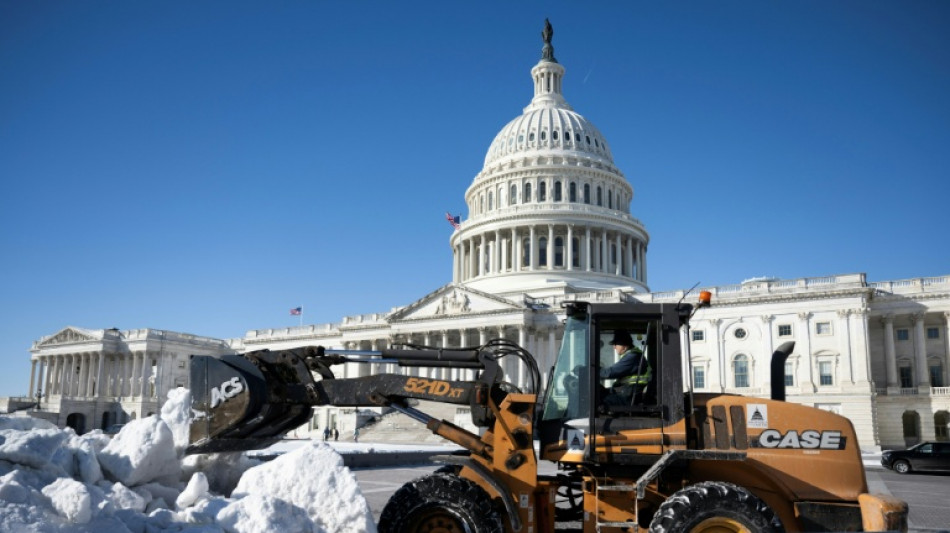
Late-January US snowstorm wasn't historically exceptional: NOAA / Photo: ANDREW CABALLERO-REYNOLDS - AFP

 Apple CEO Tim Cook gives nod to founder Steve Jobs in final memo

 Russian finance minister makes unexpected appearance at G20

 Happy to be back in NY, Sabalenka advances

 Naomi Watts to receive lifetime award at top Spain film fest

 Jury hears closing arguments in Tupac Shakur murder trial

 Pakistan sack coach, send seven players home after England defeats

 New storms threaten Grand Canyon flood search, 2 bodies recovered

 France takes aim at ultra-fast fashion with new levy

 Tribunal says India cannot withdraw from water treaty with Pakistan

 John Galliano pulls US exhibition after antisemitism backlash

 French Top 14 boss offers 'no guarantees' for first Club World Cup

 Munoz reunites with Glasner after joining Forest from Palace

 Liverpool sign Barcola from PSG for £124 million

 Putin, Xi hold talks in Kyrgyzstan as regional summit begins

 ChatGPT becomes first AI chatbot to face tougher EU rules

 Man City sign Palmeiras winger Allan on five-year deal

 More flooding feared at Grand Canyon after storm leaves 15 missing

 RedHill Divests Talicia® to Apotex for $18 Million Cash Upfront Plus Milestones to Fuel Strategic Growth Opportunities

 MEXC Data: BTC Breaks $80,000, Major-Asset Spot Trading Volume Surges 300%

 سفارة فلسطين في عُمان تنظم ندوة لتعزيز الاستثمارات والفرص الاقتصادية

 Swollen rivers, washed-out roads hamper Nepal rescue effort

 In France's north, winegrowers bet on a warmer future

 Deadly virus stalks South Africa's sardines

 South Korea women's football body probes 'period' insult

 Transitional Fashion Essentials for Autumn: Key Pieces from M&S and Joe Browns

Despite its deadly impacts, the recent winter storm that battered much of the United States was not historically exceptional, official data showed Monday.
The January 23–26 system dumped snow and crippling ice from New Mexico to Maine, with some of the worst effects felt in the South, and it was linked to more than 100 deaths.
But according to the National Oceanic and Atmospheric Administration (NOAA), the storm ranked only as a Category 3, or "major," on the Regional Snowfall Index (RSI) -- a scale that measures the societal impact of snowstorms from 0 to 5 and has been calculated back to 1900.
Category 5 storms are extremely rare, accounting for about one percent of events classified as "extreme," while Categories 0 and 1 are common, together making up 79 percent of storms.
Last week's system reached Category 3 levels in the Ohio Valley and the South, Category 2 in the Northeast, Category 1 in the Southeast, and Category 0 in the Upper Midwest and Northern Rockies and Plains.
"Snowstorms are complex and impacts can be determined by a number of varying factors, which makes communicating the severity of a snowstorm challenging," John Bateman, a NOAA meteorologist, told AFP.
"For the Regional Snowfall Index (RSI), the area of snowfall, the amount of snowfall, and the number of people living within the snowfall boundaries are used to determine a range of impacts."
By comparison, the "Blizzard of 1996" was a Category 5 storm that struck the Northeast in January of that year, affecting more than 58 million people. The "Groundhog Day Blizzard of 2011" impacted four regions and reached Category 5 intensity in the Ohio Valley and Category 3 in the South.
More notable than the snowfall itself was the prolonged blast of extreme cold that followed, hardening snow into what has been informally dubbed "snowcrete" and making cleanup efforts especially difficult.
Another storm hit the South over the weekend, with cold-stunned iguanas falling from trees in normally mild Florida, while the city of Lexington in North Carolina recorded 16 inches (40 centimeters) of snow.
J.AbuShaban--SF-PST