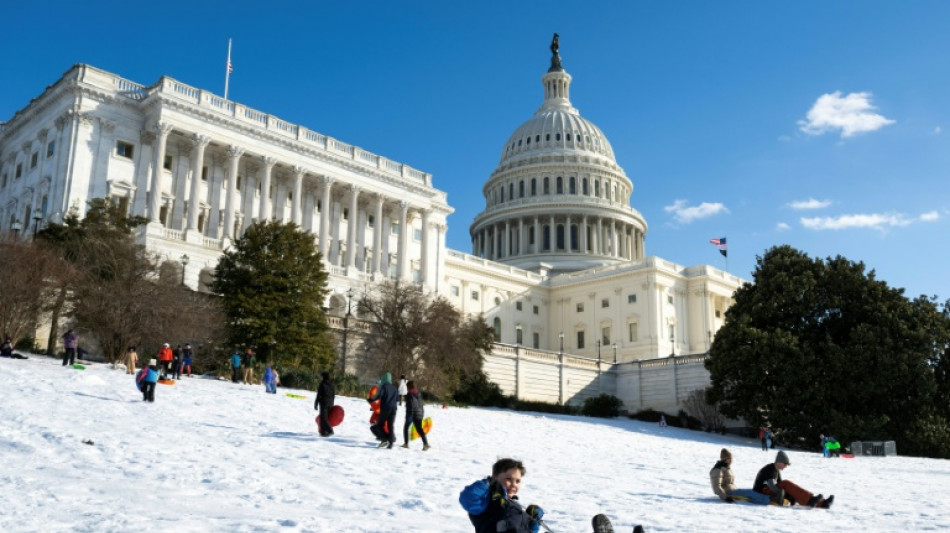
What to know about America's colossal winter storm / Photo: SAUL LOEB - AFP

 Apple CEO Tim Cook gives nod to founder Steve Jobs in final memo

 Russian finance minister makes unexpected appearance at G20

 Happy to be back in NY, Sabalenka advances

 Naomi Watts to receive lifetime award at top Spain film fest

 Jury hears closing arguments in Tupac Shakur murder trial

 Pakistan sack coach, send seven players home after England defeats

 New storms threaten Grand Canyon flood search, 2 bodies recovered

 France takes aim at ultra-fast fashion with new levy

 Tribunal says India cannot withdraw from water treaty with Pakistan

 John Galliano pulls US exhibition after antisemitism backlash

 French Top 14 boss offers 'no guarantees' for first Club World Cup

 Munoz reunites with Glasner after joining Forest from Palace

 Liverpool sign Barcola from PSG for £124 million

 Putin, Xi hold talks in Kyrgyzstan as regional summit begins
 ChatGPT becomes first AI chatbot to face tougher EU rules

 Man City sign Palmeiras winger Allan on five-year deal

 More flooding feared at Grand Canyon after storm leaves 15 missing

 RedHill Divests Talicia® to Apotex for $18 Million Cash Upfront Plus Milestones to Fuel Strategic Growth Opportunities

 MEXC Data: BTC Breaks $80,000, Major-Asset Spot Trading Volume Surges 300%

 سفارة فلسطين في عُمان تنظم ندوة لتعزيز الاستثمارات والفرص الاقتصادية

 Swollen rivers, washed-out roads hamper Nepal rescue effort

 In France's north, winegrowers bet on a warmer future

 Deadly virus stalks South Africa's sardines
 South Korea women's football body probes 'period' insult
 Transitional Fashion Essentials for Autumn: Key Pieces from M&S and Joe Browns

A deep freeze is gripping large swaths of the United States after a monster storm killed dozens of people from the Northeast to the Deep South, knocked out power to hundreds of thousands and sent air travel into chaos.
Another Arctic blast expected this weekend could deliver record lows and threaten another major storm -- even as municipalities are digging out from deep piles of snow and ice.
Here's what to know.
- Dozens dead -
The storm was linked to at least 31 deaths, according to a compilation of state government and local media reports, with causes including hypothermia as well as accidents related to traffic, sledding, all-terrain vehicles and snowplows.
That toll is expected to climb after New York Mayor Zohran Mamdani said Tuesday at least 10 New Yorkers had lost their lives after being found outdoors, though whether all the deaths were from hypothermia has yet to be determined.
In Maine, seven people were killed when a small plane crashed while attempting to take off during a snowstorm in Bangor, the Federal Aviation Administration said.
Tennessee, Texas, Mississippi and Louisiana were badly impacted by power outages, with more than 550,000 customers without electricity by midday Tuesday, according to the tracking site Poweroutage.com.
Air travel was also severely disrupted. More than 9,000 flights were canceled on Sunday -- more than on any day since the Covid pandemic -- as the storm paralyzed transportation across the country.
- Heavy snowfall -
The heaviest snowfall of 31 inches occurred in Bonito Falls, New Mexico -- followed by East Napanoch in upstate New York, where 30 inches fell, according to preliminary figures on the National Weather Service's snowfall reports tool.
Many of the hardest-hit areas were in the South, where authorities are less accustomed -- and often less equipped -- to deal with severe winter weather.
- More to come -
The National Weather Service warns that much of the northern half of the country will remain continuously below freezing through February 1, with another blast of arctic air expected to bring "the coldest temperature seen in several years for some places and the longest duration of cold in decades."
At the same time, a potentially significant coastal winter storm could spill out of Canada along the East Coast, spreading widespread precipitation as a low-pressure system collides with frigid air. Forecasters say it is still too early to determine the storm's exact track, or whether it will fall as rain or snow.
- Climate change -
It may sound counterintuitive, but a growing body of research suggests climate change could be playing a role in disruptions to the polar vortex -- a vast region of cold, low-pressure air that normally circulates high above the Arctic.
Scientists advancing this theory argue that uneven Arctic warming across Europe and Asia can amplify large atmospheric waves, making it more likely for the polar vortex to wobble and spill south over North America.
The science, however, remains contested, and researchers caution that natural climate variability also plays a role.
H.Nasr--SF-PST