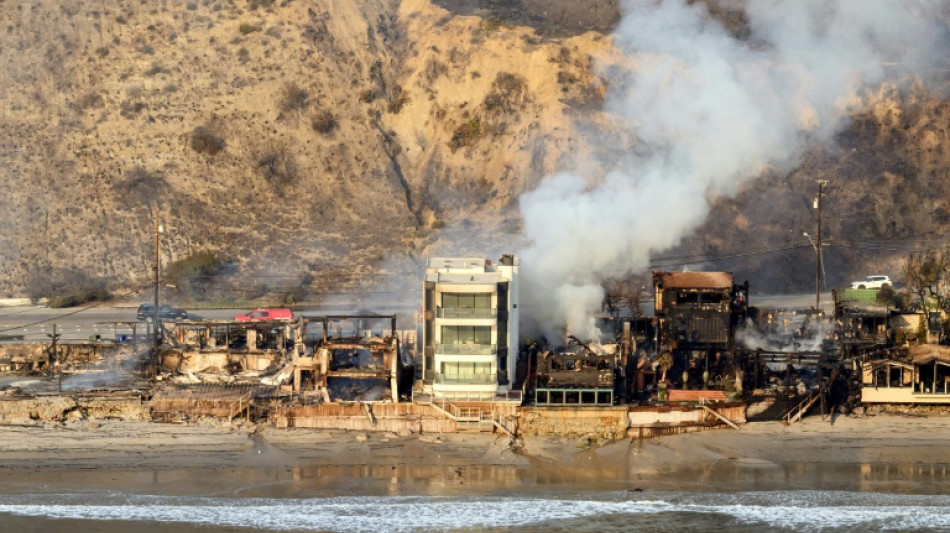
Scrapped by Trump, revived US climate-disaster database reveals record losses / Photo: JOSH EDELSON - AFP/File

 US regulator, 22 states accuse Amazon of 'manipulating' ad auctions: lawsuit

 TRON Founder Justin Sun Shares Outlook on Bitcoin, Stablecoins and Global Finance at Bitcoin Asia 2026

 Tributes to 'eternal' Messi on Argentina retirement

 Arteta hails Arsenal's 'finishers' after Saka kills off Villa

 Yamal, Raphinha bag braces as Barcelona rout Rayo

 Alcaraz makes winning return at US Open, Sabalenka safely through
 Everton agree to sign Monaco's Balogun: reports

 Milei calls for F1 to return to Argentina
 Alcaraz wins US Open first-round match after injury layoff

 Kyiv orders heightened security amid intense Russian drone strikes

 Sabalenka kickstarts US Open three-peat bid as Fils crashes out

 Fils upset by resurgent Tsitsipas at US Open

 Trump says AI data center opponents want to be 'backwards and poor'

 Pakistan ditch coaches, send seven players home after England defeats

 Galliano pulls Met Gala exhibit after antisemitism backlash

 Afghan people should 'not be abandoned': top Red Cross official

 Six defining moments of Lionel Messi's Argentina career

 Trump blasts US backlash against data centers

 It 'hurts' says Messi of decision to retire from international football

 Benzema ends brief stint with Al Hilal in Saudi league

 Djokovic's Grand Slam future uncertain after brutal US Open defeat

 Turkey says regional defence pact not against any country

 US vows to keep economic pressure on Iran as G20 finance talks begin

 Shein valued at $26.3 bn in Hong Kong market debut

 Crude prices rise above $90 per barrel on US-Iran strikes

A flagship US climate-disaster database killed by President Donald Trump's administration has been brought back to life by its former lead scientist -- revealing that extreme weather inflicted a record $101 billion in damages in just the first half of 2025.
The Billion-Dollar Weather and Climate Disasters tracker, long maintained by the National Oceanic and Atmospheric Administration (NOAA), chronicled major US catastrophes from 1980 to 2024 before it was abruptly shut down in May amid sweeping budget cuts that critics decried as an ideologically driven attack on science.
"This dataset was simply too important to stop being updated, and the demand for its revival came from every sector of society," Adam Smith, an applied climatologist who helmed the database for 15 years before resigning in May, told AFP.
Among those calling for its return were groups such as the American Academy of Actuaries, who argued the list was a vital tool for tracking the rising costs of climate-fueled disasters, from wildfires to floods, that threaten homeowners, insurers, and mortgage markets.
Congressional Democrats have also sought to restore the program within NOAA, introducing a bill last month that has yet to advance.
Now based at the nonprofit Climate Central, Smith said he worked with an interdisciplinary team of experts in meteorology, economics, risk management, communication, and web design over recent months to recreate the dataset using the same public and private data sources and methodologies.
The new findings, he said, show that "the year started out with a bang": the Los Angeles wildfires were likely the costliest in history, with insured losses reaching an estimated $60 billion.
That was followed by a barrage of spring storms across the central and southern United States, including several destructive tornadoes.
Altogether, 14 separate billion-dollar weather and climate disasters between January and June caused $101.4 billion in inflation-adjusted damages -- though 2025 as a whole may fall short of a record, thanks to a milder-than-usual Atlantic hurricane season.
Smith said his decision to leave NOAA stemmed from his realization that "the current environment to do science, across the board, is becoming more difficult, and that's likely an understatement."
But he added he was happy to give the dataset a new home so it can remain a "public good" and continue to publish updates at regular intervals.
Looking ahead, the team plans to broaden the scope of the tracker to include events causing at least $100 million in losses -- to capture the smaller and mid-sized disasters that still have "life-changing impacts to lives and livelihoods."
K.Hassan--SF-PST