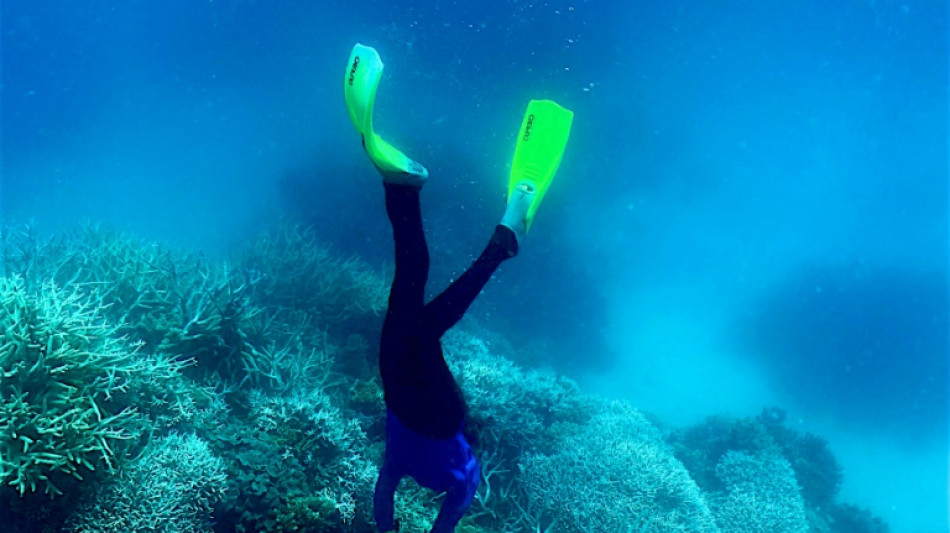
World's coral reefs crossing survival limit: global experts / Photo: Glenn NICHOLLS - AFP

 US regulator, 22 states accuse Amazon of 'manipulating' ad auctions: lawsuit

 TRON Founder Justin Sun Shares Outlook on Bitcoin, Stablecoins and Global Finance at Bitcoin Asia 2026

 Tributes to 'eternal' Messi on Argentina retirement

 Arteta hails Arsenal's 'finishers' after Saka kills off Villa

 Yamal, Raphinha bag braces as Barcelona rout Rayo

 Alcaraz makes winning return at US Open, Sabalenka safely through

 Everton agree to sign Monaco's Balogun: reports

 Milei calls for F1 to return to Argentina

 Alcaraz wins US Open first-round match after injury layoff

 Kyiv orders heightened security amid intense Russian drone strikes

 Sabalenka kickstarts US Open three-peat bid as Fils crashes out

 Fils upset by resurgent Tsitsipas at US Open

 Trump says AI data center opponents want to be 'backwards and poor'

 Pakistan ditch coaches, send seven players home after England defeats

 Galliano pulls Met Gala exhibit after antisemitism backlash

 Afghan people should 'not be abandoned': top Red Cross official

 Six defining moments of Lionel Messi's Argentina career

 Trump blasts US backlash against data centers

 It 'hurts' says Messi of decision to retire from international football

 Benzema ends brief stint with Al Hilal in Saudi league

 Djokovic's Grand Slam future uncertain after brutal US Open defeat

 Turkey says regional defence pact not against any country

 US vows to keep economic pressure on Iran as G20 finance talks begin

 Shein valued at $26.3 bn in Hong Kong market debut

 Crude prices rise above $90 per barrel on US-Iran strikes

The world's tropical coral reefs have almost certainly crossed a point of no return as oceans warm beyond a level most can survive, a major scientific report announced on Monday.
It is the first time scientists have declared that Earth has likely reached a so-called "tipping point" -- a shift that could trigger massive and often permanent changes in the natural world.
"Sadly, we're now almost certain that we crossed one of those tipping points for warm water or tropical coral reefs," report lead Tim Lenton, a climate and Earth system scientist at the University of Exeter, told AFP.
This conclusion was supported by real-world observations of "unprecedented" coral death across tropical reefs since the first comprehensive assessment of tipping points science was published in 2023, the authors said.
In the intervening years, ocean temperatures have soared to historic highs, and the biggest and most intense coral bleaching episode ever witnessed has spread to more than 80 percent of the world's reefs.
Understanding of tipping points has improved since the last report, its authors said, allowing for greater confidence in estimating when one might spark a domino effect of catastrophic and often irreversible disasters.
Scientists now believe that even at lower levels of global warming than previously thought, the Amazon rainforest could tip into an unrecognisable state, and ice sheets from Greenland to West Antarctica could collapse.
- 'Unprecedented dieback' -
For coral reefs, profound and lasting changes are already in motion.
"Already at 1.4C of global warming, warm water coral reefs are crossing their thermal tipping point and experiencing unprecedented dieback," said the report by 160 scientists from dozens of global research institutions.
The global scientific consensus is that most coral reefs would perish at warming of 1.5C above preindustrial levels -- a threshold just years away.
When stressed in hotter ocean waters, corals expel the microscopic algae that provides their distinct colour and food source.
Unless ocean temperatures return to more tolerable levels, bleached corals simply cannot recover and eventually die of starvation.
Since 2023, marine scientists have reported coral mortality on a scale never seen before, with reefs turning ghostly white across the Pacific, Indian and Atlantic oceans.
"I am afraid their response confirms that we can no longer talk about tipping points as a future risk," Lenton told reporters.
Rather than disappear completely, scientists say reefs will evolve into less diverse ecosystems as they are overtaken by algae, sponges and other simpler organisms better able to withstand hotter oceans.
These species would come to dominate this new underwater world and over time, the dead coral skeletons beneath would erode into rubble.
Such a shift would be disastrous for the hundreds of millions of people whose livelihoods are tied to coral reefs, and the estimated one million species that depend on them.
- 'Danger zone' -
Some heat-resistant strains of coral may endure longer than others, the authors said, but ultimately the only response is to stop adding more planet-warming greenhouse gases into the atmosphere.
Exceeding 1.5C "puts the world in a greater danger zone of escalating risk of further damaging tipping points", Lenton said, including the collapse of vital ocean currents that could have "catastrophic" knock-on impacts.
Scientists also warned that tipping points in the Amazon were closer than previously thought, and "widespread dieback" and large-scale forest degradation was a risk even below 2C of global warming.
That finding will be keenly felt by Brazil, which on Monday is hosting climate ministers in Brasilia ahead of next month's UN COP30 conference in Belem on the edge of the Amazon.
In good news -- the exponential uptake of solar power and electric vehicles were two examples of "positive" tipping points where momentum can accelerate for the better, said Lenton.
"It gives us agency back, policymakers included, to make some tangible difference, where sometimes the output from our actions is sometimes disproportionately good," he told AFP.
Y.Shaath--SF-PST