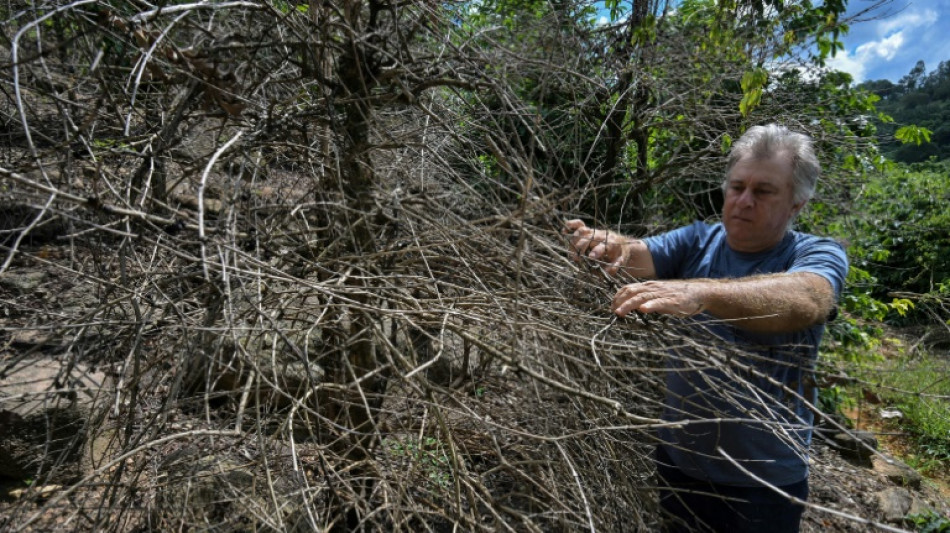
Brazil drought lights a fire under global coffee prices / Photo: Nelson ALMEIDA - AFP

 China-Nepal flood toll tops 1,000 as tunnel rescue offers last hope

 Japan to relax overtime regulation under workaholic PM

 Thwarted Niger mutiny exposes junta's Russia dependence

 Illegal mining ravages S.Africa's economic hub

 Nepal's wall of missing offers last hope after Himalayan flood

 US to press G20 on light-touch AI regulation

 2 die in Grand Canyon flash flood, only 1 person unaccounted for

 US Army Secretary Driscoll submits resignation: White House

 Oil extends gains, stocks drop as Trump issues fresh Iran warning

 Tsitsipas says Kyrgios's positive cocaine test 'kind of expected'

 In Japan's mountains, a different way to manage bears

 Middle East war a boon for UAE defence giant with global ambitions
 Former gang member found guilty of murdering Tupac Shakur

 Top-seeded Zverev opens US Open campaign
 US regulator, 22 states accuse Amazon of 'manipulating' ad auctions: lawsuit

 TRON Founder Justin Sun Shares Outlook on Bitcoin, Stablecoins and Global Finance at Bitcoin Asia 2026

 Tributes to 'eternal' Messi on Argentina retirement

 Arteta hails Arsenal's 'finishers' after Saka kills off Villa

 Yamal, Raphinha bag braces as Barcelona rout Rayo

 Alcaraz makes winning return at US Open, Sabalenka safely through

 Everton agree to sign Monaco's Balogun: reports

 Milei calls for F1 to return to Argentina

 Alcaraz wins US Open first-round match after injury layoff

 Kyiv orders heightened security amid intense Russian drone strikes

 Sabalenka kickstarts US Open three-peat bid as Fils crashes out

Brazilian coffee producer Moacir Donizetti first smelled the smoke, and then watched in desperation as a blaze consumed his family coffee plantation last year.
The 54-year-old was one of hundreds of farmers hit by a brutal forest fire in Sao Paulo state, where years of soaring heat and erratic rains are set to drive up the cost of an espresso or latte far afield in Paris, New York or Tokyo.
Brazil, the world's largest coffee producer and exporter, experienced its hottest year on record in 2024 and a record number of forest fires.
Locals in the municipality of Caconde believe the fire broke out due to uncontrolled burning of garbage, but experts attribute its scale to drought conditions exacerbated by climate change.
"It was desperate: seeing the flames advance, destroying our plantation, coming within twenty meters of my house," said Donizetti.
His family fought the fire for four days on the remote farm in the mountains of the Atlantic Forest, losing five hectares (12 acres) of coffee -- a third of the family's production area.
Standing alongside scorched and blackened coffee crops, he estimates his land will take three or four years to produce again.
The loss is compounded by several years of unpredictable weather and disappointing harvests in Brazil.
"For about five years it has been too dry, sometimes it doesn't rain for months," said Donizetti. "It has also gotten a lot hotter, it is unbearable."
- Invest more to produce less -
In 2024, Brazil was responsible for more than a third of global coffee production.
A poor harvest in the Latin American giant significantly impacts international prices.
Arabica coffee, the most popular variety, in December reached its highest price since 1977, listed at $3.48 per pound on the New York Stock Exchange.
"I have been working in coffee for 35 years and I have never seen a situation as difficult as the current one," said Brazilian coffee grower and consultant Guy Carvalho.
"High temperatures and irregular rainfall force us to invest more to produce the same, or even less, than we did in the past," he added.
"After the last big harvest, in 2020, we have always had some weather problem."
Carvalho said that the high prices were largely explained by "frustration" over disappointing harvests between 2021 and 2024, and bleak forecasts for 2025.
Geopolitical factors such as potential US tariffs and future European Union regulation on deforestation also contributed to the higher prices.
- Adapting to changing climate -
Some Brazilian coffee producers are adopting new strategies to adapt to the increasingly unpredictable climate.
In Divinolandia, another small coffee-growing town in Sao Paulo state, producer Sergio Lange has turned to shade-grown coffee -- an ancient technique used in places like Ethiopia, the birthplace of coffee.
Planting coffee shrubs under the shade of trees protects the plants from excessive heat and allows them to ripen more slowly, producing a larger, sweeter bean with a higher market value.
Lange and 50 other colleagues have been applying a "regenerative coffee growing model" since 2022, in which the crop is planted alongside other species, grown without pesticides, and relies on a natural water source from the mountains.
"At first, productivity falls, but we expect fantastic results in four or five years," he said.
He pointed to climate change as having a "severe" impact on coffee production.
"Producers who fail to adapt will struggle to stay in business," he warned.
N.AbuHussein--SF-PST